
You made it time. If you want to look a little longer, just scroll back up and press “Continue.”
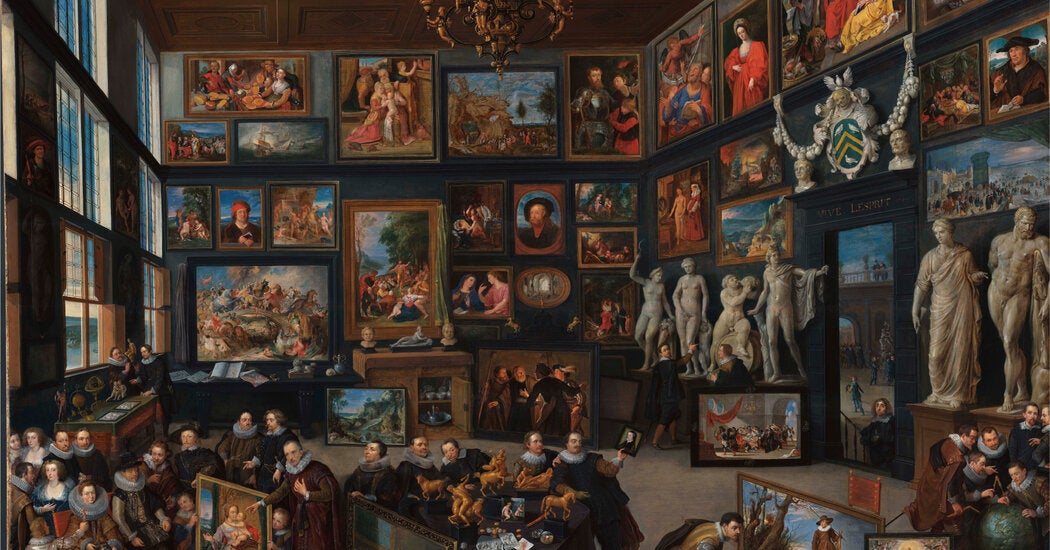
In this grand painting of paintings, I suppose it’s best to start here, with our host.
Meet Cornelis:
We are in Antwerp. It’s the early 1600s. Cornelis van der Geest made his money in spices and real estate, and he lived in a beautiful house near the river. The painting almost certainly depicts his real art collection, though probably not his real house.
It’s a weird time. The Scheldt river (which you can see out the window in the painting) is blockaded by the Dutch. Catholics and Protestants are fighting across the Low Countries. The painter Peter Paul Rubens (a good friend of van der Geest’s who makes a cameo here) is asked to mediate some of the conflict. The prior century in Antwerp was thought to be its best. Is Antwerp over?
Still, the arts are rich, and van der Geest wants you to look
at
all
his
stuff:
This type of painting is called a kunstkamer (“art cabinet” or “art chamber”), a genre that emerged in Antwerp at the time, according to Abigail Newman, a research curator at the Rubenshuis in Antwerp where this painting is normally kept. (It is currently on loan to the Liechtenstein Garden Palace in Vienna.) The kunstkamer united the objects of a collection into one frame and could act as a visual inventory not just of paintings, but of coins, shells, drawings, artifacts, like this early example:
The genre blossomed into full-blown imagined rooms. Soon after creating this painting, Willem van Haecht depicted a scene in which Alexander the Great looks over the shoulder of Apelles, a famed ancient Greek artist, as he paints Alexander’s mistress, Campaspe (lower left):
In one of many collaborations between Rubens and Jan Brueghel the Elder, Cupid shows Venus a painting of Jesus healing a blind man, flanked by instruments of sight like telescopes:
In these scenes of people surrounded by an outrageous number of beautiful things, the form becomes an ode to looking.
Van Haecht was seen as a master of the form. He has laid out van der Geest’s collection in a palatial room, packing the frame with frames.
Objects are spilling out of open cabinets, the tabletops are full, and scientific instruments are strewn about the floor.
No one can be bothered to pick them up.
They’re all too busy looking:
You, too, are invited to the looking party.
Perusing a painting of paintings (or, more accurately, a digital reproduction of a painting of paintings) can be a slightly uncanny experience, but it rewards your attention — and your ability to zoom in.
Find this small painting, far on the back wall,
and look closer:
You can see what appear to be faint grid lines that van Haecht used to faithfully translate the originals to their new lighting conditions and perspectives in this frame:
Here’s another example, with the original on the bottom, which van Haecht then had to tilt for its place on the wall:
Zoom in even further, and the figures may be simplified down to just a few touches of paint, but they are all there, even the dogs:
More than 40 of these reproductions cram the walls.
There are some famous ones, including a Rubens, with a curtain dangling alongside to protect it from the light (that you can see now in Munich):
There’s a painting of the Sermon on the Mount, possibly by Raphael:
There’s a piece from the master Jan van Eyck, the only record of which exists in this painting:
The real action, though, is right where we started.
The audience van der Geest is addressing aren’t just extras. They’re another collection entirely: royalty and diplomats, artists and military leaders, the master of the Antwerp mint, even van der Geest’s housekeeper — a who’s who that could never have all been in one place at one time:
Van der Geest is showing off one of his favorites, Quentin Metsys’ “Madonna of the Cherries” (they’re in her right hand):
“You see him pointing to it and touching his heart,” Ms. Newman said. “It’s about a kind of love.”
As the story goes, Archduke Albert was so taken with “Madonna of the Cherries” that he offered to buy it.
Risking royal wrath, van der Geest, as politely as he could, said no.
In immortalizing this moment, van Haecht ensures that the story of van der Geest’s love of his collection will be told over and over again. We’re doing it right now.
Van Haecht has placed himself back here in the shadow of a doorway, away from the crowds, taking it all in:
The collection was eventually broken up. Paintings were sold, scattered, lost.
Twenty-one are known to still exist today.
Only here, in this one frame, are they still together.
This is an installment in our series of experiments on art and attention. If you liked this one, you may like these past exercises: a finished, unfinished portrait; a sudden rain over a bridge; a unicorn tapestry; some buckets from Home Depot; and a Whistler painting.
Sign up to be notified when new installments are published here. And let us know how this exercise made you feel in the comments.