
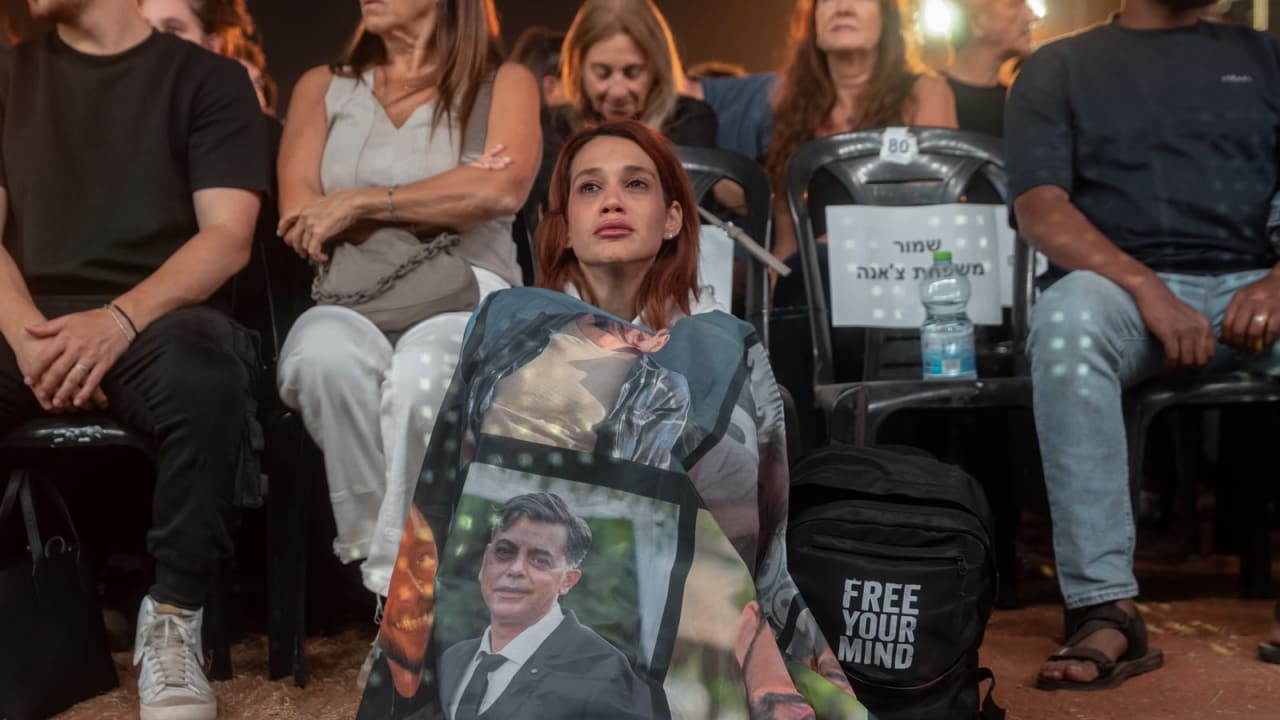
The main ceremony organized by the families of victims of the October 7 massacre is being held in Tel Aviv’s Yarkon Park on Wednesday.
The ceremony opened with singer Arkadi Duchin performing “Who Loves You More Than Me,” as participants reflected on the lives lost and the memories that have stayed with Israel since.
Duchin was filmed playing a piano placed in the Kipnis family home in Kibbutz Be’eri, where Eviatar “Teri” Kipnis and Lilach Kipnis were murdered, along with Paul Vincent Castelvi, Teri’s devoted caregiver.
Images of those murdered and fallen were projected behind Duchin. Standing beside him was Or-Li Niv, the mother of Staff-Sgt. Omri Niv Feierstein, a soldier in the Home Front Command’s Search and Rescue Brigade who fell in battle at the Zikim military base. Niv read the poem “Mothers” by Osnat Eldar.
Actress and comedian Shani Cohen spoke about what was lost that morning and the memories that have remained with the country ever since.
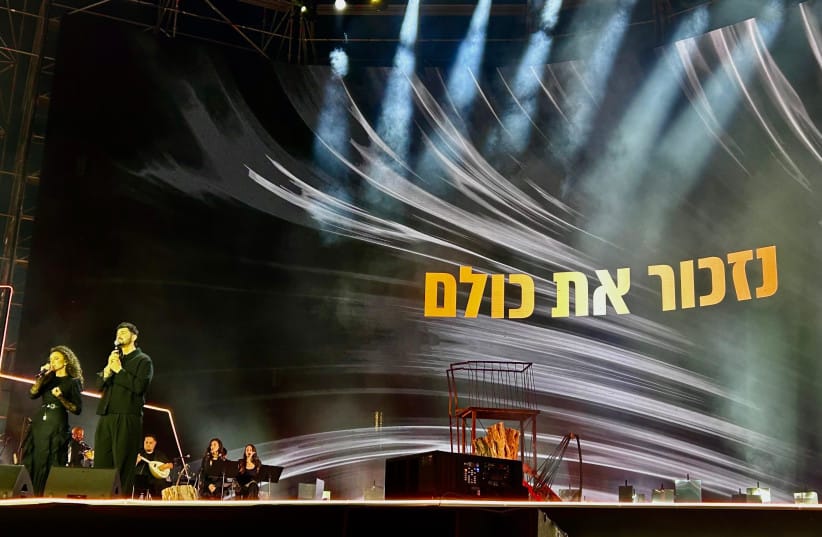 National memorial ceremony for families of October 7 victims. October 7 2026 (credit: AVSHALOM SASSONI/MAARIV)
“And on that Saturday morning, we lost so much,” she said. “We lost some of the innocence we had, and our hearts burned.”
She recalled those who pleaded for help from safe rooms that were set ablaze and from crowded roadside shelters, as well as the desperate messages that became the soundtrack of an unimaginable reality and of people’s final moments.
“Tonight, we will stop to remember everything we lost, and also to ask what has remained within us since then,” Cohen said.
Eli Sharabi spoke of the children who hid for hours inside closets, those who were forced to hold their breath to protect young lives, parents who turned their bodies into human shields, and those who said goodbye in a short text message.
He also recalled neighbors who became like brothers, members of local security teams, and civilians who stepped forward without asking questions.
Sharabi referred to all those who fell in the October 7 war and to “those who saw the abyss open before them and remained human.”
He called on Israelis to remember and tell the story of what happened on the day when “the sky fell on us,” concluding: “We will remember them all and never forget. This is a ceremony of the people, created thanks to the people and held for the people.”
Opening memorial prayer recited by Ido Yakir
Later in the ceremony, Ido Yakir, a member of Kibbutz Magen’s local security team, recited a special Yizkor memorial prayer. Members of the team fought on the morning of October 7 and prevented terrorists from infiltrating the kibbutz. Two members of the team, Ofir Yaron and Avi Fleischer, were killed in the fighting.
“May the people of Israel remember its sons and daughters, the loyal and the brave, people of labor and peace, victims of the massacre of the Black Sabbath of 5784,” Yakir began.
The prayer remembered those murdered in their homes, in the fields, and on the roads of the western Negev, parents who tried to save their children, and partygoers who fled from terrorists.
“Those fallen whose bodies were taken into captivity, and those who were abducted alive and died in captivity,” he recited.
“We will remember the brave-hearted who came to the defense,” Yakir continued, mentioning members of local security teams, female and male soldiers at bases along the border, members of the security and rescue services, and civilians who rushed to help those under attack and were killed.
“We will remember all those who lived along the frontier, civilians and soldiers, strangers, residents, and guests, who with their bodies became our border. May those who fell on the Black Sabbath be sealed in the heart of Israel from generation to generation.”
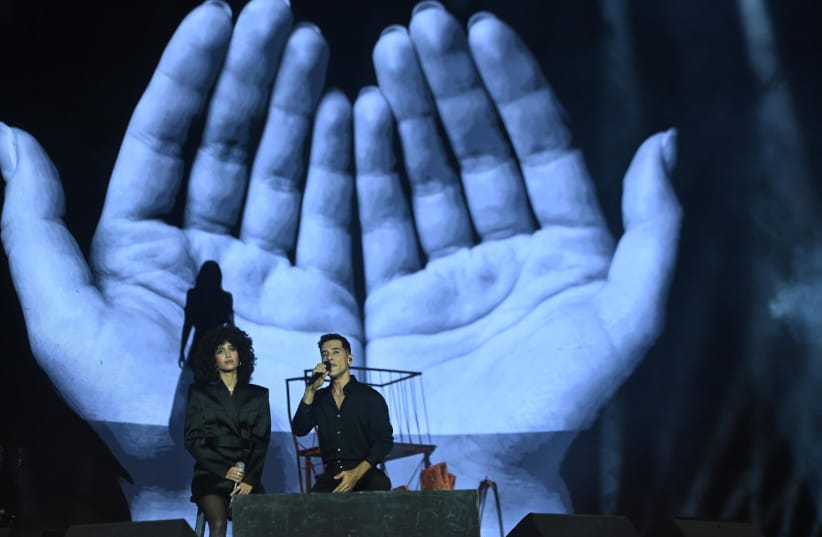 National memorial ceremony for families of October 7 victims. October 7 2026 (credit: AVSHALOM SASSONI)
Alongside the memory of those murdered and killed, the prayer was also dedicated to those left to cope with the loss: survivors of the horrors, children, those wounded in body and mind, orphans, widows and widowers, and communities that were forced to leave their homes.
“Those rebuilding the ruins, returning to their land like streams in the Negev, and those whom the horrors of the past and the memory of their loved ones do not allow to return,” Yakir recited.
He concluded: “May the mourning neither fall silent nor find consolation nor fade until Israel dwells securely and in peace on its land, from generation to generation.”
Rabbi Beni Kalmanson, father of the late Elhanan Kalmanson, recited the Kaddish. On October 7, Elhanan set out with his brother and cousin to save lives, and fell in the fighting in Be’eri. This evening, his father stood at the memorial ceremony and spoke on his behalf:
“I stand here in the name of my son Elhanan, who sprang into action, fought, and fell for his people and for the sanctification of God’s name,” Rabbi Kalmanson said before reciting the Kaddish. “For unity among the people, for overcoming divisions, for mutual responsibility among us, and for the struggle for what is good and worthy in the world.”
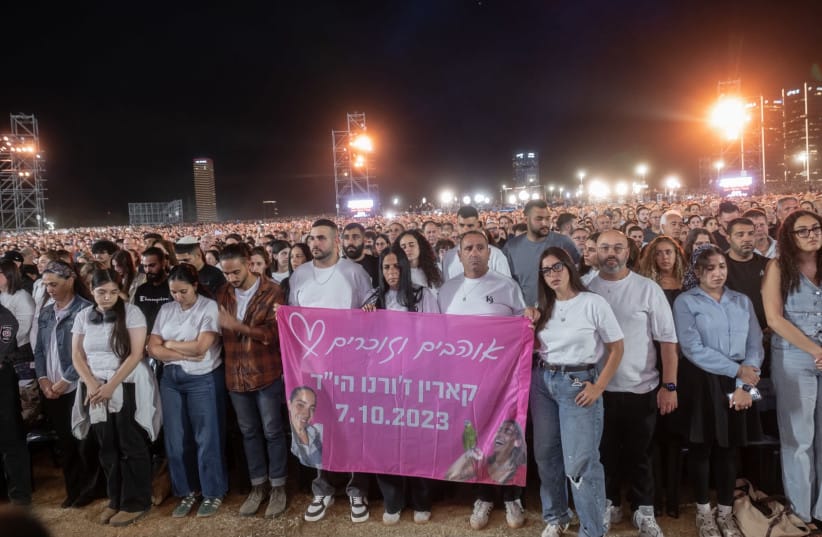 October 7th memorial ceremony takes place in Hayarkon Park in Tel Aviv, where families affected by the massacre come together. (credit: Chen G. Schimmel/The Jerusalem Post)Recounting those who fought to save others
Later in the ceremony, Shani Cohen and Eli Sharabi dedicated remarks to those who went out to fight and save lives amidst the chaos of the morning of October 7. Cohen described the moments in which, facing the horrific images, there were those who realized the responsibility fell upon them:
“Amid the chaos of the morning of October 7, against the backdrop of images of the border fence being trampled, white pickup trucks driving through Sderot, and heartbreaking live streams of entire families being murdered before our eyes, heroes emerged in the field who realized that if not them, all was lost; it was on them.”
Sharabi continued, describing the decision to head into battle even without organized orders:
“Without organized orders, they took responsibility upon themselves, left their homes, leaving families locked in the safe rooms, rushed out from command posts, police stations, and protected shelters, not out of a sense of heroism, but simply because they understood that this was them, this was what they had to do.”
Cohen mentioned the late Major Ido Shani, deputy commander of the Nahal Reconnaissance Battalion, and the order he relayed over the radio that morning:
“The late Major Ido Shani, deputy commander of the Nahal Reconnaissance Battalion, was, on the morning of October 7, the officer in charge of the Kerem Shalom–Sufa sector. At 6:43 AM, with the first barrage of rockets, he declared over the radio: ‘We are at war. Everyone to defense in their sector, kill terrorists, good luck.’”
Afterward, she spoke about the battle in which he fell, saying, “Minutes later, Ido ran into an ambush against terrorists and was killed in battle facing them.”
Ivri Lider and Eden Golan performed “The Song About the Land” (HaShir Al Ha’Aretz). Later, a video was screened in memory of two transport drivers who set out to rescue civilians on October 7: Abed al-Karim Nasasra from Kuseife, who was murdered in a terrorist ambush on Route 232, and Haim Ben Aryeh, the legendary transport driver of Gush Katif, who evacuated children from Be’eri to the Dead Sea. The horrors to which Haim was exposed broke his spirit, and he took his own life at the end of October 2023.
Following the performance, Youssef Nasasra shared that his brother Abed set out to rescue partygoers from the Nova festival despite the danger: “It doesn’t matter, I know it’s dangerous, but these people, they have to be brought back.” Irit Ben Aryeh, Haim’s widow, shared that she had asked him not to go. His answer was: “If I am needed, I am going.”
‘Without investigating the truth, we cannot repair’
Their testimonies were followed by Omri Shifroni’s, a co-founder of the “Kumu” movement, who addressed the ceremony and spoke directly to his family members who were murdered at Kibbutz Be’eri. Shifroni is the uncle of Liel and Yanai Hetzroni and the nephew of the late Aviya and Ayala Hetzroni. Facing the crowd, he recalled the helplessness of that morning:
“My beloved family, you didn’t have to be murdered. None of you. You were alone, defenseless, and I couldn’t help either.”
From his family’s loss, Shifroni turned to the shattered trust during those agonizing hours waiting for help, saying, “That morning, the systems collapsed; the state failed to function. During those long hours in the safe room, the trust that had anchored us shattered to pieces. But there was also something else. Fighters pressed forward, broke through, and finally arrived. Civilians showed up with all their hearts, and we felt the full power of Israeli mutual solidarity.”
Alongside this mobilization, Shifroni demanded answers. In his words, the path to healing and rebuilding trust requires a full reckoning with what occurred:
“Yet mutual solidarity alone is not enough. To rebuild trust, we also need the truth. We must know what happened. Without investigating the truth, we cannot repair, and we cannot ensure that this will never happen again.”
This is a developing story.