
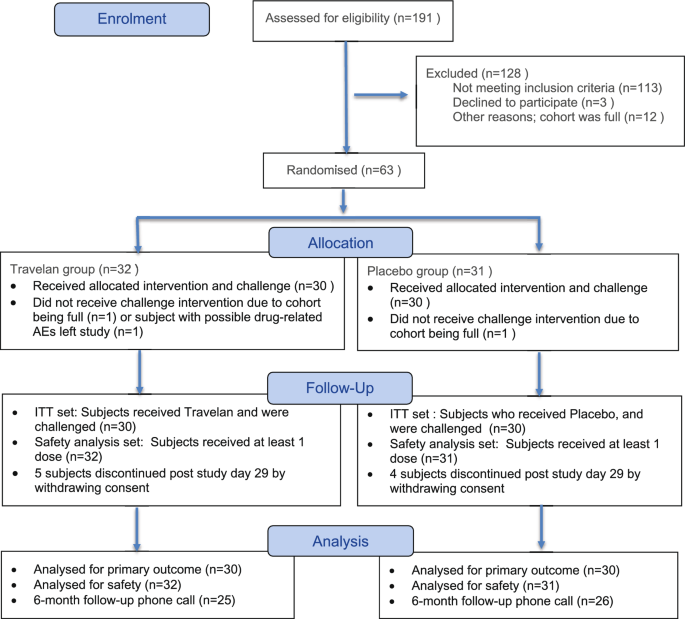
The primary objective of this randomized double-blind placebo-controlled study was to evaluate the clinical and biological prophylactic effects of Travelan (IMM-124E) once-daily dosing following challenge with ETEC H10407. Prior clinical evidence has established that the same daily dose of 1,200 mg of Travelan administered as 3 individual doses provided up to 90% protective efficacy against ETEC infection11. However, Travelan’s broader impact on systemic inflammation, bacterial shedding, microbiome protection and the host’s capacity to mount a natural immune response had not been comprehensively characterised. We designed this study as a controlled, hypothesis-generating evaluation of Travelan prophylaxis as a single daily dose in a human challenge model, integrating clinical, microbiological and immunological endpoints.
The observed safety and tolerability profile of Travelan was consistent with findings from prior published clinical studies11 and post-market data accumulated across more than 30 million doses. During the pre-challenge period, only one subject in the Travelan arm developed minor gastrointestinal symptoms (abdominal cramps, chills, and headache) following the first dose, though not confirmed, was classified as a possible treatment-related AE. No other treatment-related AEs were recorded during the pre-challenge period.
It should be noted that, by design, AEs in this study were solicited and largely reflect symptoms induced by the challenge strain. Compared with placebo, subjects receiving Travelan reported 50% fewer total AEs and 36% fewer GI challenge-related AEs (P = 0.0001) indicating that Travelan reduced both the onset and severity of challenge-associated adverse events.
Travelan has previously been administered at higher doses and for longer durations in multiple clinical studies without any safety concerns. Notably, a Phase 2 randomised, double-blind, placebo-controlled study in 133 participants evaluated doses of up to 1,200 mg 3 times daily (3,600 mg/day) for 24 weeks, with no SAEs and only minor AEs reported (unpublished data; ClinicalTrials.gov: NCT02316717). To date, more than 500 clinical trial participants have received Travelan at doses up to 10.65 g/day for durations ranging from 3 days to 24 weeks in clinical studies conducted under FDA IND applications as well as and other clinical studies conducted in Europe under Good Clinical Practice, with no SAEs and very few AEs reported. The commercial product, recommended dosing three times daily, has also demonstrated safe use in the US, Canada, and Australia, with no SAEs or suspected unexpected serious adverse reactions (SUSARs) identified through Immuron’s ongoing pharmacovigilance program.
In this study, Travelan demonstrated a non-significant 40% reduction in moderate-to-severe diarrhoea (primary endpoint), accompanied by non-significant reductions across multiple secondary outcomes including a 50% reduction in severe diarrhoea, elimination of intravenous rehydration requirements, a 44% reduction in diarrhoea of any severity, and a 71% reduction in early rescue antibiotic use. Although none of these differences reached statistical significance, the consistent direction of effect across several independent clinical measures suggests a reproducible trend favouring a single daily dose of Travelan prophylaxis. These findings, while preliminary, support the biological plausibility of a treatment effect, and the wide confidence intervals and limited statistical power of the study necessitate cautious interpretation and underscore the need for confirmation in larger, adequately powered trials.
Interpretation of efficacy outcomes in this study should be considered in the context of the substantially lower‑than‑anticipated placebo attack rate (33%), compared with the intended rate of approximately 70% derived from historical H10407 challenge studies19. This reduction directly limited statistical power for the primary endpoint and resulted in wide confidence intervals across clinical outcomes. In addition the data was fully inclusive of all subjects and there was no adjustment for multiplicity of the secondary and exploratory outcomes. As such, protective efficacy estimates and outcomes from this study should viewed as supportive trends rather than definitive evidence of clinical efficacy.
The reduced placebo attack rate observed in this study is most likely attributable to differences in the challenge strain and inoculum. An inoculum of 1 × 10⁸ CFU was used here, compared with the 1 × 10⁹ CFU dose employed in prior studies that achieved attack rates exceeding 70%11,17,23,24. The relationship between inoculum dose and attack rate is not, however, straightforward. Two previous CHIM studies using as few as 2 × 10⁷ CFU of the H10407 strain achieved attack rates of approximately 70%, indicating that inoculum dose alone does not fully explain the observed variability15,25. Variation in H10407 challenge strain bacterial preparation methods at different facilities may also have contributed. In the present study, the challenge material was derived from frozen cGMP cell banks thawed on the day of challenge whereas earlier studies used freshly cultured organisms with conditions that may influence pathogen viability and infectivity19. Measures have been implemented to standardize CHIM methodologies, including efforts to minimize the challenge dose15,26 to avoid overwhelming participants and potentially masking protective effects. These findings highlight the need for more rigorous standardization of challenge strain preparation across institutions and study designs, including careful control of cell bank derivation and culture conditions, to ensure that future CHIM studies reliably achieve their intended attack rates.
Beyond clinical outcomes, several biological findings provided additional mechanistic evidence of Travelan’s activity. Although a statistically significant increase in faecal bacterial load was observed 48-h post-challenge in Travelan subjects relative to placebo exploratory microbiome analyses demonstrated a reduction in relative abundance of faecal E. coli (Fig. 2d) alongside a statistically significant increase in beneficial bacterial populations in Travelan-treated participants following challenge (manuscript in preparation). These findings could reflect Travelan’s mechanism of action: neutralization of ETEC at the luminal surface to facilitate pathogen clearance while supporting a favorable microbial environment. This is biologically plausible given that the active component of Travelan (IMM-124E) hyperimmune bovine colostrum, contains not only anti-ETEC antibodies but also bioactive components such as lactoferrin, cytokines, and growth factors known to selectively promote beneficial microbiota and support microbial homeostasis27,28.
Prophylactic protection conferred by Travelan did not compromise the host’s ability to develop natural immunity. Serological analysis confirmed seroconversion in over 90% of Travelan subjects by day 15, with robust IgG and IgA antibody responses to lipopolysaccharide O78, an abundant challenge-strain antigen albeit significantly lower in magnitude to those observed in the placebo group at day 8 for IgA and day 15 and 29 for IgG. This pattern is consistent with findings from other ETEC challenge studies in which protection against diarrhoea correlated positively with a preserved but attenuated immune response18,23,24. The reduced endpoint titers among Travelan recipients could reflect diminished intestinal bacterial load resulting from pathogen clearance, which would limit the antigen exposure driving systemic immune priming. These data suggest that while Travelan attenuates ETEC colonisation at the mucosal surface, it does not substantially impair the host’s capacity to mount a systemic adaptive immune response.
Importantly there were measurable reductions in downstream gut inflammation in the subjects who received Travelan. Faecal concentrations of MPO and calprotectin, established markers of GI inflammation, were significantly lower in Travelan subjects on day-4 post-challenge, highlighting the potential utility of such biomarkers and other inflammatory markers as exploratory outcome measures in future TD prophylaxis studies.
In conclusion, although this controlled human infection study was underpowered to demonstrate definitive efficacy, it revealed consistent, biologically plausible trends; indicating that once-daily administration of Travelan reduces the severity of ETEC-associated illness, attenuates intestinal inflammation, and promotes clearance of the ETEC pathogen without impairing the development of natural immunity.
Previous CHIM studies administering Travelan at a total daily dose of 1,200 mg in three divided doses demonstrated clear and statistically significant protective efficacy, ranging from 76.7% to 90.9% across dosing regimens. In contrast, the present study evaluated whether the same total daily dose delivered once daily could provide comparable prophylactic benefit. Once-daily dosing resulted in a non-significant 40% reduction in moderate-to-severe diarrhoea, alongside non-significant reductions in several secondary outcomes, including severe diarrhoea, intravenous rehydration requirements, diarrhoea of any severity, and early rescue antibiotic use. Although these trends consistently favoured Travelan, the wide confidence intervals and limited statistical power prevent conclusions regarding equivalence between once-daily and three-times-daily dosing. The current formulation delivers 200 mg of active IMM-124E per immediate-release tablet and given the practical advantages of simplified dosing for deployed military personnel and travellers, an enteric-coated capsule formulation designed for small-intestinal release is under investigation. This next generation formulation may enhance bioavailability and support a viable once-daily prophylactic strategy, but confirmation will require adequately powered clinical studies.
Collectively the clinical, safety, microbiological, and immunological findings presented here provide a strong rationale for larger, adequately powered confirmatory trials to evaluate the prophylactic effects of once-daily Travelan.