
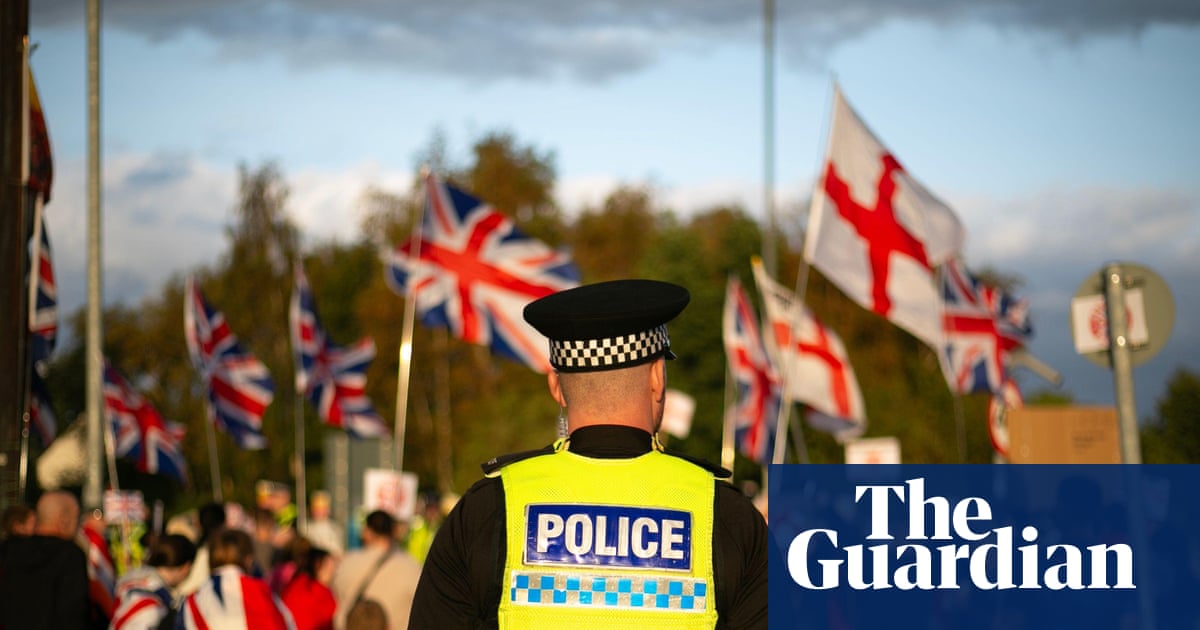
Extremists with anti-migrant opinions are becoming increasingly likely to consider carrying out terrorist attacks against immigration centres and asylum hotels in the UK, the head of MI5 has warned.
Ken McCallum said a shift from radicalised rightwing sentiment to violence was “the most marked trend” in the spy agency’s caseload over the past year, contributing to a rise in the overall UK terror threat level.
The comments formed part of a wide-ranging annual threat update in which the spy chief indicated a more aggressive Iran had threatened other military bases in the UK, as well as being behind the incident at RAF Fairford late last month.
He also warned of the potential use of AI by hostile states and terrorists, including to possibly develop a novel bioweapon – while adding that MI5 would create a new AI Threat Assessment Centre to distinguish fact from fiction.
On the evolving extreme rightwing threat, McCallum said there had been an increase in cases where “extremist versions of anti-immigration and anti-Muslim grievance are tipping into terrorist intent”, such as planning attacks on migrants and Muslims.
Ken McCallum, the director general of MI5, speaks in London on Tuesday 13 October.
A number of aggressive anti-migrant protests have been held this autumn by the far-right Patriot Platform at Portsmouth and Dover, while racially and religiously motivated offences are running at record levels.
McCallum said young people were particularly likely to gravitate towards extreme rightwing terrorism, and at one point this year the Security Service was “investigating a radicalised … 13-year-old in the UK”.
A year ago, he added, a 16-year-old from Inverclyde received a 10-year prison sentence after he pleaded guilty to planning mass murder by firebombing a Muslim centre in Greenock.
There was a “concerning trend of violence targeted at political figures, religious or community groups”, McCallum said, as demonstrated by the killing of the former minister and Reform UK spokesperson, Ann Widdecombe.
Iran, he said, was trying to expand hostile activities in the UK and now had “ambitions to come at harder targets, like military sites”, including the RAF Fairford airbase in Gloucestershire.
Five men from London drove to Whelford, a village next to a base used by the US air force, in three white vans shortly after midnight on 27 September. They were released on police bail a day later after no bombs or explosives were found.
There was also a hint that Iran had sought to target other bases. “Fairford is not unique in the UK,” McCallum said, though he would not be drawn specifically on what other sites had been threatened, or the nature of the threat.
However, allies said his comments were not a reference to RAF Molesworth in Cambridgeshire, where two Latvians were found by police at 2am inside the perimeter of a base used for US and Nato intelligence operations in Europe. They were subsequently released on police bail.
Iran, though, still has a relatively low level of capability to match its ambitions. Tehran typically hired criminal proxies to carry out operations abroad, so any ability to target a military base “is really a function of the sophistication level of those criminals”.
On Thursday, Wes Streeting, the defence secretary, is due to meet his US counterpart, Pete Hegseth, at the Pentagon for a discussion where the issue of base security in the UK is almost certain to be discussed. A week after the Fairford incident, the US withdrew 12 B-1 bombers from the RAF base, which had been used to attack Iran in the spring and early summer.
MI5’s counter-Iran operation has led to more than 50 arrests in the UK in the past year, with much of Tehran’s increased aggression aimed at “British Jewish communities” including terrorist plots and arson attacks against synagogues, businesses and ambulances.
In an unexpected observation, McCallum said he was “particularly focused” on the risk of hostile states or terrorists using AI to generate new, deadly bioweapons, particularly if guardrails introduced by software companies failed.
Last month, Anthropic, the company behind Claude, warned that there were “five case studies of actors using our models in ways that could support biological weapons development” – and said misuse could have serious consequences.
Liam Booth-Smith, head of Europe policy at Anthropic and a former chief of staff to Rishi Sunak, told the Commons business committee on Tuesday that there was a risk of real harm from the fast-developing technology.
“Without appropriate mitigations, it’s possible that real harm could be caused in the space of helping people to create biological or chemical weapons,” Booth-Smith said.
The MI5 chief added that AI could also be exploited by cyber hackers, to help terrorists refine their attack plans and even try to use “AI-enabled drones”, he said, and to easily produce “propaganda and radicalising material tailored to the individual”.
In response, MI5 would create a new AI threat assessment centre to bring together expertise from across government to carefully distinguish the reality of the threats generated by the new technology and advise both government and the wider public to “separate the bluster from the realities”.
Russia, the MI5 chief emphasised, remains “aggressor number one” as the Kremlin continues to lash out against the west with assassination plots, explosive threats and cyber-attacks that at times stop “not much short” of conventional warfare.
Moscow tried to interfere in the 2016 Brexit referendum with anti-EU coverage on RT and Sputnik media, and via troll social media accounts, but there was a big difference between “what may have been attempted and what actually resulted”.
The UK’s relationship with China was “multifaceted”, with MI5 focused on Beijing’s efforts to steal university research and intellectual property, and obtain political secrets about areas it was interested in.
Overall, threats from hostile states had quadrupled in the last decade and now were running on par with MI5’s counter-terrorism mission. “We have again entered a new era of national security,” he said.