
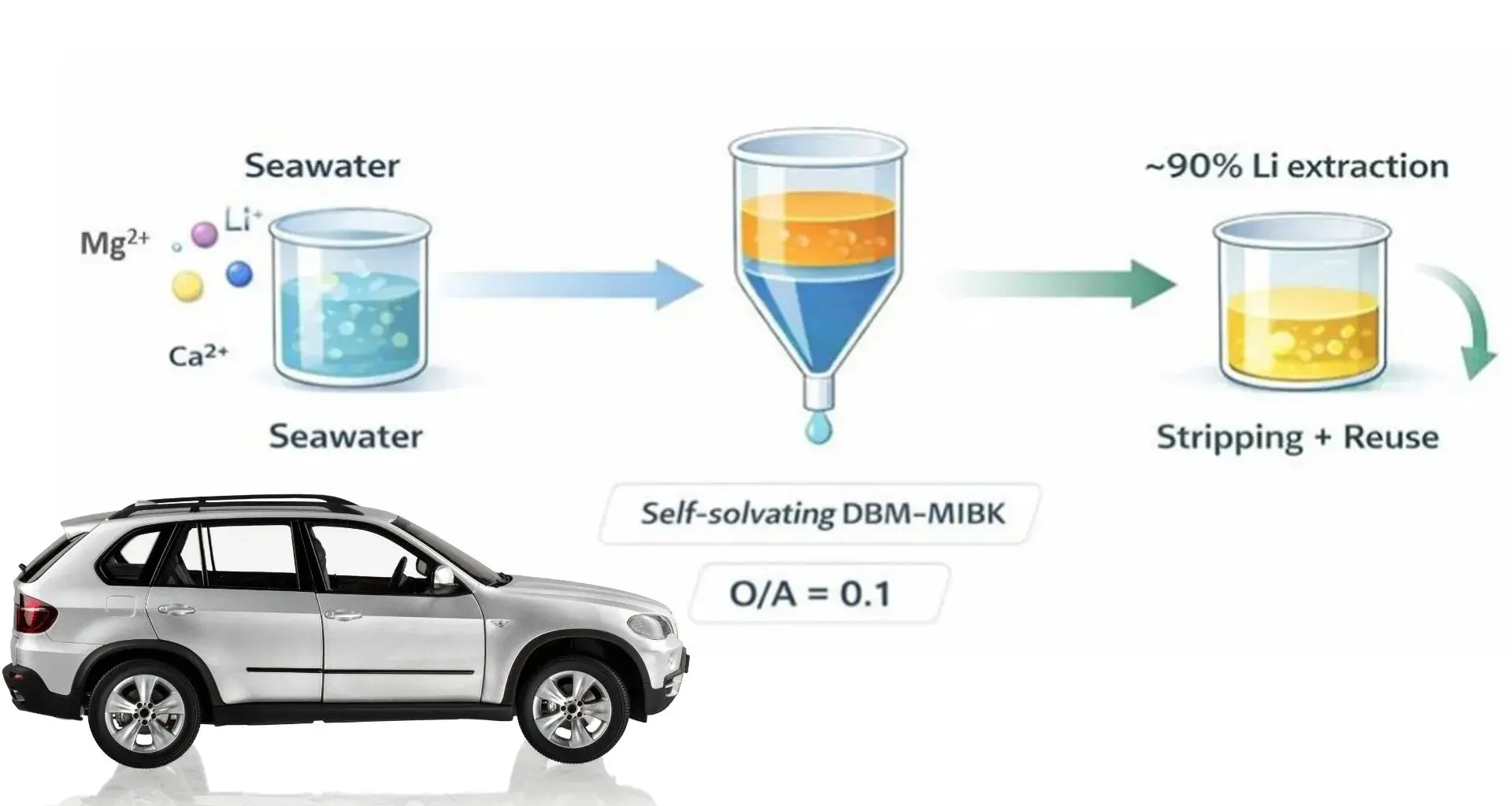
A novel donor-free solvent extraction technique achieves roughly 90% lithium recovery directly from natural seawater while slashing chemical and solvent requirements.
As global demand for computing, electric vehicles and large-scale renewable energy storage skyrockets, traditional lithium sources like land-based brines and hard-rock mines face heavy environmental and supply-chain pressures. One way to ease the pressure would be to use the world’s oceans, which hold a massive reservoir of roughly 180 to 230 billion tons of dissolved lithium, often called blue lithium. However, extracting it has long been challenging because lithium concentrations are ultra-low compared to competing minerals like magnesium, which are overwhelmingly abundant.
Researchers at the Bhabha Atomic Research Centre have now developed an innovative chemical technique that extracts about 90% of the lithium dissolved in natural seawater without the complex, messy chemical additives that have held back previous methods. This new approach bypasses traditional roadblocks by using a streamlined, self-solvating system that drastically cuts down on required solvent volumes and chemical waste.
The research team first subjected seawater to a sequential alkaline preconditioning process. By methodically raising the pH using sodium hydroxide and sodium carbonate, they managed to remove over 99% of interfering multivalent ions like magnesium and calcium without losing the valuable lithium. After this cleanup, they introduced an organic mixture containing dibenzoylmethane dissolved in methyl isobutyl ketone (MIBK). Unlike older techniques that rely on additives, such as extra synergistic chemicals, to stabilise lithium metal complexes, this system uses MIBK as both the extraction solvent and a stabiliser. By keeping the mixing contact time short to control the phase of the solution, the system successfully extracts around 90% of the lithium directly from the treated seawater. They also achieved remarkably low solvent usage, with an organic-to-aqueous phase ratio of 0.1, meaning 100 millilitres of solvent for every litre of seawater used.
The new method works by altering chemical behaviour through pH manipulation, ionic strength, and a clever molecular design. In dilute solutions, water molecules tightly wrap lithium ions, making them difficult to capture. However, the high ion concentration in seawater weakens this hydration shell through electrostatic forces, allowing the solvent to interact more efficiently with the lithium ions. At higher pH, dibenzoylmethane loses a proton to become an active ligand that interacts with and traps the lithium ions. The MIBK solvent then stabilises the resulting neutral complex without requiring additional chemical additives. After the solvent is extracted, dilute nitric acid strips the trapped lithium and resets the system, allowing the organic components to be recycled and reused across multiple cycles with minimal performance loss.
Many conventional methods require high solvent-to-water ratios and complex mixtures of expensive chemical additives that often cause messy emulsions and generate significant secondary waste. They also struggle with poor phase behaviour and a large chemical footprint when scaled up for dilute resources. By embedding the necessary coordination functionality directly into the solvent and using kinetic control to maintain stability, this new method achieves high extraction efficiency while significantly reducing solvent use.
The method also showed excellent reusability over five cycles, keeping recovery rates around 90% while progressively concentrating lithium in the stripping solution. However, the researchers caution that the system requires careful regulation of contact times during extraction. If the system is mixed for too long under high ionic strength conditions, it can become unstable at the interface and form persistent emulsions. Additionally, while the organic phase can be recycled, it still incurs physical losses of about 10% per cycle, requiring makeup additions to maintain optimal volumes.
Nonetheless, the research provides a highly sustainable pathway to secure the critical raw materials needed for the green energy transition. By unlocking vast, untapped lithium reserves in our oceans, without depleting freshwater supplies or requiring excessive chemical inputs, this research paves the way for cleaner, more geographically independent energy storage technologies.