
On a drizzly morning in March 2025, a bright blue dive boat motored through Halifax Harbor in Nova Scotia toward the Tufts Cove generating station. The boat rumbled past the power plant’s three smokestacks, striped red and white like candy canes, to a yellow buoy bobbing in the waves.
Canadian company Planetary Technologies had been adding an alkaline slurry to the generating station’s cooling water before it rushed through a concrete tunnel and into the harbor near the buoy. The added alkalinity is meant to shift dissolved carbon dioxide into more stable forms, drawing more of the gas out of the air. The question was how much.
The captain thrummed the engine to steady the vessel against the incoming tide. Dalhousie University oceanographer Dariia Atamanchuk lowered the team’s “carbon cage,” a rectangular frame of wires and sensors, into the blue-green waves and checked the water’s CO₂ concentration on her laptop. “It is just slightly below atmospheric,” she said.
On supporting science journalism
If you’re enjoying this article, consider supporting our award-winning journalism by subscribing. By purchasing a subscription you are helping to ensure the future of impactful stories about the discoveries and ideas shaping our world today.
Phytoplankton could have produced that small deficit as they grew. The nearby Sackville River could have delivered low-carbon fresh water from the spring melt. Planetary’s alkaline slurry could also have begun to alter the water. “It’s hard for us to measure that signal because it’s so small,” Atamanchuk said.
That ambiguity is the central problem facing marine carbon dioxide removal, or mCDR. Meeting global climate goals will probably require pulling billions of metric tons of CO₂ from the atmosphere annually by mid-century, according to the United Nations. Land-based facilities that do it with fans, heat and chemicals have removed only a few thousand tons of CO₂, at high cost. The ocean already absorbs nearly a third of humanity’s emissions, making it an enticing place to try to remove more. But seawater is always moving, and companies cannot simply meter what they claim to remove.
For many of these companies, the business model depends on selling carbon credits, each meant to represent one metric ton of CO₂ removed from the atmosphere. When the removal cannot be measured directly, the credibility of each credit rests on the model used to calculate it.
A few days before the boat trip, I walked through the Tufts Cove generating station with Planetary’s lead scientist, Will Burt. On muddy gravel between the smokestacks and the water, a forklift held what looked like an enormous sack of sand. A worker in a respirator and a hard hat climbed onto scaffolding and began mercilessly beating the sack with a cricket bat to clear a blockage. White powder poured into a round tank below.
The sack held more than a ton of a feedstock made largely of magnesium oxide. Mixed with water in the slurry Planetary uses to dose the plant’s outflow, it becomes magnesium hydroxide, the active ingredient in some antacids such as Rolaids. The approach is similar to natural weathering of minerals in rocks, but rather than acting on CO₂ dissolved in tiny raindrops, it converts CO₂ dissolved in the vast ocean into stable forms of carbon. “That’s what allows this to be megascalable,” Burt said. “That is the same reason it’s challenging to measure it.”
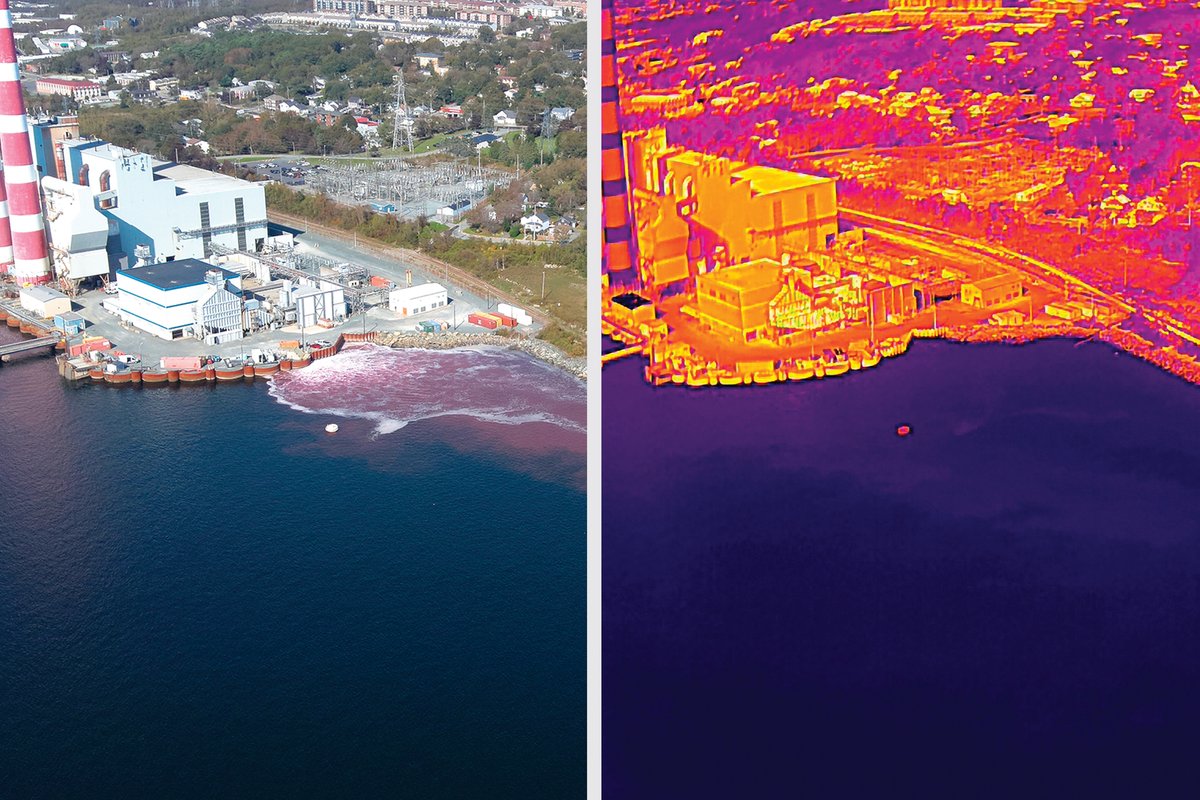
The foamy pink water spread across Halifax Harbor; some stayed near the surface and some sank, painting streaks across the water.
A pipe wrapped in orange insulation carried the slurry to a concrete cistern, where it mixed with seawater that had cooled the plant’s turbines. I climbed the scaffolding and peered into the outflow. White froth churned as the slightly more alkaline water cascaded into the gray-blue harbor. Once the mixture entered the sea, Burt said, “the carbon removal happens everywhere.” Planetary believes ocean alkalinity enhancement could eventually remove billions of tons of CO₂ a year.
The chemistry takes advantage of the ocean’s carbonate system. Less than 1 percent of the inorganic carbon in seawater exists as dissolved CO₂; most is held in bicarbonate and carbonate ions. Planetary’s slurry shifts more carbon into those stable forms, lowering the CO₂ concentration at the surface. The imbalance allows more CO₂ from the air to dissolve into the water, where much of it can remain as bicarbonate for millennia.
The chemical reaction is only the beginning of the accounting. Air-sea equilibration can continue long after the treated water leaves the outfall. Currents may carry the alkalinized water beyond the area where scientists can sample, and some of it may sink before taking up as much atmospheric CO₂ as the chemistry allows. Measuring, reporting and verifying the removal—MRV, in the field’s shorthand—requires researchers to reconstruct what happens after the treated water disappears into the harbor.
In one experiment, Atamanchuk’s team released a cloud of rhodamine dye into the Tufts Cove cistern so the researchers could follow the treated water. The foamy pink water spread across Halifax Harbor; some stayed near the surface and some sank, painting streaks across the water. The team collected samples and filmed the plume with an underwater drone to make a three-dimensional map. Most of the dye remained near the surface, although the share changed with the tide and the stratification of the water.
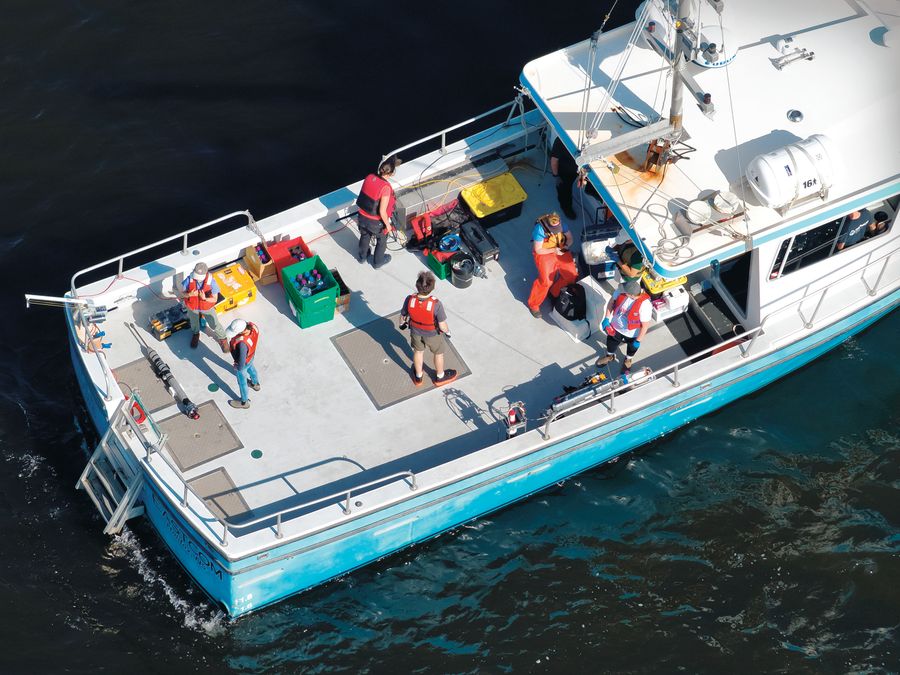
Researchers track how treated water moves with currents and depth—a key step in measuring ocean carbon removal.
New instruments are beginning to improve the picture. This past April a research team that included Planetary scientists reported the first field deployment of an autonomous alkalinity analyzer. Positioned 60 meters from the Tufts Cove outfall in 2023, it repeatedly detected Planetary’s added alkalinity—although it could not determine how much additional CO₂ ultimately entered from the atmosphere.
For that, the Halifax researchers rely on a high-resolution computer model. While I was at Dalhousie, oceanographer Katja Fennel showed me a simulation of Planetary’s trials. Alkaline water appeared as a purple blob on top-down and side views of the harbor. She hit play, and the blob pulsed with each dose, washing up and down the bay with the tide. Purple tendrils snaked toward the Atlantic and dissipated.
Fennel’s model calculates how long the treated water remains close enough to the surface to exchange CO₂ with the air and how much the harbor would have absorbed without Planetary’s intervention. In the simulation she showed me, the treated water had achieved about 60 percent of its maximum possible carbon removal by the end of the study year. It could continue absorbing CO₂ after that, Fennel said.
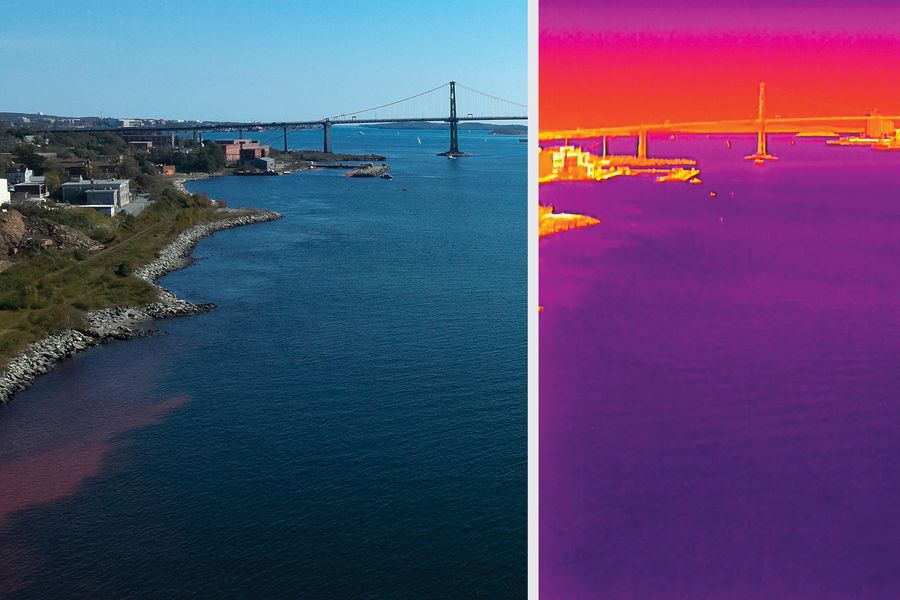
The pink tracer follows the shoreline, but tides and water layers reshape its path. Researchers must rely on models to estimate how much carbon it could absorb.
Researchers at Dalhousie are also watching for ecological effects. They have found a local phytoplankton species and a mussel species that appear to be harmed by heavy exposure to magnesium hydroxide in the lab, but that exposure is higher than what they would face in Tufts Cove. “We have to have monitoring and assessment to make sure that we’re not doing damage,” said Hugh MacIntyre, a Dalhousie professor who previously researched the effects of Planetary’s dosing. “Before all else, do no harm.”
Experiments have already met resistance on shore. Planetary abandoned a proposed project in St. Ives Bay in England after local surfers protested to “keep our sea chemical free”; the company later said a larger rollout was also commercially infeasible. In North Carolina, the U.S. Fish and Wildlife Service warned that an olivine-sand trial by carbon-removal company Vesta could smother organisms on the seafloor, and the project was sharply scaled back. Countries that oversee international rules against dumping at sea identified ocean alkalinity enhancement as one of four techniques requiring priority scrutiny, warning that these approaches could cause widespread or lasting harm and urging that projects outside legitimate scientific research be deferred. The parties have met twice since and still have not settled on how existing treaties should govern the technique.
The field’s history helps to explain that caution. Ocean iron fertilization grew from the idea that iron-rich dust blown across the oceans during past ice ages fed blooms of phytoplankton, helping to lower atmospheric CO₂. Beginning in the 1990s, researchers tested whether adding iron to seawater could reproduce some of that effect. The blooms were easy to trigger, but most experiments could not show how much of the captured carbon sank far enough to remain out of the atmosphere. Added nutrients could also shift food webs or fuel harmful algal outbreaks.
In 2012 American entrepreneur Russ George spread roughly 100 tons of iron in the North Pacific, provoking international criticism that a commercial venture had begun geoengineering without adequate oversight. The episode helped to turn ocean fertilization into a warning for the broader mCDR field: a visible biological response did not necessarily amount to durable, measurable carbon removal.
At that rate, removing one billion tons of CO₂ a year would consume almost 8 percent of the electricity produced worldwide.
Other projects have tried to move carbon downward in seaweed. Last year, at the University of California, Santa Barbara, I visited oceanographers Craig Carlson and David Siegel, who were part of a $2.9-million research program studying what becomes of the carbon fixed by kelp. Locals were catching a lunchtime surf as we walked down to the beach. Beyond the breaks stood forests of giant kelp, each capable of growing as much as 50 centimeters a day. Particles of disintegrating kelp drifted downward like falling leaves. About a tenth of that biomass reaches deep water, according to a 2016 Nature Geoscience study; the rest is eaten or decomposes on the way down, and the kelp also oozes a dissolved “slime” of carbohydrates and proteins that microbes pull apart. Here, too, the challenge was tracing where the carbon went and how long it stayed there.
Running Tide tried to turn that process into a business. The company, based in Portland, Me., raised $70 million to grow kelp on floating buoys made of waste wood and designed to sink to the deep sea. It claimed to have removed more carbon than any other mCDR company. It shut down in 2024. Running Tide had struggled to grow kelp offshore at scale and shifted toward deployments of wood chips mixed with alkaline substances, said former general manager Kristinn Hróbjartsson. Founder Marty Odlin told me the company had not finished developing sensors and methods to reliably measure key properties such as pH and dissolved inorganic carbon. He blamed the shutdown on weak demand and the cost of proving removal, including $30 million spent on measurement. “It’s insanely expensive to do MRV in open systems,” he said.
One response is to bring more of the process onshore. At Berth 58 in the Port of Los Angeles, I visited a long barge with yellow railings and a jumble of tanks and pipes threaded with gauges. Gaurav Sant, an engineer at the University of California, Los Angeles, who co-founded mCDR company Equatic, said the young field faced “an issue of trust and confidence.”
Equatic pumps seawater through an electrolyzer, where an electric current passes through a sandwich of plastic and metal plates and separates the water into two streams, one alkaline and one acidic, while also producing oxygen and hydrogen. In the alkaline stream, calcium in the seawater converts CO₂ into calcium carbonate, the durable compound seashells are made of. Magnesium in the stream then transforms CO₂ added to the water in a tank into bicarbonate before returning to the ocean. The Los Angeles pilot uses bottled CO₂ to demonstrate the chemistry; planned plants in Singapore and Quebec are designed to draw it from the air instead. The acidic stream is neutralized with crushed olivine. Because the reactions occur in containers, sensors can measure them. “I can track every gram of carbon dioxide I removed,” Sant said.
Some want the entire field to be held to that standard. In early 2025 Garrett Boudinot, a geochemist who founded alkalinity company Vycarb, argued on the climate news site Carbon Herald that mCDR should be measured directly. “The future of the climate depends on measuring—not modeling—climate solutions,” he wrote.
But that process takes considerable power. Equatic estimated that it takes about 2.5 megawatt-hours per ton of CO₂ removed. At that rate, removing one billion tons a year would consume almost 8 percent of all the electricity produced worldwide. Hydrogen produced along the way could generate electricity in a fuel cell or be sold, potentially offsetting some of that demand. The promise has already attracted Boeing, which signed a prepurchase option covering 62,000 tons of future carbon removal and 2,100 tons of hydrogen. Open-water approaches may be cheaper to scale and can take advantage of the ocean’s enormous surface area. Their claims, however, depend more heavily on models built from observations of only a small part of the moving sea.
Buyers are already putting money behind methods that remain difficult for outsiders to assess. In 2025 mCDR start-up Gigablue sold 200,000 future credits for a method intended to stimulate phytoplankton on mineral particles that later sink. The company has disclosed little about the particles or its supporting data; Chelsey Baker of the U.K.’s National Oceanography Center told me that the public information was too sparse to determine whether the method would durably remove as much carbon as the company claims.
Fennel says measurement alone cannot verify open-ocean removal, because we don’t know how the ocean would have evolved without the intervention. Once alkaline water mixes into the sea, modeling becomes unavoidable. Fennel believes the Halifax team may eventually pin its estimate to within 10 percent. For an intervention dispersed through a harbor and out to sea, that may be as close as the ocean gets to a meter reading.
Back on the boat, Atamanchuk’s instruments could show only that the surface water held slightly less CO₂ than the air above it. The answer Planetary needed—how much of that difference it could claim—was already moving with the tide.