
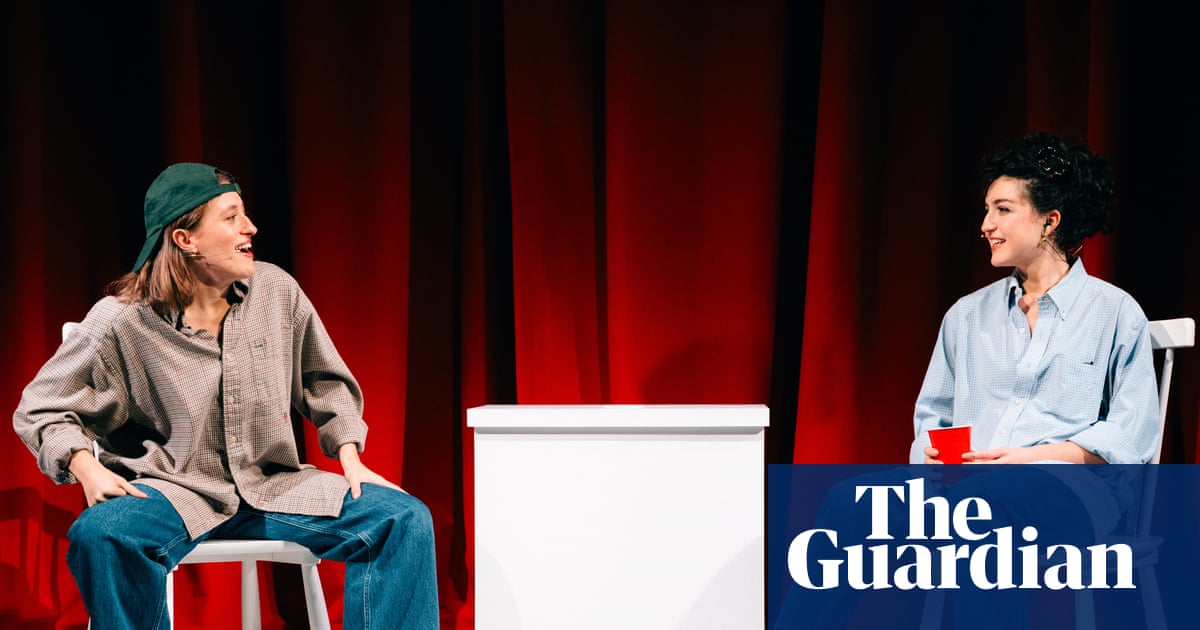
Among the first questions posed in Two Girls, a verbatim play reconstructing the events of shock-porn video 2 Girls 1 Cup, is a seemingly simple one: “Can you describe the cup?”
The cup was plastic, insists one interview subject, transparent but also red, “like you get at a pizzeria”. Another man describes the cup, with certainty, as “a tapering, slightly green glass”. A third subject, sounding less certain, suggests it was a clear Ikea glass, six inches tall, adding: “You see into it, which is important.”
And a fourth interviewee simply declares: “No, I cannot describe the cup.”
The playwright Eliya Smith’s strange, unexpectedly tender theatrical investigation draws on interviews with eight men to unpack the legacy of infamous viral phenomena 2 Girls 1 Cup, a 60-second trailer for the Brazilian scat fetish pornographic film Hungry Bitches that took the internet by storm in 2007.
Created with buzzy experimental theater company The Goat Exchange and subtitled, “A Homeric Retelling in the Oral Tradition,” Two Girls is currently playing at the Cherry Lane Theatre, a historic venue in New York’s West Village now owned and operated by the indie film studio A24, until 29 November.
Back in an age of MySpace when something close to an online monoculture still existed, 2 Girls 1 Cup sparked waves of screaming, revulsion-filled reaction videos. Teens dared each other to watch, framing it as an endurance test: how long can you last?
“We didn’t know what we were being exposed to, we had no business,” declared actor Keke Palmer in a recent Hollywood Reporter roundtable, after her mention of the video sparked hysterics across the table. “They should have protected us!”
We all saw it. We all remember it. Or do we?
Juliana Sass and Chloe Claudel. Photograph: Courtesy of Cherry Lane Theatre
Smith conducted hours of interviews with a group of male friends and acquaintances for Two Girls, none of whom are identified. Interviewer and subjects are all played by Chloe Claudel and Juliana Sass, who trade off with each scene, swapping places opposite a plain white table on a nondescript set. (Claudel also directs, alongside Mitchell Polonsky, her Goat Exchange co-artistic director.)
And since the subjects interviewed for Two Girls struggled to even recall the cup in question, no surprise that the video’s exact content also proves a challenge. One says the two women are topless, “obviously”; another says they start out in bikinis; a third says he “pictures” them wearing pantsuits.
Some of the men then grow uncomfortable, hesitant to describe the memories bubbling up. Others are less shy, launching into evocative descriptions of defecation into a glass, the mutual consumption of said feces and finally projectile vomiting. “It definitely has an arc,” insists one interviewee.
So too does Two Girls, which begins as an attempt to reconstruct the video in question but grows into a deeper examination of coming-of-age in the early era of internet porn and coming to associate sexuality, however unconsciously, with a certain kind of shame or disgust. Did 2 Girls 1 Cup play a part in that?
Playwright Eliya Smith. Photograph: Courtesy of Eliya Smith
The playwright, who made her off-Broadway debut last spring with the melancholic Grief Camp, began interviewing acquaintances about 2 Girls 1 Cup around two years ago, uncertain if the conversations would make for anything interesting.
“I was thinking a lot about bodies, pornography and disgust,” said Smith. “But I don’t know that I totally understood why I was interested in these themes, at least at the beginning.”
Smith is also a longtime collaborator with Claudel and Polonsky, dating back to the trio’s time at Harvard. Goat Exchange had a breakout hit this summer with Smith’s teen-girl focused Dad Don’t Read This, a meta-theatrical tale of sleepovers and living vicariously through The Sims. (Goat Exchange also made their Ireland debut with Radio Bette at the Dublin Theatre Festival in September.)
The company’s subjects are varied, but each production sees Goat Exchange artists building a new and peculiar kind of narrative structure that ultimately breaks down to reveal the story’s emotional center.
“Chloe and I are really interested in structures and systems, building the scaffolding around the heart and finding the things that move us,” said Polonsky.
Their theatrical work Time Passes (For Ellen Brody) toggles between Virginia Woolf’s To the Lighthouse and Chief Brody’s wife from Jaws flirting with a giant inflatable shark, finding an existential ennui in the strange mash-up. And Deadclass, Ohio, also a verbatim piece by Smith, literally “breaks” at the halfway point and begins to loop, poking at the instability of memory by adjusting small details with each repetition. Both shows will play return engagements at the Under the Radar festival in January.
Juliana Sass in Two Girls. Photograph: Courtesy of Cherry Lane Theatre.
In Two Girls, the subversion comes in the awkward moments of strange social tension between Smith and her subjects who, in discussing the video, reveal themselves in disquieting ways. One subject confesses, seemingly to his own surprise, that he first understood sex as its own kind of game of chicken.
“For years, until it all gets demystified a little bit, what’s hot is not the blow job, but that you got her to do it,” he admits. “And that you both knew she wasn’t supposed to if she was going to be, like, a good person.”
Far from censorious of their male subjects, the show’s writer and performers feel almost protective of them. “There’s something very vulnerable and honest about telling someone over the phone how something affected you as a 12-year-old,” said Claudel. For her and Sass, the task is to channel those vulnerable admissions (piped directly into their ears with in-ear technology) as honestly as possible.
“I was interviewing people who encountered internet pornography when they were very young, and didn’t understand their own bodies or the bodies of people around them,” said Smith. “Once I provided the space for them to answer questions, a lot of them really wanted to process the way that had shaped them.”
2 Girls 1 Cup becomes a container, of a sort, for all the ways in deconstructing the conceptions of empowerment, attractiveness and health we hold around our own bodies, built into us by teen confusion never fully disentangled. “This video, and the way we relate to it, synthesizes all of that,” said Smith.
In its final moments, Two Girls makes an unexpected pivot that reframes the play’s tension around the question of voyeurism. And until this moment comes along, it may not have occurred to you that the women who actually performed 2 Girls 1 Cup have scarcely, in all of this deep dissection, been mentioned at all.
Yet still, the conclusion is not one of finger-pointing or shaming. “We’re just trying to figure this out together,” said Smith. “What it means to live in this world that we participate in shaping, and started shaping when we were really young, and didn’t understand much.”
Two Girls is at Cherry Lane Theatre, New York, until 29 November