
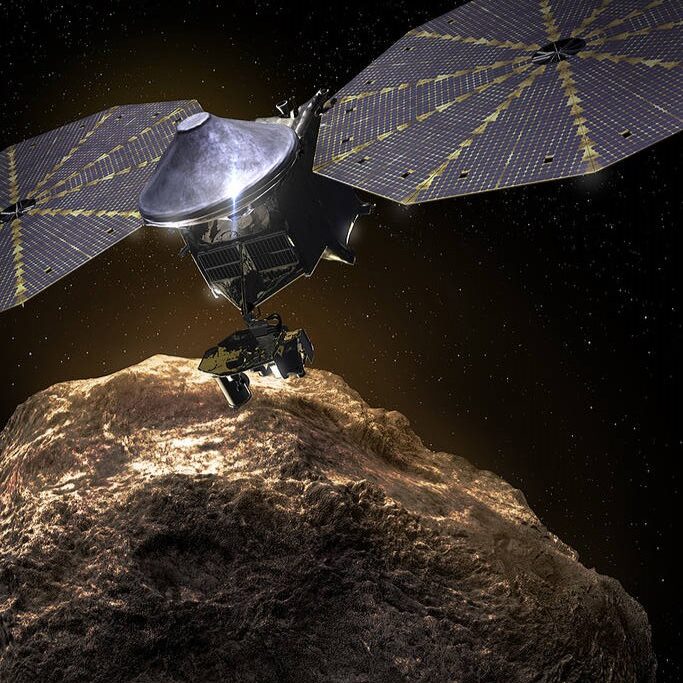
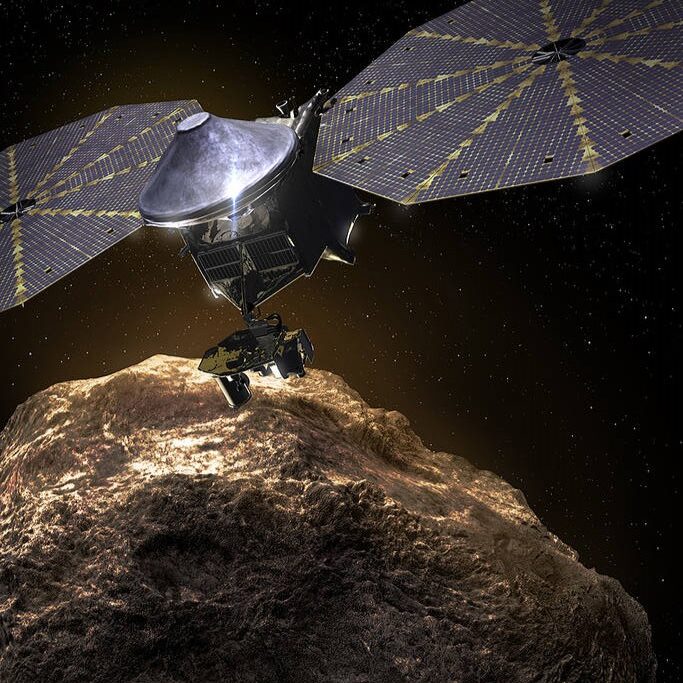
 View larger. | Artist’s concept of the Lucy spacecraft making a close flyby of an asteroid. The Lucy mission is now less than a year from reaching the Trojan asteroids near Jupiter. Image via NASA.
NASA’s Lucy mission is headed to the Trojan asteroids. These asteroids, traveling ahead of and behind Jupiter in its orbit, have never been explored before.
Lucy is now less than a year away from the Trojans. But it has already made several exciting discoveries.
These include new findings at other asteroids in the main asteroid belt between Mars and Jupiter.
Science news, night sky events and beautiful photos, all in one place. Click here to subscribe to our free daily newsletter.
5 years into the Lucy mission
NASA’s Lucy spacecraft is getting ever closer to its destination, the Trojan asteroids. These are two groups of asteroids that travel ahead of and behind Jupiter in its orbit. Lucy is now less than a year away from meeting its first Trojan. Exciting!
Launched on October 16, 2021, Lucy has been traveling for about five years now. But even though it hasn’t reached the asteroids yet, it has already made several remarkable discoveries, researchers from the Southwest Research Institute (SwRI) said on October 19, 2026.
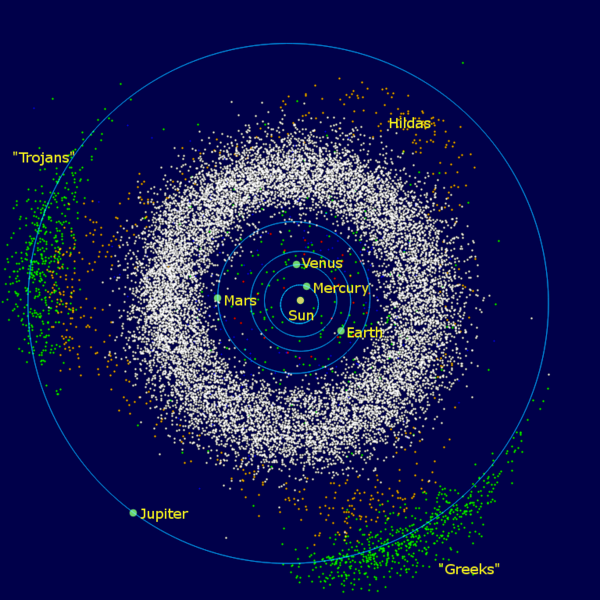 Here, the white “donut” represents the main asteroid belt, between Mars and Jupiter. And the green groups of dots are Trojans. These asteroids move in Jupiter’s orbit, 60 degrees ahead of and behind the giant planet. Asteroids orbiting in front of Jupiter are named for the Greek heroes of the Trojan War. And likewise, asteroids trailing behind Jupiter are named for the Trojan heroes. Image via Wikimedia Commons.
An ambitious mission to unexplored asteroids
Lucy will be the first mission to explore the Trojan asteroids. Hal Levison at SwRI is the principal investigator of the mission. He said:
Lucy is an ambitious NASA mission, with plans to visit 11 asteroids in its 12-year mission to tour the Trojan asteroids that are located in two swarms leading and trailing Jupiter. As we passed through the main asteroid belt, we visited three asteroids, capturing close-up views of those bodies while performing engineering tests of the spacecraft’s innovative navigation system in advance of the main event to study the Trojans. These relics are effectively fossils of the planet formation process, holding vital clues to deciphering the history of our solar system.
Dinkinesh has a moon
Even though Lucy hasn’t reached the Trojans yet, it has already made several discoveries.
The first was at the asteroid Dinkinesh. Back in 2022, the mission team found that Lucy would come close to the asteroid, which was still unnamed at the time. Dinkinesh is in the main asteroid belt between Mars and Jupiter.
The flyby happened in November 2023. The mission team tweaked the spacecraft’s trajectory so it would fly even closer to Dinkinesh. And there was a surprise waiting for them.
The asteroid had a tiny moon! So now, scientists count that as being two asteroids. But there was yet another surprise.
The little moon, now named Selam, was a contact binary. That is, it had two parts that were joined together. So there were three bodies altogether, not just one.
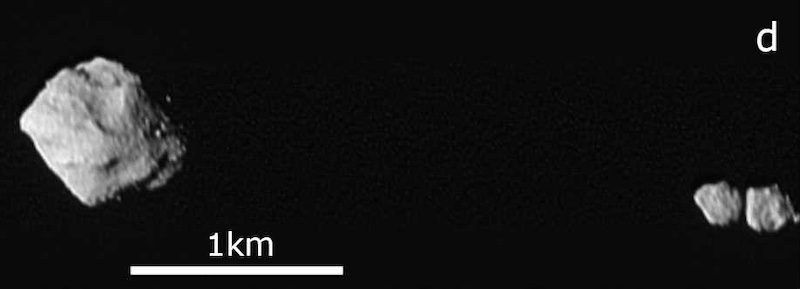 The Lucy mission took this image a few minutes after closest approach to asteroid Dinkinesh on November 1, 2023. We clearly see the asteroid’s double moon, Selam, on the right, as 2 smaller bodies stuck together. Image via NASA/ SwRI/ Johns Hopkins APL/ NOIRLab.
Peanut-shaped Donaldjohanson
Later, in 2025, Lucy flew past another asteroid, Donaldjohanson. And this time, it was the asteroid itself that was a contact binary.
Donaldjohanson is peanut-shaped, with two large lobes joined together by a smooth “neck.” Simone Marchi, deputy principal investigator for Lucy, said:
The Donaldjohanson flyby revealed many surprises about the small asteroid. For instance, the peanut-shaped, two-lobed structure is connected by a remarkably smooth neck. The asteroid also wobbles, rotating end-over-end once every 10.5 Earth days while rolling around its lateral axis once every 26.5 days.
 This is asteroid Donaldjohanson, as NASA’s Lucy spacecraft saw it during a flyby on April 20, 2025. Its apparent rotation here is due to the spacecraft’s motion as it flew by Donaldjohanson at a distance of 660 to 1,000 miles (1,060 to 1,600 km). But Lucy did find that this little asteroid wobbles in space. Image via NASA/ Goddard/ SwRI/ Johns Hopkins APL.
Gravity assists boot Lucy’s speed
During its journey, Lucy looped back and passed by Earth twice. Why? It might sound counterproductive, but the spacecraft uses Earth’s gravity to gain speed and fine-tune its trajectory.
The first gravity assist was in October 2022. Lucy passed only 220 miles (350 km) above the surface of Earth. This propelled Lucy into a two-year solar orbit. Lucy took images of Earth and the moon to calibrate its instruments.
Later, in December 2024, the second flyby increased its speed relative to the sun by over 16,000 mph (25,750 km/h). That put Lucy on a current path to make its first Trojan encounter in August 2027.
Lucy will make yet another Earth flyby in December 2030. It will then reach the second Trojan swarm of asteroids in March 2033.
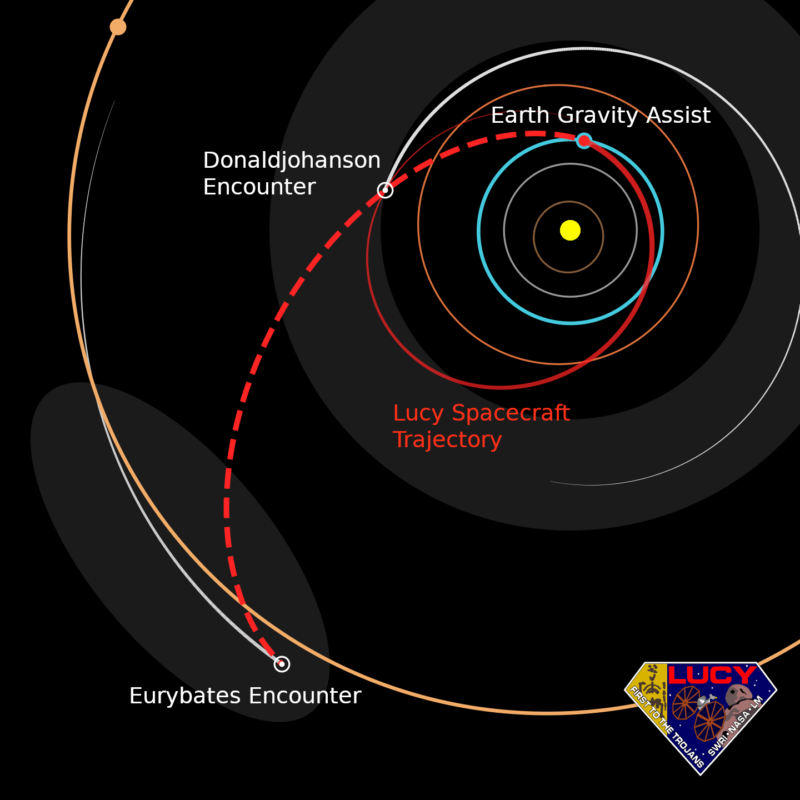 NASA Lucy spacecraft’s 2nd Earth gravity assist dramatically alters the spacecraft’s trajectory, enabling it to travel through the Jupiter Trojan asteroids. Lucy’s trajectory after the assist is shown by a dashed red curve. The gray regions indicate the approximate location of the main asteroid belt (upper right) and the leading group of Jupiter trojan asteroids (lower left). In addition, the main belt asteroid Donaldjohanson and the Trojan asteroid Eurybates are shown at the time of Lucy’s encounters. Image via NASA/ SwRI.
When problems arise
With any mission, there can be problems that occur, and Lucy was no exception. Soon after launch, one of its two huge solar panels didn’t deploy properly.
However, mission engineers were able to diagnose the problem and get the solar panel to deploy far enough to save the mission.
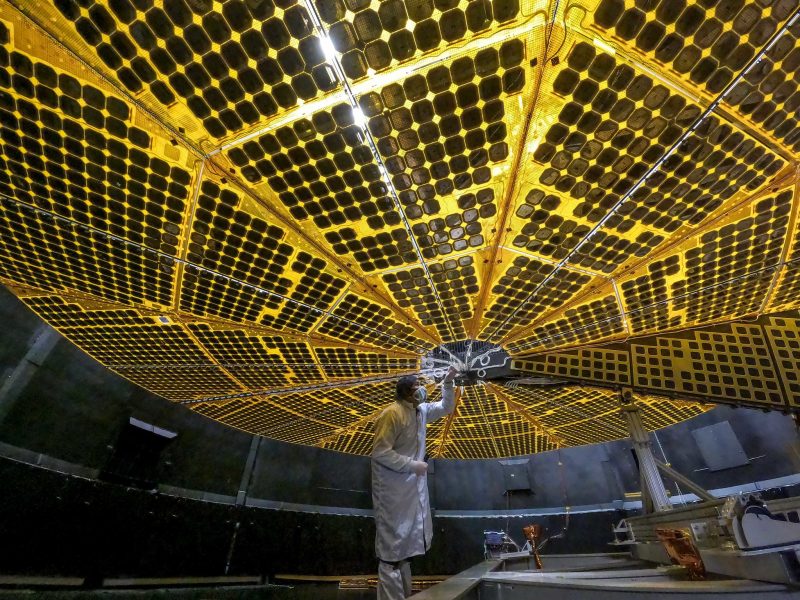 View larger. | Lucy’s massive solar arrays completed their 1st set of deployment tests in January 2021 inside this thermal vacuum chamber at Lockheed Martin Space. NASA engineers had to solve a problem with them on the fly, as the spacecraft makes its way to the Trojan asteroids. Image via Lockheed Martin Space/ NASA.
Image via Lockheed Martin Space.
Other observations
Lucy has been fortunate to witness some other events too during its journey.
In September 2022, NASA DART probe impacted the near-Earth asteroid Didymos (on purpose, to demonstrate planetary defense technology). And Lucy saw it happen.
In September 2025, Lucy observed the now-famous interstellar comet 3I/ATLAS as it passed through our solar system.
But there is much more to come, as Levison noted:
Despite these eventful five years, most of Lucy’s mission still lies ahead. The main events start in less than a year as Lucy gets a close-up look at four Trojan asteroid systems: Eurybates and its satellite Queta in August 2027, Polymele and its as-yet-unnamed satellite in September 2027, Leucus in April 2028 and Orus in November 2028.
It will be exciting when Lucy finally reaches the Trojans. None of them have been seen up close before, so what will Lucy find?
Bottom line: NASA’s Lucy mission is now less than a year from reaching the Trojan asteroids near Jupiter. And it has already made some exciting discoveries along the way.
Read more: Lucy spacecraft 1st images of asteroid Donaldjohanson!
Read more: Lucy spacecraft update: And then there were 3!
Paul Scott Anderson
View Articles
About the Author:
Paul Scott Anderson has had a passion for space exploration that began when he was a child when he watched Carl Sagan’s Cosmos. He studied English, writing, art and computer/publication design in high school and college. He later started his blog The Meridiani Journal in 2005, which was later renamed Planetaria. He also later started the blog Fermi Paradoxica, about the search for life elsewhere in the universe.
While interested in all aspects of space exploration, his primary passion is planetary science and SETI. In 2011, he started writing about space on a freelance basis with Universe Today. He has also written for SpaceFlight Insider and AmericaSpace and has also been published in The Mars Quarterly. He also did some supplementary writing for the iOS app Exoplanet.
He has been writing for EarthSky since 2018, and also assists with proofing and social media.