
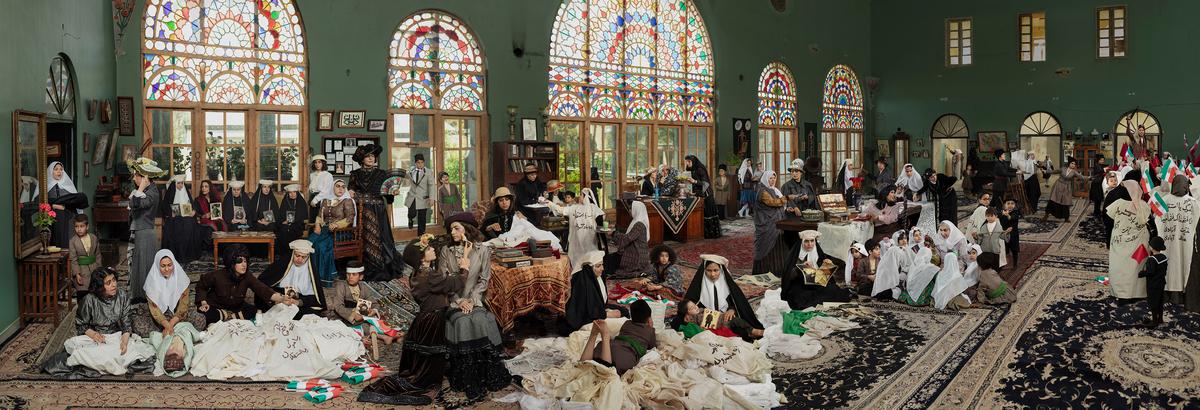
Visiting Azadeh Akhlaghi at the Peabody Museum. Did you know LARB is a reader-supported nonprofit?
LARB publishes daily without a paywall as part of our mission to make rigorous, incisive, and engaging writing on every aspect of literature, culture, and the arts freely accessible to the public. Help us continue this work with your tax-deductible donation today!
AZADEH AKHLAGHI was busy preparing for the opening of her exhibition at the Peabody Museum at Harvard, From Iran: A Visual Testimony, in February, just as the Israelis and Americans were initiating military strikes against Iran. The timing was, in a sense, serendipitous: Akhlaghi is an artist of deeply cultivated historical imagination who has devoted herself to the examination of critical, often traumatic, moments in the history of Iran.

Azadeh Akhlaghi, The First Iranian Women’s Movement, Dr. Kahhal’s Office, Tehran | December 1, 1911. © Azadeh Akhlaghi.
Born in 1978, shortly before the culmination of the Islamic Revolution; raised in Iran; and educated at Royal Melbourne Institute of Technology in Australia, Akhlaghi began her artistic career as a close collaborator of the legendary filmmaker Abbas Kiarostami. In 2009, following a few short films of her own, she began developing a series of 17 large-format photographic tableaux, By an Eyewitness, in which she recreated the deaths of pivotal figures from modern Iranian history. The project, first exhibited at Mohsen Gallery in Tehran in 2012, grew in response to the Green Movement, a sustained series of protests in support of opposition presidential candidates, and the 2009 killing of a young woman, Neda Agha-Soltan, by unknown assailants, which was captured on video.
The image of Agha-Soltan’s murder was galvanizing for the civil rights movement, and Akhlaghi undertook to depict other crucial deaths from Iran’s past—for example, the 1924 assassination of the immensely popular revolutionary poet, playwright, and journalist Mirzadeh Eshghi, gunned down in his own home in Tehran. In this series and in her subsequent photographs of intricately choreographed and often densely staged historical reenactments, Akhlaghi has conducted meticulous research to faithfully recreate the scene and capture authentic period details in clothing and objects. At the same time, she always places herself inconspicuously in the pictures. In her recreation of the killing of Eshghi, we see Akhlaghi in the corner of the photograph, emerging from a cellar. That, in effect, is her signature intervention: making herself a contemporary witness to the otherwise distant events she is depicting.

Azadeh Akhlaghi, Tehran-Mirzadeh Eshghi / 3 July 1924, 2012. From By an Eyewitness series. © Azadeh Akhlaghi. Courtesy of the artist and Mohsen Gallery, Tehran.
The Israeli-US attacks on Iran, targeting its infrastructure and decapitating its leadership, began on February 28, and continued until the ceasefire announced on April 8, a total of 40 days—the Deuteronomic number of punishment, or else the Sufi number of ascetic seclusion and meditation. These were exactly the days when Akhlaghi, half the globe away from her homeland, was preparing for her exhibition at the Peabody. (At the time of writing, the ceasefire has collapsed, and the United States has resumed its assault on Iran.) The coincidence of these two events—genocidal ideology unleashing war on yet another front, and an art exhibition in a country that has begun to object to its resources being wasted on that war—generates a cognitive dissonance we need to decipher.
At the Peabody, Akhlaghi presents a new body of work that furthers the aesthetic and historical strategies developed in By an Eyewitness, illustrating, across 17 photographs, 11 landmarks in 20th-century Iranian history, bookended by the Constitutional Revolution of 1905–11 and the Islamic Revolution of 1979—that is, starting with the bombardment of the newly formed Iranian parliament, the Majlis, on the morning of June 23, 1908, by the shah, Mohammad Ali, and ending with the dramatic events of February 11, 1979, and the toppling of the Pahlavi dynasty. In these large-scale tableaux, she reenacts events with astounding, almost obsessive, attention to detail, costume, and historical veracity.

Azadeh Akhlaghi, The Conquest of Tehran Zahir al-Dowleh’s Residence, Tehran | August 20, 1909. © Azadeh Akhlaghi.
The First Iranian Women’s Movement, Dr. Kahhal’s Office, Tehran | December 1, 1911 is based on a passage in William Morgan Shuster’s classic book The Strangling of Persia (1912), in which the author, an American lawyer appointed treasurer general of Persia by the Iranian parliament, gives a firsthand account of how British and Russian imperial intervention undermined the country’s constitutional government and forced the collapse of its efforts at political and financial independence. In a recent interview, Akhlaghi described how Shuster once saw “300 women with guns come to Parliament, warning that if Iran capitulated to Russian demands, they would kill their husbands, their sons, and the members of Parliament—basically threatening to take over Parliament.” She commented:
I wanted to know more about that moment. Who were those women? How did they organize such a thing? I found out that they had organized through six or seven societies that met in secret to talk about their demands. They published a newspaper, Danesh, which means “knowledge.” The woman who ran the paper was also Iran’s first female ophthalmologist, and the paper was run out of her clinic. You can find her at the center of the image, as well as other figures, like the first Iranian singer to perform without a hijab in front of men. My piece imagines the Danesh offices, moments before these women march on Parliament.
But what exactly are we are looking at in these deeply researched, hyperdetailed photo tableaux, recreating with theatricality some of the most traumatic moments of Iranian history? What is it we are seeing in these pictures of social uprisings, military invasions, revolutionary aspirations, guerrilla warfare, women’s rights movements, and treacherous coups d’état? Is this an act of mourning for a past that cannot be changed or a case of melancholia for an aspiration that was never delivered? In his signature essay “Mourning and Melancholia” (1917), Sigmund Freud distinguishes between normal, healthy mourning and pathological, depressive melancholia. The object of mourning is clear and specific, and the healthy mourner, after a time, divests from the lost object and reinvests their libido in a new object of desire. The melancholic can’t let go and fetishizes the lost object, abandoning hope and desire. Mourning can be short in duration but ultimately leads to healing; in melancholia, the ego so thoroughly and pathologically identifies with the lost object that it loses itself too.

Detail from The Conquest of Tehran Zahir al-Dowleh’s Residence, Tehran | August 20, 1909. © Azadeh Akhlaghi.
Reclaiming the love of homeland in the aftermath of a national trauma—war, revolution, military intervention—is a healthy response, a form of mourning that facilitates moving forward. Akhlaghi’s pictures are, in this sense, cathartic to behold: they offer a renewal by passage through negative emotions. Yet this raises the question of the context of the presentation of the work and the identity of the spectator. For an American, encountering these photographs as their military continues to pursue an unprovoked war on Iran, Akhlaghi’s images may capture the moment of revelation, of a dawning understanding. In a sense, her work oscillates between these two Aristotelian dramatic categories. How an American perceives the dramatic restaging of, say, the CIA-MI6 coup of 1953 will necessarily differ from the way an Iranian does. For an Iranian, these are moments of catharsis; for an American, anagnorisis: in one, we are liberated, and in the other, we are caught, self-implicated. The moment Shuster captured, which enabled Akhlaghi to muster one of her most powerful images, is where the two sides of the dramatic conversation are brought together. We witness these two sides—Iranian and American, catharsis and anagnorisis—as mirror images of one another: Iranians who wish to restore to the United States the hopeful model they had once imagined, and Americans who wish to liberate their own homeland from being implicated in global warmaking.
Consider a particularly powerful picture of a pivotal event: a year after the bombardment of Iran’s parliament by the ruling Qajar monarch, constitutionalist revolutionaries from around the country, particularly from Tabriz, moved on Tehran, arriving at the outskirts of the city on July 16, 1909. Looking closer, you can see, on the right-hand side of the picture, the artist herself giving red roses to the gathering revolutionaries. This detail captures how deeply contemporary Iranians are invested—morally, emotionally, and imaginatively—in the memory of their revolutionary aspirations, defending their homeland as a citadel of democratic ambition. It is a memory that is revived as the country’s sovereignty is again under threat.

Coffee house painting depicting scenes from the tragedy of Rostam and Sohrab in Abolqasem Ferdowsi’s Shahnameh.
Between mourning and melancholy, however, stands the redemptive suffering that marks the dramaturgy of ta’zieh, or the “Persian passion play.” Specifically, the subgenre of pardeh khani, or “canvas recitation,” is a kind of performance theater where a storyteller, a naqqal, stands in front of a canvas full of epic stories and recites the tales of their heroes and saints. In the same way that the naqqal stands in front of a densely illustrated canvas and tells the audiences stories of bygone heroism and sacrifice, Akhlaghi, too, from inside her pictures, tells the world the stories of her homeland. In pardeh khani, the storyteller performs the dramas of bygone and sanctified saints and martyrs. In her “pardehs,” now generically sublimated, Akhlaghi becomes a storyteller herself, but she expands the genre into the stories of a nation, a people, a homeland. From Akhlaghi’s tableaux, we can even speculate that the entire course of Iranian cinema has parabolically expanded the genre of pardeh khani from fixed to moving pictures.
The force of Akhlaghi’s work is the way she visualizes thick description, to borrow a famous phrase from Clifford Geertz’s 1973 book The Interpretation of Cultures. She details and stages her mourning based on evidence derived from sustained research that, in its embrace of nuance and complexity, puts to shame an entire industry of politically pandering and historically selective Iranian memoir on the model of Azar Nafisi’s notorious Reading Lolita in Tehran (2003). When Akhlaghi exhibits her artwork, she is not telling her American spectators “Come and see the miserable life I had before I came to you and found freedom and salvation.” Rather, her thick description revives the past as a living memory of the nation, enabling a depth of sympathy, empathy, and solidarity across borders.

Azadeh Akhlaghi, Women Political Prisoners Performing “The Little Prince,” Women’s Ward, Qasr Prison, Tehran | 1975. © Azadeh Akhlaghi.
Akhlaghi’s tableaux are what Russian literary critic Mikhail Bakhtin would call “visual utterances.” They are expressions of meaning embedded in context rather than abstracted from it. Bakhtin thought the truths of certain people can become knowable to others far from those experiences. A viewer can look at every single corner of Akhlaghi’s picture depicting political prisoners performing Antoine de Saint-Exupéry’s The Little Prince (1943) in the women’s ward of Qasr Prison in Tehran in 1975 and wonder: Who are these prisoners? What were they charged with? What are their dreams and nightmares? And how will they survive? The picture is full of what Bakhtin called “answerability.” They invite a conversation, a dialogue, across cultures and histories, where viewers enter worlds beyond their own immediacies.
¤
Featured image: Detail of The First Iranian Women’s Movement, Dr. Kahhal’s Office, Tehran | December 1, 1911. © Azadeh Akhlaghi.
LARB Contributor
Hamid Dabashi is Hagop Kevorkian Professor of Iranian Studies and Comparative Literature at Columbia University in New York. His most recent books are The Subversive Seventies in Tehran: Romancing Revolutions (2025) and Imagine a Nation: Six Persian Poets in Search of a Homeland (2025).
Share
Copy link to articleLARB Staff Recommendations
The destruction of Iranian cultural heritage sites, and the cultural histories buried in the rubble.
Despite Western media’s dismissal of them as mere propaganda, the Iranian LEGO videos have a long and complex genealogy.