
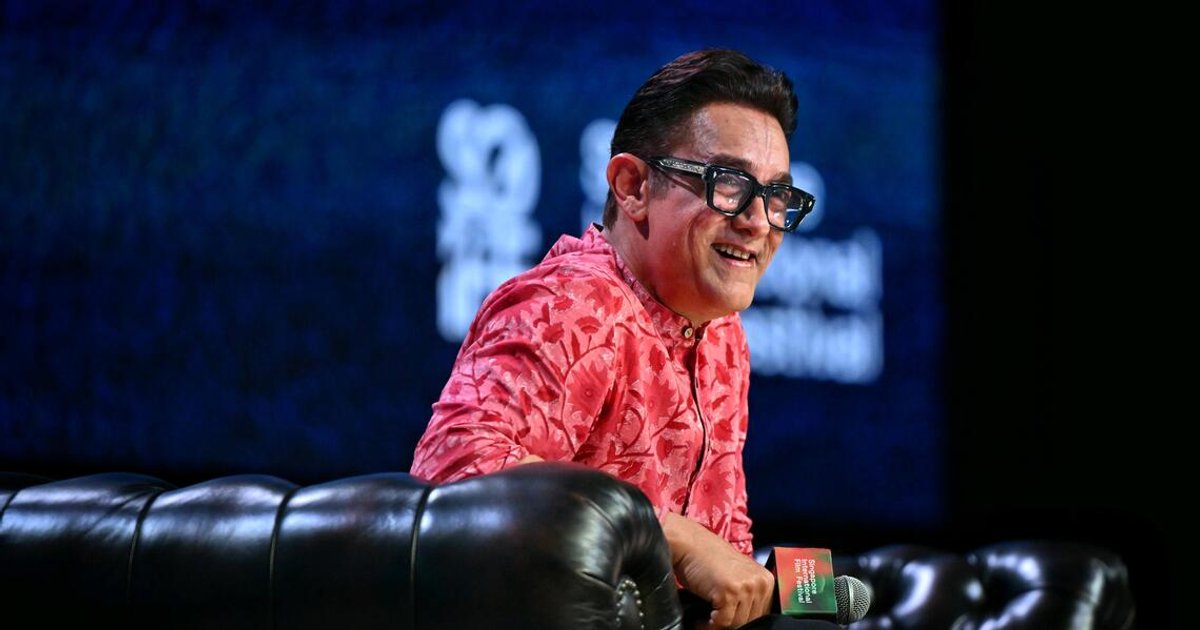
SINGAPORE – Few stars have shaped modern Indian cinema quite like Aamir Khan.
The actor, director and producer is behind some of Bollywood’s most beloved films, including Lagaan (2001), 3 Idiots (2009), PK (2014) and Dangal (2016). Often dubbed Mr Perfectionist, he is known for committing to one film at a time and immersing himself fully in each role.
He has won four National Film Awards and nine Filmfare Awards, and the Indian government conferred him the Padma Shri in 2003 and Padma Bhushan in 2010, two of the country’s highest civilian honours.
His films have also found huge audiences beyond India, especially in China.
On Oct 22, during the Singapore International Film Festival’s (SGIFF) In Conversation With session at Marina Bay Sands, the 61-year-old received the Screen Icon Award, whose past recipients include Malaysian actress Michelle Yeoh and South Korean actress Youn Yuh-jung. It was presented by Khan’s friend, Hong Kong director Peter Chan, who joked that Khan’s cook makes the best aloo paratha he has ever eaten.
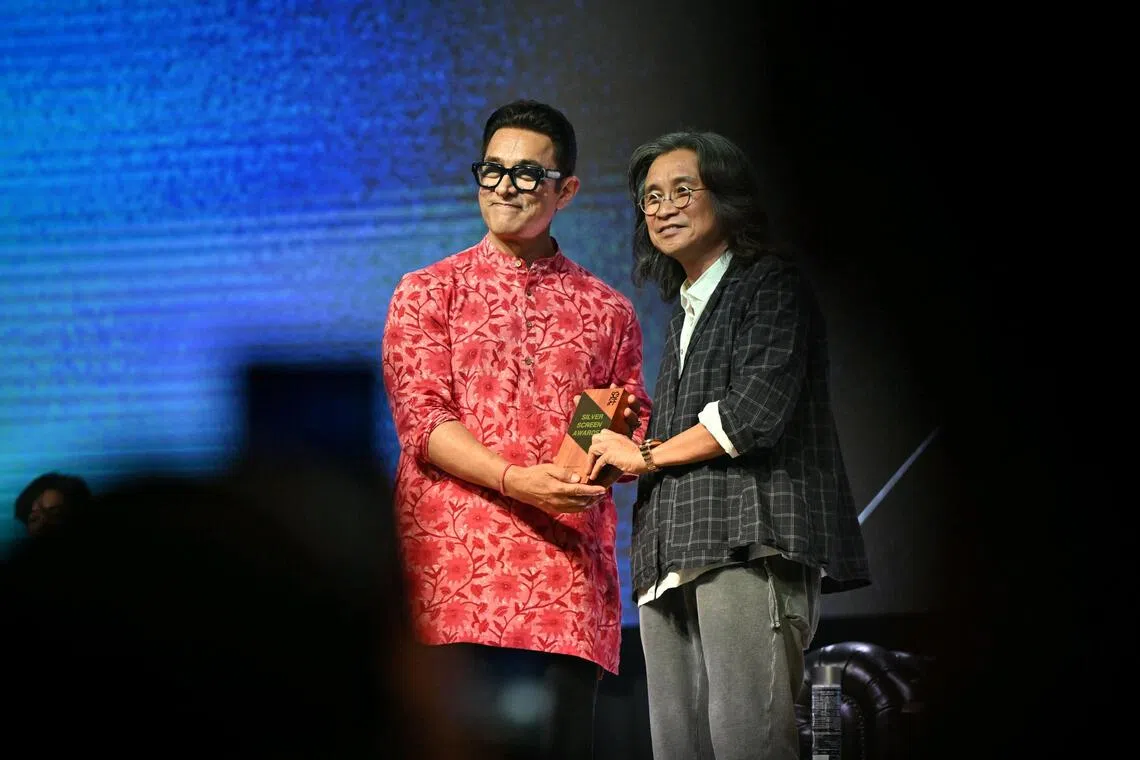
Bollywood star Aamir Khan receiving the SGIFF Screen Icon Award from his friend, Hong Kong director Peter Chan, on Oct 22.
ST PHOTO: ARIFFIN JAMAR
Accepting the accolade, Khan said film-making is a collective art form and shared the honour with the writers, directors and crews he has worked with.
SGIFF is also celebrating 25 years of Lagaan, the Oscar-nominated period drama he produced and starred in and the most expensive Indian film at the time of its release, which screens as part of the festival on Oct 23.
During the two-hour panel discussion moderated by local comedian-host Rishi Budhrani, Khan shared good news for fans: 3 Idiots director Rajkumar Hirani is working on a sequel to the hit comedy-drama and leading man Khan expects to receive the final draft of the script when he returns home to Mumbai in the next couple of weeks.
Khan turned reflective the rest of the evening. Here are three things he opened up about, including lessons, regrets and turning points from his four decades in cinema.
The ‘no’ that saved his career
After his first lead role in Qayamat Se Qayamat Tak (1988) became a hit, Khan signed up for nine or 10 films within six months. Most of them flopped, and he said he felt deeply unhappy and stressed, as though he were sinking in quicksand.
He made a promise to himself: He would take on a film only if he loved the script, the director and the producer.
This was soon tested. At his lowest point, director Mahesh Bhatt, then riding high after Arth (1982), Saaransh (1984) and Naam (1986), offered him a film. Khan did not like the script, and after a sleepless night, he turned it down. The film was never made.
“Had I compromised that day… I think my entire career would have been a series of compromises,” he said.
Saying no when he was at his weakest, he added, gave him the strength to stand by his convictions for the rest of his career. There were no hard feelings: Bhatt later directed him in the hits Dil Hai Ke Manta Nahin (1991) and Hum Hain Rahi Pyar Ke (1993).
Making time for family
The Covid-19 pandemic brought another reckoning. Khan, who called himself a workaholic for three decades, said being stuck at home made him realise how much time he had lost with his three children, his mother and the rest of his family.
Son Junaid Khan, 33, an actor, and daughter Ira Khan, 29, a mental health advocate, are from his first marriage to producer Reena Dutta. Son Azad, 14, is from his second marriage to film-maker Kiran Rao. In July, he wed his third wife, wellness entrepreneur Gauri Spratt.
“It’s okay to work like a madman, completely obsessed with what you’re doing, for one year, two years, five years. But if it goes on for 30 years… your kids have grown up,” Aamir Khan said, pausing as he teared up. An audience member then walked up to hand him a pack of tissues.
He has since made a point of spending time with loved ones. “I’m so glad that this thought occurred to me when I was 56 and not when I was 86.”
He has also switched off his phone. Describing himself as having “a very addictive personality” that endless social media reels could easily feed, he said he worries about younger generations who have never known boredom.
“You must have time to waste… so that your mind starts taking over.”
Lessons on- and off-screen
Khan sees artificial intelligence as a tool that can help him tell stories better, but he fears it will cost skilled workers – such as the carpenters and painters who build film sets – their jobs. He believes humans will still be needed to judge what works creatively, and asked whether a robot’s cooking could match a meal made by a mother’s hand.
He was also candid about his popularity in China, which he credits to pirated copies of 3 Idiots that spread among Chinese students.
“My popularity in China is thanks to piracy,” said Khan, who added that he does not condone it. The deeper reason, he believes, is that Indians and Chinese share “a very similar emotional key”.
The film that changed him most was the family-musical Taare Zameen Par (2007), about a boy with dyslexia. While researching it, a doctor told him that children need security, dignity, trust and faith most, with love coming last, like dessert after a good meal.
Khan realised adults need the same things, and later applied the lesson to his own strained relationships, both personal and professional, and found that it worked.
“When you give another person dignity, self-respect, love, trust, faith and security, then you get those in return.”