
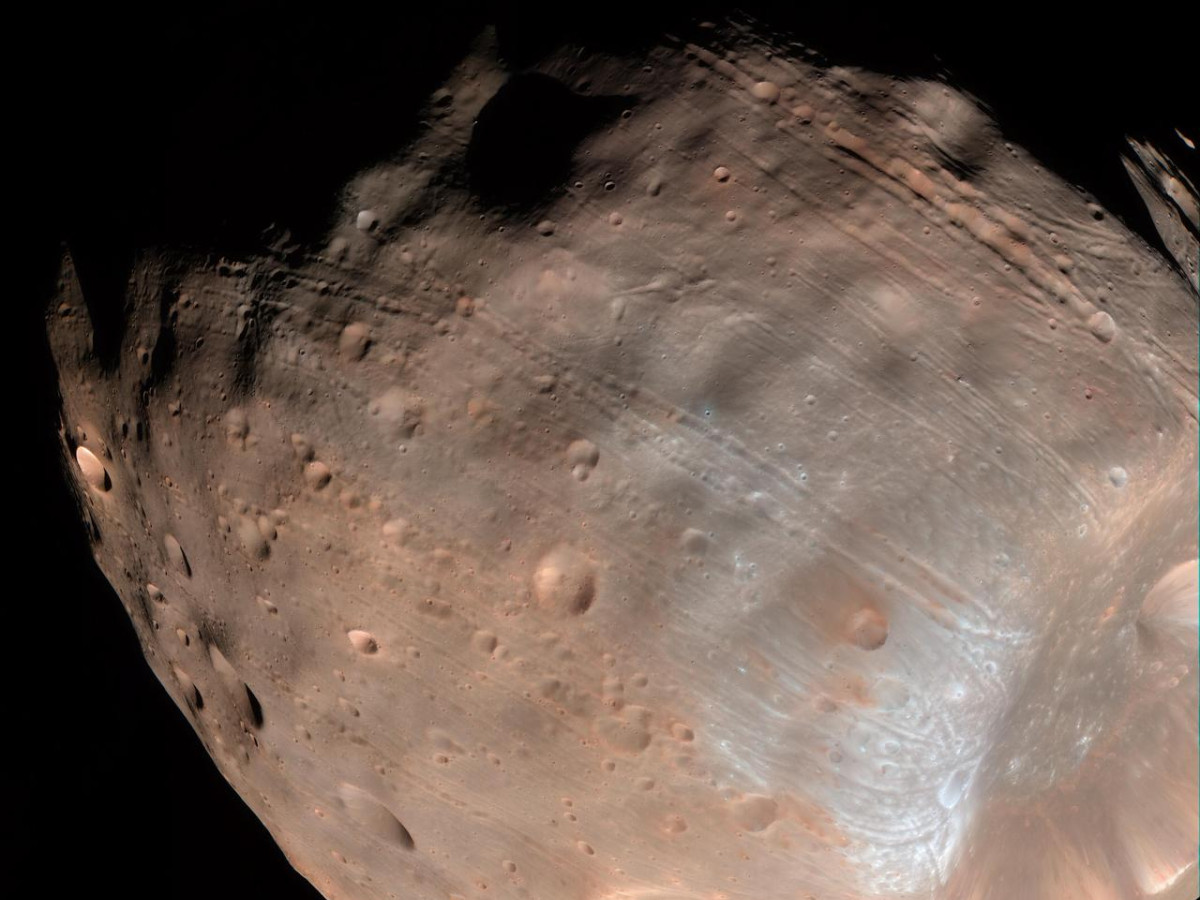
JAXA, the Japanese space agency, has launched its Martian Moons eXploration mission, MMX for short, in a bid to bring back a sample from one of Mars’s moons to Earth. The spacecraft will target the larger of Mars’ two moons, that’s Phobos, while also making a series of flybys of its other moon, Deimos. If successful, it’ll be the first time a sample has been brought back from any moon in the solar system other than our own. A good friend of the programme has been heavily involved in the project, and she joined Chris Smith from Japan…
Sara – Hi, I’m Sara Russell. I’m a planetary scientist at the Natural History Museum in London.
Chris – But you’re not in London. Where are you?
Sara – No, I am in Yakushima, which is an island in southern Japan, a lovely tropical island with monkeys in it, but that’s not why I’m here.
Chris – Why are you there?
Sara – So I’m here because me and the rest of the team involved came to watch the launch of a space mission called MMX or Mars Moon Explorer, which is a Japanese mission and it’s heading to the moons of Mars. So Mars has got two small moons, Phobos and Deimos. This mission is going to go there and pick a piece of Phobos off the surface and bring it back to Earth for us to study.
Chris – Where did it launch from and when?
Sara – So it launched from the neighbouring island called Tanegashima and it launched at 4.40 in the morning our time on the 20th of October. So it was just an amazing thing to watch. It was just incredible. So the whole science team were standing outside just in a car park, beautiful, clear, very, very, very dark night, no moon. And then suddenly the whole sky lit up as the rocket launched from the neighbouring island. It was just absolutely amazing.
Chris – What’s the nature of it? Is it a launch vehicle with then the probe that will go to the moons or is the whole thing going and coming back? Just talk us through how this is going to work practically.
Sara – The whole rocket doesn’t go to the moon, and in fact, the spacecraft itself has already separated from the rocket. And so it’s just a relatively small spacecraft is going to head by itself to the Mars moons. When it gets a piece of Phobos, it’s going to collect a little bit and bring it back to Earth. The capsule that comes back to Earth at the end of all this is very small. It’s only, I don’t know, the size of a saucepan or something like that.
Chris – Because you have form in this area, don’t you? Because you’ve got a bit of an asteroid that you’ve got sitting in your lab at the Natural History Museum. That’s Bennu. And that’s a sample and retrieve mission. So is it similar? You’re building on the learning basically for how you did that to do this mission to Mars.
Sara – There’s actually been three asteroid sample return missions so far. So one was OSIRIS-REx that went to asteroid Bennu, which was an American mission. And there were two Japanese ones before that called Hayabusa and Hayabusa 2, which went to two different asteroids. And so this mission is really kind of building on the heritage of those. It will be Japan’s biggest sample return mission, and it’s super exciting because at the moment we have no idea how the moons of Mars got to be there. So there’s an idea that it might be a captured asteroid. So when it comes back, it might look a lot like Bennu, which we’re so familiar with already. Or it might have formed by a collision when something hit the surface of early Mars and the material that sprayed out then went to form the moons. So once we have the sample back in our labs, we’ll definitely be able to say how it formed and solved this big mystery.
Chris – Why is this a priority, understanding this?
Sara – Well, it really has implications for understanding the Solar System as a whole. So there aren’t very many moons in the inner solar system. There’s only three of them, one being our moon and the other two being around Mars. And so the fact that we don’t really understand Mars’ moons is a poor show so far. So I think if we understand this, we’ll understand better how material travels through the solar system, whether it’s easy for asteroids to wander into the inner solar system and get captured, whether impacts are really important for forming moons. And ultimately, that will help us understand not only our own solar system, but then we can apply that knowledge to all the exoplanetary systems that we’re discovering now, and we can make predictions about what we expect those systems to look like and whether we may eventually see evidence for exo-moons.
Chris – Phobos and Deimos are really small, aren’t they? Because our moon is, relative to our planet, very big, but we think that’s because something smashed into us early in Earth’s history and maybe put the moon there. Is that why you think it’s tempting to speculate Phobos and Deimos might be captured asteroids, because they’re very small?
Sara – They actually look, from the data that we have so far, they look a lot like asteroids. They’ve got the same shape and the same sort of colour and spectral features that we expect from asteroids. So they look a lot like asteroids, but they circle Mars almost in a very circular orbit and right on the equator, and you would expect if it was a captured asteroid that the orbit might be a bit wobbly or eccentric, or you wouldn’t expect it to be quite so perfect, and that’s more easily explained by the alternative impact model.
Chris – So now you have a tantalising wait to see. How long have you got to wait? What’s the timeline on the mission, getting there, getting back, etc?
Sara – Yes. So it will reach the Mars neighbourhood next year in August 2027. And then it will do a lot of work observing both Phobos and Deimos and Mars, because it’s also going to be very close to Mars as well, before collecting the sample.
And it comes back to Earth in 2031. So we’ve got a five-year wait before we find out what it looks like.
Chris – Really fast going out, about 9-10 months. That’s about average, isn’t it? Why so long coming back?
Sara – Oh, well, it’s not that the journey itself is long, but it’s going to do a lot of work, make a lot of observations and map the whole Moon before deciding where to collect the sample from. And as well as doing the sample collection, there’s also a little rover that’s going to be deployed onto the surface, and that’s going to scoot around and also get some data as well. So to do all of these things just takes time.
Chris – And how will the sample get back? Is it another one of these, it arrives in sort of Earth’s environs and then parachutes down? Is that how it’s going to happen? Like you did with the Bennu bits?
Sara – Exactly. Yes, yes. And so this is something that humanity has got quite a lot of experience with now. So for the Japanese missions, it parachutes down over the Australian desert. So that’s where it will land and get picked up from.