
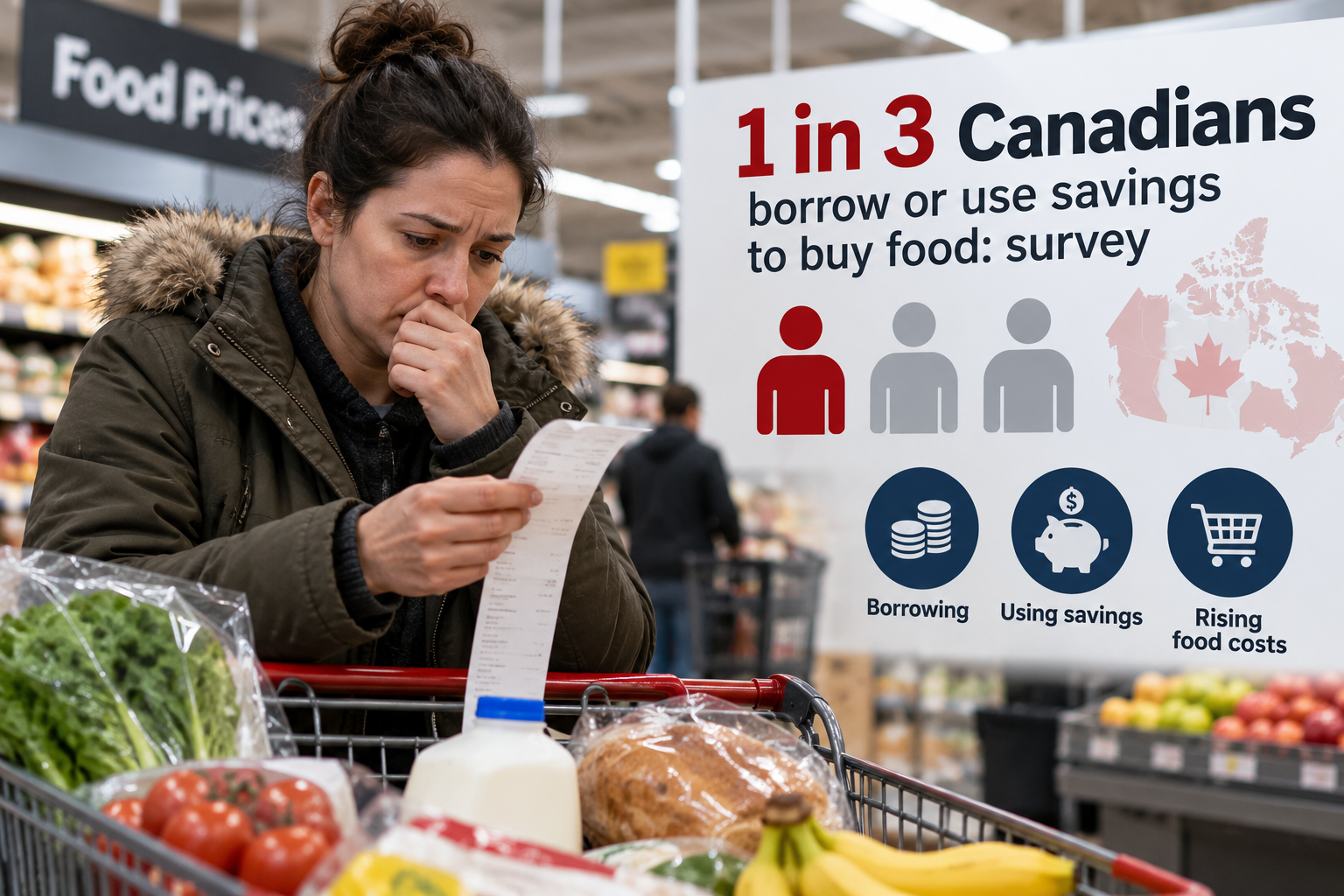
A survey of about 3,000 people reveals that 32% face difficulties in financing their food purchases, with Ontario recording 34%, while transportation costs are becoming an increasing burden o
Ottawa – October 23, 2026
A new Canadian survey revealed that about one-third of participants are now relying on their savings or resorting to borrowing to cover food costs, indicating the continued financial pressures facing households, despite the slowdown in the rate of food price increases in recent months.
The report of the «Canadian Food Sentiment Index», issued by the Agricultural Food Analytics Lab at Dalhousie University, showed that 32% of participants used their savings or borrowed money to buy food, an increase of four percentage points compared to the same period last year.
The survey included 2,998 people from across Canada and was conducted from September 11 to 17, 2026, in cooperation with Caddle Insights, to monitor the impact of rising living costs on consumer behavior and their ability to afford food expenses.
Ontario among the most affected provinces
Saskatchewan recorded the highest percentage of participants who reported using savings or borrowing to cover their food purchases, at 36%, followed by Alberta at 35%, then Ontario at 34%.
Conversely, the percentage was 24% in Nova Scotia, and 14% in Prince Edward Island, with researchers warning to handle the results of the latter province cautiously due to the small sample size there.
The results showed that food prices remain the primary source of financial concern for Canadians, as 76.7% of participants pointed to them as one of the main expenses becoming more difficult.
However, transportation costs emerged as an increasing source of pressure, with the percentage of those who consider it one of the fastest rising expenses rising to 41.2%, compared to 20.2% just six months ago.
79.2% of participants reported that their transportation expenses increased over the past year, adding a new burden to the cost of purchasing food and accessing stores.
Consumers are tired of searching for savings
The survey also revealed that several methods Canadians used to reduce their food expenses have become less common compared to two years ago.
The percentage of users of discount coupons dropped from 30.5% to 20.3%, while the percentage of shoppers looking for lower-priced stores decreased from 24.9% to 21%.
Nevertheless, searching for deals and discounts remains the most common way to save money, relied upon by 45.5% of participants.

Researcher Stacey Taylor, assistant professor at the Telfer School of Management at the University of Ottawa, said Canadians have spent years adjusting shopping habits to extend their purchasing power, but the decline in the use of some saving methods may indicate a growing sense of fatigue, especially with rising transportation costs and the time needed to find the best prices.
Conversely, buying products with store private labels has become a more entrenched habit among consumers, in an attempt to obtain less costly alternatives.
Inflation slows but prices remain high
The results showed a clear gap between actual inflation rates and consumers’ perception of rising prices.
While the official inflation rate for food in stores reached 2.8% in August, the reference month used in the report, participants estimated the average price increase over the past year at about 7.9%.
53% of them believed that food prices rose by at least 8%, while 25.1% expected increases exceeding 10% in the coming year.
Researchers see this gap as reflecting the impact of accumulated increases over previous years, as a decline in the inflation rate does not mean prices have fallen or returned to their old levels.
Assistant professor at Dalhousie University, Arman Ozbilge, said consumers still feel the burdens resulting from years of rising prices, and that increasing energy and transportation costs make affordability the key factor in their food choices.
As an additional indicator of changing spending, the estimated average monthly food expenditure in the survey rose to $521, compared to $497 in spring 2025.
Despite a slight decrease in monthly grocery spending from $412 to $409 over the last six months, spending on restaurants and ready meals increased by 3.8%.
Sylvain Charlebois, senior director of the Agricultural Food Analytics Lab at Dalhousie University, considered the results to carry worrying indicators about households’ ability to face financial pressures, noting that the increasing reliance on savings and credit to provide food reflects a decline in financial flexibility among a segment of consumers.
The report indicates that the problem of affordability is no longer related to food prices alone, but has become affected by the overlap of transportation, energy, and daily needs expenses, at a time when some consumers have exhausted much of the available means to reduce their spending.