
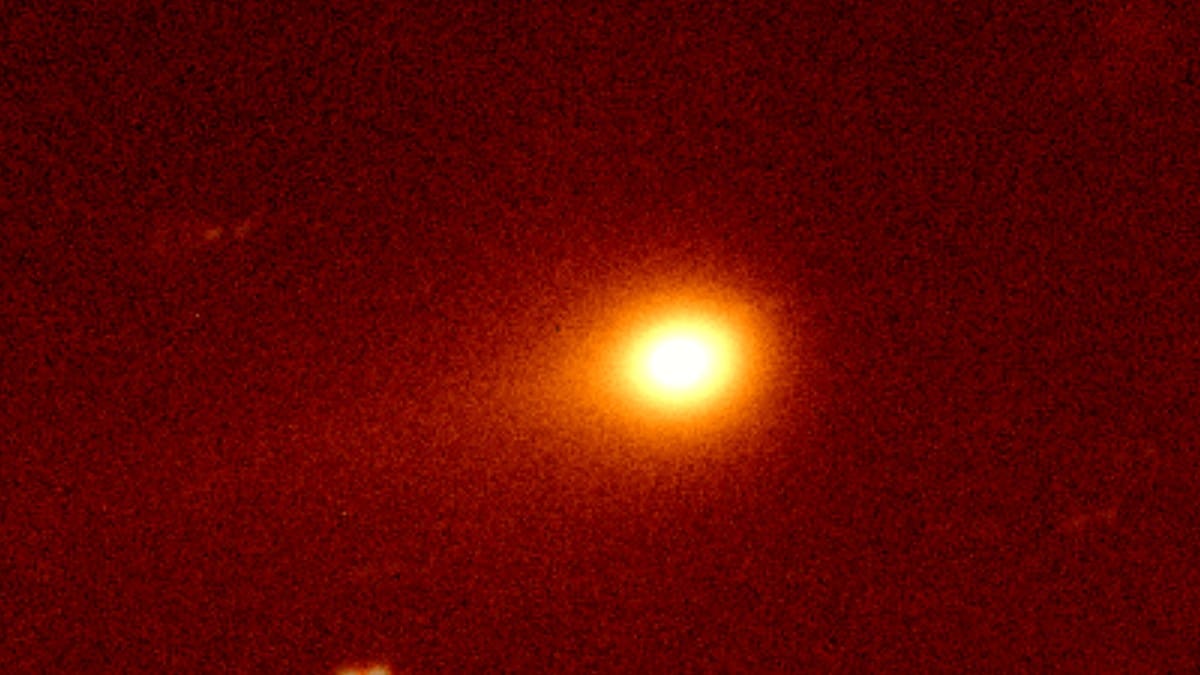
Spectroscopy can reveal which gases and refractory species leave a comet, but those measurements do not by themselves show how far below the original surface the released material originated. Tessa T. Frincke and Darryl Z. Seligman of Michigan State University addressed that problem by compiling reported production rates from 3I/ATLAS before and after perihelion and converting the accumulated mass loss into an estimated change in nucleus radius. Their framework connects compositional measurements with a physical depth inside an interstellar comet.
The distinction is important because 3I/ATLAS is material from another planetary system that has also experienced a long history of alteration. Astronomers want its chemistry to constrain conditions outside the Solar System, but material released into the coma — the cloud of gas and dust surrounding an active comet — can come from layers modified during interstellar travel as well as from deeper material. Earlier research concluded that galactic cosmic rays can chemically and structurally process approximately the outer 15–20 m (49–66 feet) of 3I/ATLAS, making the depth reached by solar-driven erosion central to interpreting what its spectrum represents.
Frincke and Seligman calculate that gas production alone corresponds to removal of approximately 1.71–5.24 m (5.6–17.2 feet) of the comet’s surface during its Solar-System passage. In their model, that represents about 1010 kg of material, equivalent to approximately 0.40–1.25% of the comet’s modeled initial mass. When they include dust-to-gas ratios from 1 to 4, the estimated erosion exceeds 10 m (33 feet).
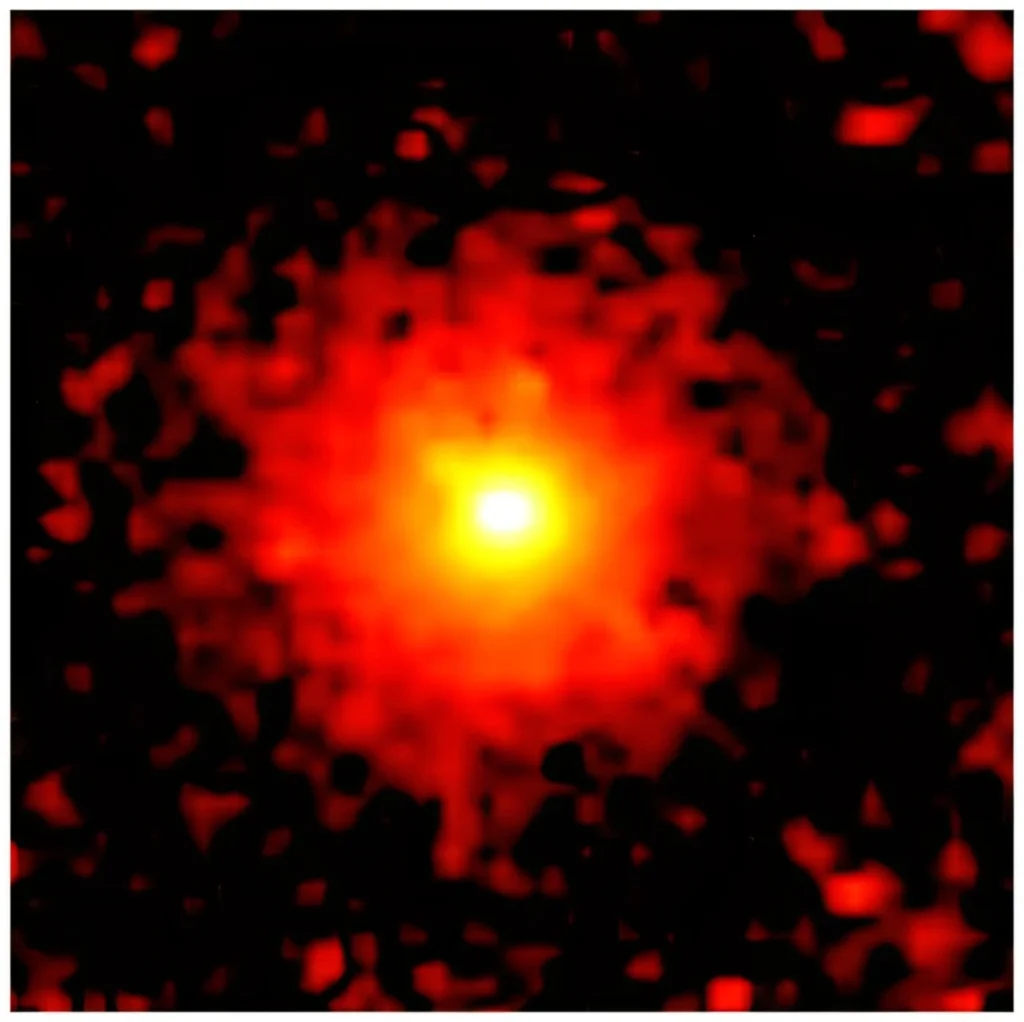 SPHEREx Comet 3I ATLAS. Credit: NASA/SPHEREx
Those depths are calculated rather than directly observed excavation depths. Solar heating causes volatile ices near a comet’s surface to sublimate — change directly from solid ice into gas — and the escaping material can carry dust away with it. Frincke and Seligman use the measured production of volatile and refractory material to estimate the accumulated mass removed and express that loss as a change in radius. The calculation therefore provides an equivalent depth scale; it does not show that every part of the irregular, active nucleus lost exactly the same thickness.
The researchers produced conservative and optimistic estimates because observations did not continuously track every material component along the comet’s trajectory. Their conservative intervals begin where activity was reported observationally, while their optimistic intervals use the typical heliocentric distance at which each species begins to sublimate. The authors describe the resulting erosion estimates as approximations and lower limits because the underlying measurements are discontinuous and were obtained with different instruments and methodologies.
The new calculation can be compared with a separate line of research into radiation processing. Romain Maggiolo and colleagues modeled the effect of galactic cosmic rays on 3I/ATLAS and concluded that sustained irradiation could alter ice chemistry and physical structure through roughly the outer 15–20 m (49–66 feet). Their model combines radiation-transport calculations with laboratory results for irradiated ice mixtures and identifies that depth as a processed layer rather than a directly observed boundary inside the comet.
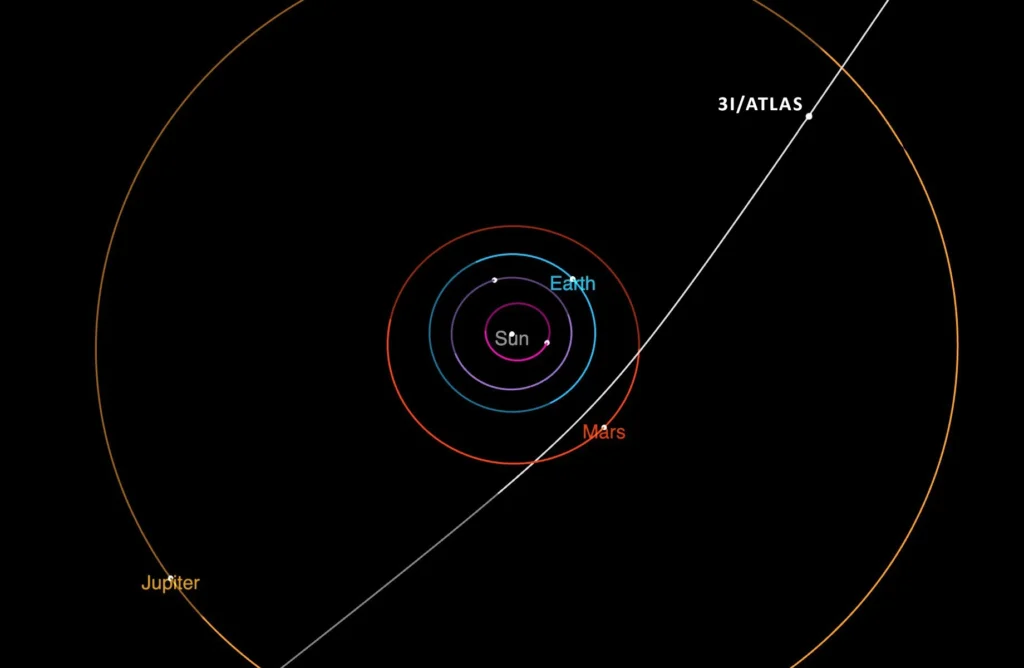 This diagram shows the trajectory of interstellar comet 3I/ATLAS as it passed through the solar system. Credit: NASA
Gas-only erosion in the Frincke and Seligman calculation remains below that modeled 15–20 m processed-zone scale. Including dust raises the erosion estimate above 10 m (33 feet), but the accepted manuscript does not provide a verified upper limit in its accessible text or demonstrate that erosion reached beyond the cosmic-ray-processed layer. The two studies therefore constrain the same physical question from different directions without establishing that observers sampled a pristine interior.
That distinction affects how compositional measurements are interpreted. NASA’s James Webb Space Telescope used NIRSpec to map water, carbon dioxide and carbon monoxide in 3I/ATLAS and subsequently measured isotope ratios that researchers used to investigate the comet’s formation environment. Such measurements provide information about material originating outside the Solar System, but establishing the depth from which that material escaped helps separate formation signatures from chemical alteration accumulated later in the comet’s history.
3I/ATLAS is the third known object confirmed to have entered the Solar System from interstellar space. Its hyperbolic trajectory shows that it is not gravitationally bound to the Sun. The NASA-funded ATLAS survey telescope in Chile first reported it on July 1, 2025, and NASA says the comet passed perihelion around October 30, 2025, at about 1.4 AU, or 210 million km (130 million miles), from the Sun. It posed no impact threat to Earth.
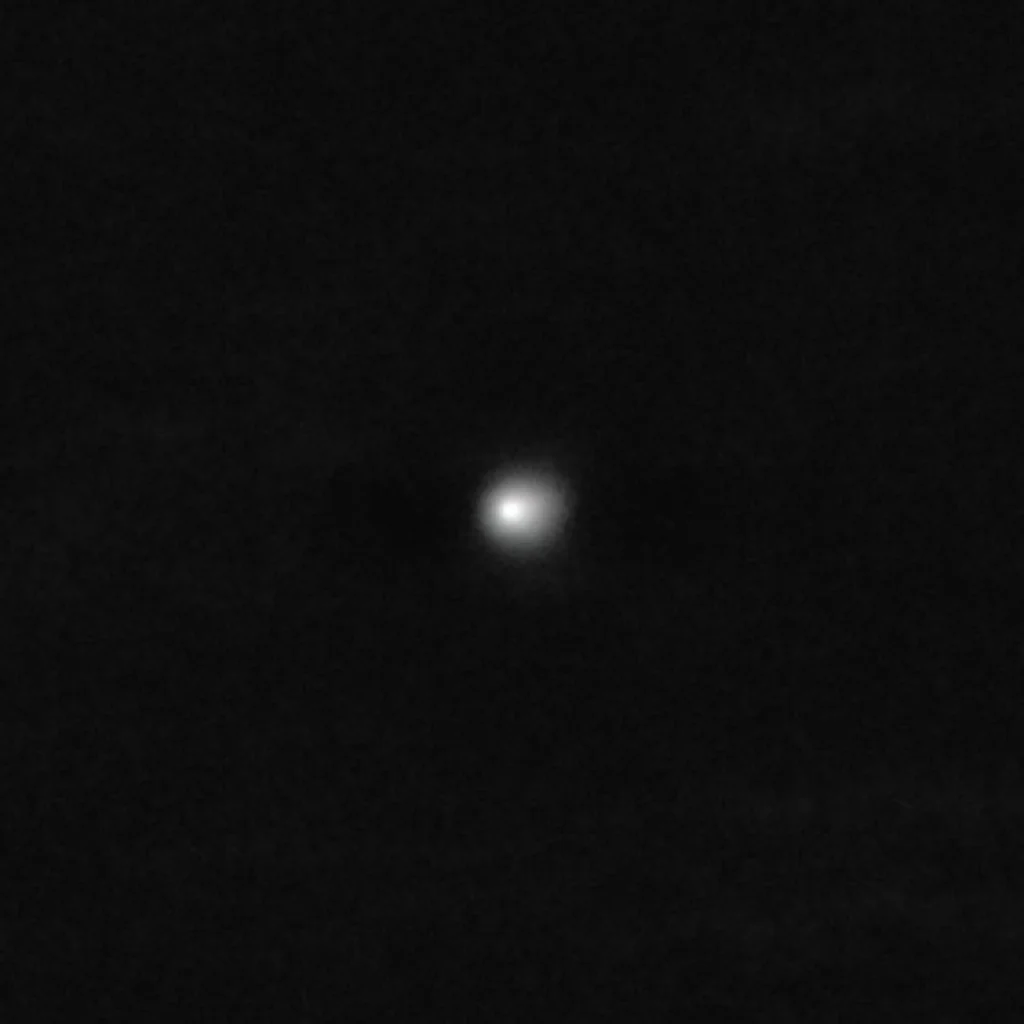 ESO’s Very Large Telescope (VLT) has obtained new images of 3IATLAS, an interstellar object discovered last week. Credit: ESO
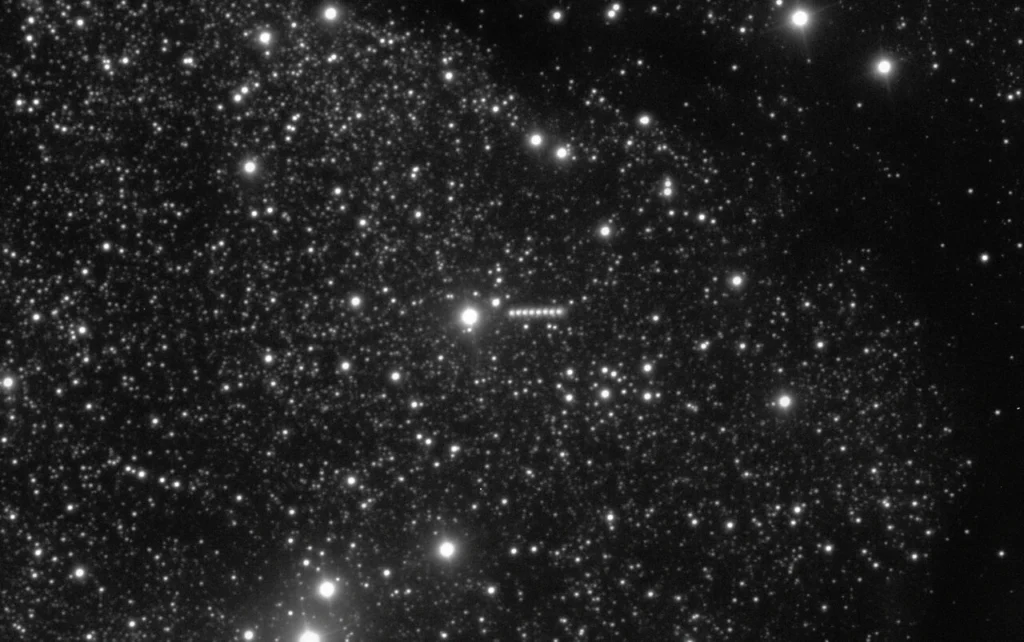 ESO’s Very Large Telescope (VLT) has obtained new images of 3IATLAS, an interstellar object discovered last week. Credit: ESO
Frincke and Seligman’s framework is not limited to 3I/ATLAS. The authors designed it to calculate radius changes for small bodies undergoing mass loss on arbitrary trajectories, while their machine-readable compilation brings together the reported volatile and refractory production rates for this comet. Future observations of interstellar objects could use the same approach to connect changing production rates with the physical layers exposed as solar heating removes material.
A central uncertainty remains: an erosion depth is not the same as proof that primordial material has been uncovered. Determining whether any spectrum of 3I/ATLAS sampled material shielded from long-term radiation processing requires both better constraints on how much mass was removed and a reliable estimate of how deeply that processing penetrated. The new work supplies one of those constraints by turning the comet’s observed material loss into a physical depth that can be tested against compositional changes along its trajectory.
References:
1 Frincke, T. T., & Seligman, D. Z. (2026). Assessment of the mass loss and radius change of 3I/ATLAS based on observed production rates. Monthly Notices of the Royal Astronomical Society, stag1941. https://doi.org/10.1093/mnras/stag1941
2 Maggiolo, R., Dhooghe, F., Gronoff, G. P., De Keyser, J., & Cessateur, G. (2026). Interstellar comet 3I/ATLAS: Evidence for galactic cosmic-ray processing. The Astrophysical Journal Letters, 996(2), L34. https://doi.org/10.3847/2041-8213/ae2fff