
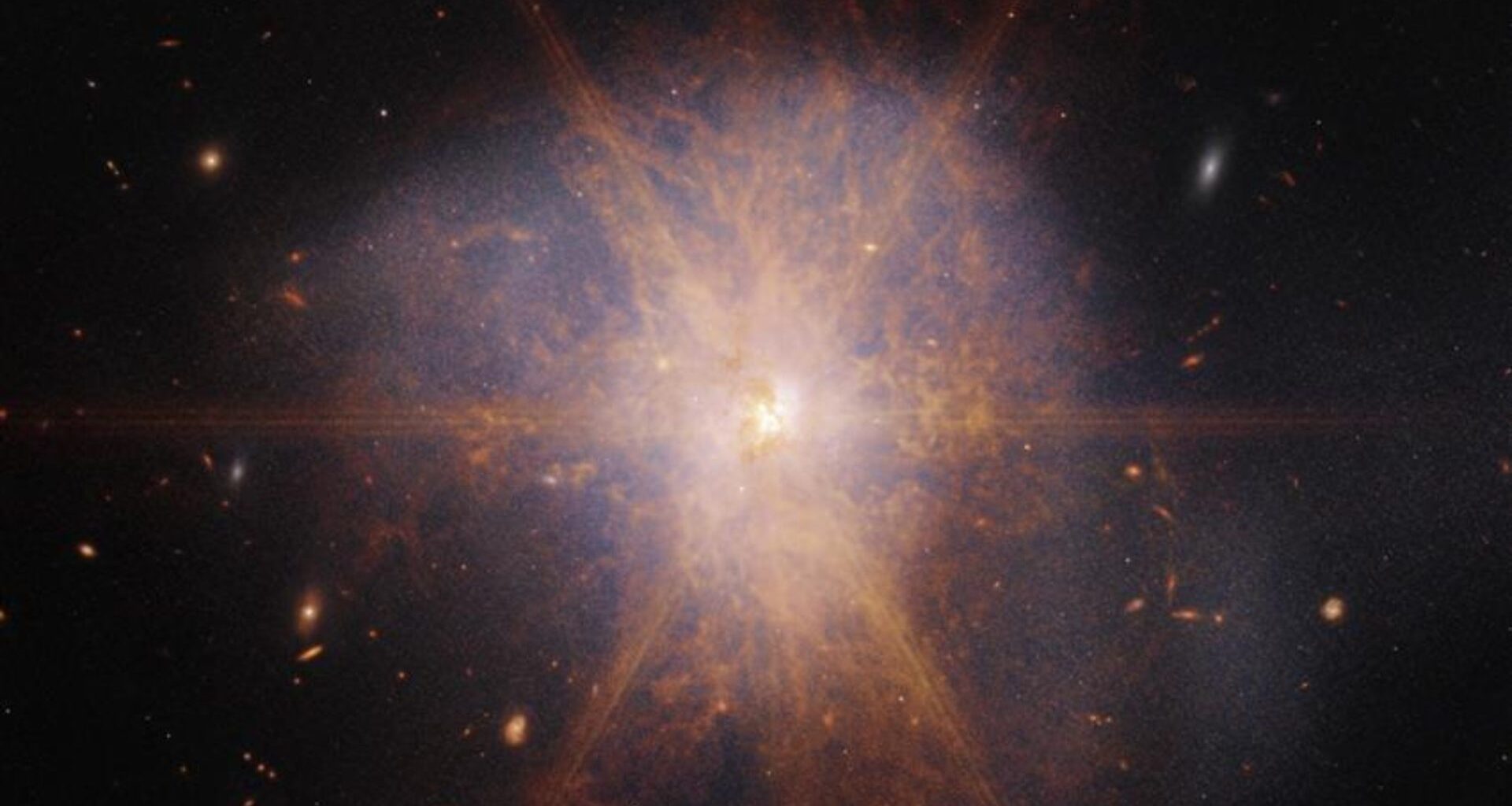
Arp 220 is one of the brightest infrared galaxies in the nearby universe, with intense star formation fueled by a collision that began 700 million years ago.
From a distance, Arp 220 looks like a single galaxy with a brilliant center and enormous clouds of glowing material spreading into space.
But the James Webb Space Telescope has revealed something far more complicated.
The object is actually two spiral galaxies in the process of merging, creating one of the brightest infrared galaxies in the nearby universe.
Located roughly 250 million light-years from Earth, Arp 220 offers astronomers a remarkable opportunity to study what happens when galaxies collide, gas clouds compress, and new stars begin forming at extraordinary rates.
A collision 700 million years in the making
The story of Arp 220 began about 700 million years ago, when two spiral galaxies started colliding.
Their enormous gravitational forces pulled at each other’s stars, gas, and dust, gradually transforming both galaxies.
Unlike a collision between solid objects, a galactic merger unfolds over hundreds of millions of years.
Individual stars are so widely separated that direct collisions between them are extremely unlikely.
Instead, gravity reshapes the galaxies, changing the paths of stars and drawing enormous quantities of gas toward their centers.
In Arp 220, that process triggered an intense period of star formation. The merger has become a natural laboratory for understanding how galaxies grow and change.
Although the two galaxies appear to form a single object in Webb’s image, their original cores remain distinguishable.
Earlier observations by NASA’s Hubble Space Telescope revealed that these centers are separated by approximately 1,200 light-years. Each contains a rotating ring where stars are forming.
A galaxy brighter than a trillion suns
Arp 220 belongs to a rare category known as ultraluminous infrared galaxies. These objects release enormous amounts of energy, much of it at infrared wavelengths.
According to NASA, Arp 220 shines with the luminosity of more than one trillion suns. By comparison, the Milky Way has a total luminosity of roughly 10 billion suns.
Much of Arp 220’s extraordinary infrared brightness comes from dust absorbing energy produced by intense activity within the merging galaxies and radiating that energy at longer wavelengths.
The region surrounding the galactic centers is especially remarkable.
Approximately 200 massive star clusters occupy a dusty area measuring just 5,000 light-years across. That is only about five percent of the Milky Way’s diameter.
Yet this relatively small region contains roughly as much gas as the entire Milky Way.
Webb reveals the hidden structure
Dust presents a major challenge when astronomers study galaxies. Thick clouds can block visible light, concealing stars and other structures.
Infrared observations help researchers investigate regions that would otherwise remain difficult to see.
For this image, Webb combined observations from its Near-Infrared Camera (NIRCam) and Mid-Infrared Instrument (MIRI).
Together, these instruments reveal different aspects of Arp 220, including its bright central regions and the material extending outward from the merger.
The brilliant spikes radiating from the center are especially noticeable. They are diffraction spikes, an optical effect produced when intense light interacts with the telescope’s structure.
The reddish-orange streams and filaments trace material associated with the galaxies, including carbon-rich organic molecules.
Meanwhile, faint blue structures near the outskirts reveal tidal tails, streams of material pulled away by the gravitational forces of the merger.
These features help astronomers reconstruct how the two galaxies have interacted over time.
The remains of exploding stars
The intense star formation in Arp 220 also means that massive stars can reach the ends of their lives in a relatively short astronomical time.
Some explode as supernovae, releasing tremendous energy and scattering newly formed elements into surrounding space.
Radio telescope observations have identified approximately 100 supernova remnants within a region less than 500 light-years across.
That concentration provides further evidence of the extraordinary stellar activity occurring near the galactic centers.
Supernovae also influence their surroundings. Their expanding shock waves can heat gas, redistribute material, and affect the formation of subsequent generations of stars.
In a crowded environment like Arp 220, these processes take place alongside the gravitational forces driving the merger.
Why astronomers study merging galaxies
Galactic mergers are an important part of cosmic evolution.
Over billions of years, interactions between galaxies can alter their shapes, change their star formation rates, and influence the growth of the supermassive black holes at their centers.
Arp 220 is particularly valuable because it is relatively nearby by cosmic standards.
Its distance of 250 million light-years places it in the constellation Serpens, the Serpent. It is the closest known ultraluminous infrared galaxy.
Its name comes from astronomer Halton Arp’s Atlas of Peculiar Galaxies, a catalog of unusual-looking galaxies and interacting systems.
The object appears as entry number 220, reflecting its distinctive structure and history.
By comparing observations from Webb, Hubble, and radio telescopes, scientists can investigate different layers of this complex system.
Each wavelength reveals information that the others cannot, helping researchers build a more complete picture of the collision.
A glimpse into the future of galaxies
The image of Arp 220 captures a transformation that is still unfolding.
Two galaxies that once existed separately are gradually becoming one, while their combined gas supplies fuel intense star formation.
Over time, that activity will change as the available gas is consumed, dispersed, or redistributed.
Our own Milky Way has also experienced galactic interactions throughout its history, and encounters between galaxies continue to shape the universe today.
Arp 220 shows just how dramatic those changes can become.
What appears in Webb’s image as a single brilliant object is actually the result of hundreds of millions of years of gravitational interaction, stellar birth, and destruction.
Image Credit: NASA/ESA/CSA/STScI
—–
Like what you read? Subscribe to our newsletter for engaging articles, exclusive content, and the latest updates.
Check us out on EarthSnap, a free app brought to you by Eric Ralls and Earth.com.
—–