

In 1956, an unconventional Irish-born philosopher staged a one-woman protest against the then US president, opposing plans by her university to award the man – whom she believed to be a mass murderer – an honorary degree.
The philosopher was Elizabeth Anscombe, the president Harry Truman, and the charge against him: the intentional killing of civilians in Hiroshima and Nagasaki in Japan.
Anscombe’s stance at the University of Oxford 70 years ago challenged a general consensus among western political leaders that using nuclear weapons to end the second World War was justified. She set out her thinking in a pamphlet still referenced today in moral philosophy: Mr Truman’s Degree.
“Choosing to kill the innocent as a means to your ends is always murder,” she wrote.
Anscombe wasn’t a pacifist. Killing innocent civilians “is not necessarily murder”, she said, “even if you know as a matter of statistic certainty” that such deaths will take place as a downstream effect of military force. What qualifies as murder is the intent to kill innocent people.
While Truman might argue the nuclear attack hastened the end of war and spared further loss of life in combat, there is no escaping the fact that the US set out to kill men, women and children indiscriminately. It is estimated that between 120,000 people and double that number ultimately perished.
Anscombe’s essay is highly relevant to modern discussions on the limits of legitimate military action. And it came to mind after watching NAZA, a chilling and impactful documentary on the Israel Defense Forces’ (IDF) bombing campaign in Gaza that began after the Hamas terror attack of October 7th, 2023. The film comprises interviews with 24 anonymised soldiers and intelligence personnel exploring the IDF’s policy on “collateral damage”, or NAZA as it’s known militarily (short for nezek agavi in Hebrew).
Shocking claims are made that the IDF uses artificial intelligence (AI) to help select targets, using crude formulae to decide how many civilian casualties are permitted in each airstrike. Some interviewees testify that “20 NAZA” – killing 20 civilians in order to target one suspected Hamas member – is routinely allowed. One veteran claims a strike endangering 500 civilians was approved to target a single Hamas member. The IDF denies this and other allegations in the film, while Israeli prime minister Binyamin Netanyahu has branded NAZA’s Israeli directors as enemies of the state.
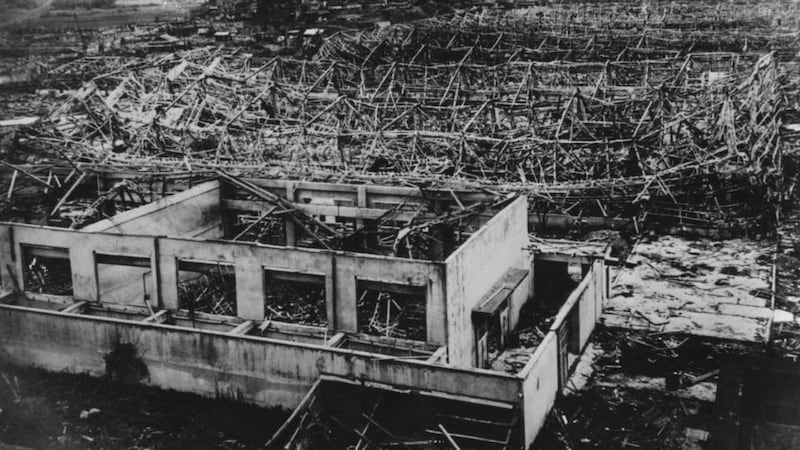 Hiroshima after the dropping of the atomic bomb in the second World War. Photograph: Keystone/Getty Images
The documentary strengthens the case for hauling Netanyahu before a war crimes tribunal. But, strangely, it may weaken the case for describing what has been happening in Gaza as genocide by the strictest, legal definition of that word. Under international law, to constitute genocide there must be “proven intent” to exterminate a specific population. However, none of those interviewed testified to deliberately trying to kill civilians.
If they are representative of IDF thinking then it suggests what lies at the heart of the Israeli war machine is not so much murderous intent as callousness, inhumanity and a sickening indifference to the scale of Palestinian suffering.
[ Naza: Why Israel doesn’t want the world to see this movieOpens in new window ]
Some will recoil at this line of thinking, and it feels distasteful to be mulling over the meaning of words when more than 74,000 people in Gaza lie dead, according to local estimates. However, Anscombe insisted on clearly defined moral concepts, without which, she believed, ethical reasoning would collapse altogether.
Anscombe was born in Limerick on March 18th, 1919. Her father was a captain in the British army posted to Munster during the War of Independence so the family didn’t stick around Ireland long. In academic stints at Cambridge and Oxford, she established herself as one of the greatest moral philosophers of her generation and became a close confidante of Ludwig Wittgenstein. The two endlessly discussed the limits of morality and linguistics – and when Wittgenstein moved to Dublin in 1948 to recuperate from illness, Anscombe joined him for a fortnight in Ross’s Hotel (now the Ashling Hotel) on Parkgate Street where he had lodgings.
Anscombe, who was Catholic, continued to work on the idea of intention for decades. Establishing intent is far from straightforward, and it is beyond the scope of this column to settle the argument in the case of Israel. At least one IDF insider interviewed for NAZA supported the argument that Israel’s actions amounted to genocide. And there are numerous examples of innocent civilians being killed by the IDF as a means to an end (for example, the end of creating a security buffer zone) – which is the definition of murder in Anscombe’s book.
Crucially, Anscombe emphasised that evil impacted on your character irrespective of its wider consequences. Truman could not escape the fact that he was a murderer – and he had to live with that knowledge, Anscombe insisted – no matter how he tried to justify his actions.
A striking aspect of NAZA was how many of the interviewees were struggling to marry an instinctive loyalty to Israel with an awareness of the nature of their actions. It was like watching in real time what psychologists call cognitive dissonance – the mental discomfort that comes from holding two incompatible beliefs.
Tellingly, one contributor said it was better that AI selected the targets in Gaza since it would be difficult for him, or any other human, to sanction them.
There is horror in that realisation, but also hope.
The hope is that a moral conscience lost in midst of war can yet be found.