 This image combines many exposures of different durations taken to reveal aspects of the widely-viewed total solar eclipse of 21 August 2017, which was visible from the United States. Image credits: EOS.
On July 17, 709 BCE, the Sun vanished over an ancient Chinese capital. Someone recorded the extraordinary event, preserving a brief account that would survive for more than 2,700 years.
Now, that ancient observation is helping scientists reconstruct how fast Earth rotated thousands of years ago. By combining historical texts, archaeology, and modern astronomical calculations, an international research team has resolved a long-standing discrepancy in the eclipse’s location. Their work also offers a tantalizing glimpse of what the Sun itself looked like in antiquity.
An eclipse that shouldn’t have happened
The record comes from the Chunqiu, or Spring and Autumn Annals, an ancient Chinese chronicle traditionally associated with Confucius. It contains 37 reports of solar eclipses, three of which explicitly describe totality.
The earliest is from 709 BCE, making it the oldest known datable written account that explicitly identifies a total solar eclipse.
The text is straightforward: “In fall, in the seventh month, on the rénchén day, the first day of the month, the Sun was totally eclipsed.”
But there was a problem.
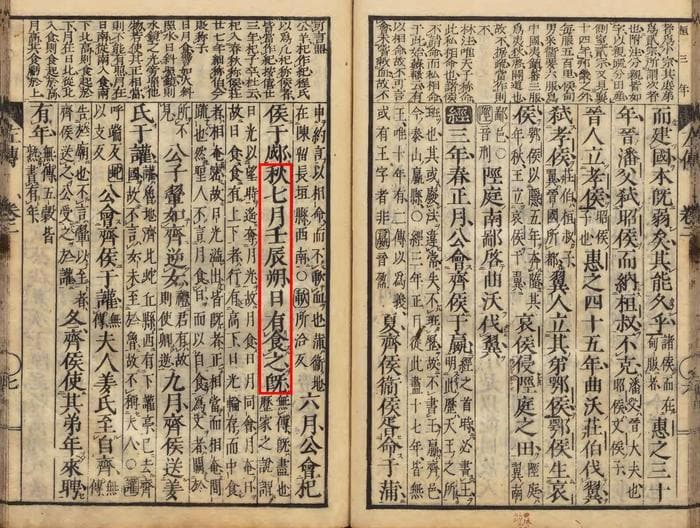 Ancient Chinese text from the Spring and Autumn Annals that contains humanity’s earliest datable written record of a total solar eclipse from 709 BCE. The text states “In autumn, in the seventh month, on the renchen day, the first day of the month, the Sun was totally eclipsed.” The term “renchen” refers to a specific day in the traditional Chinese 60-day calendar cycle. Image courtesy of the National Archives of Japan.
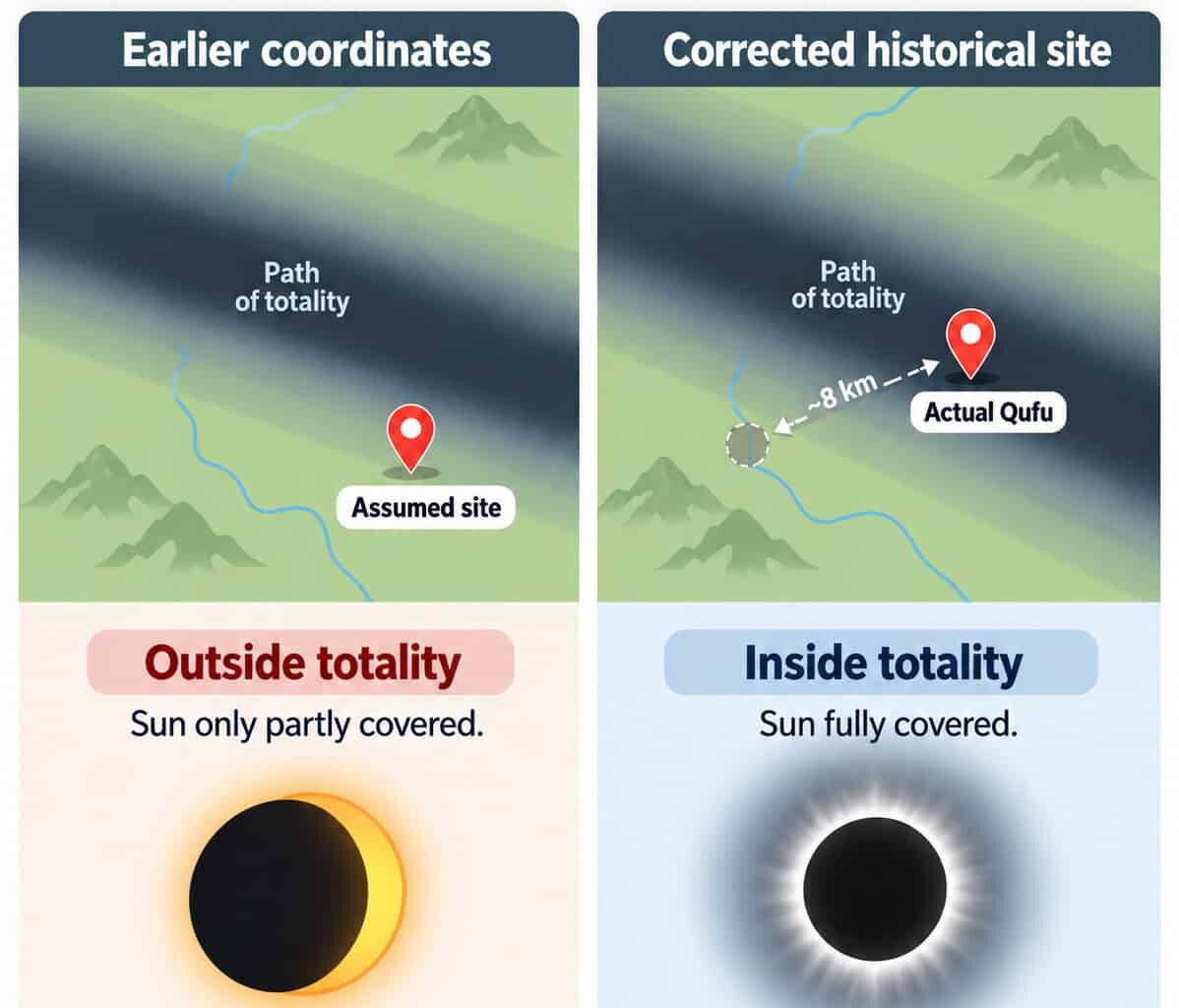
When researchers reconstructed the eclipse using modern astronomical models, something didn’t fit. The observation was made in the ancient capital of Qufu, the hometown of Confucius. But Qufu appears to lie outside the Moon’s path of totality. According to those calculations, the Sun would have remained partially visible.
So, why did these people report seeing a total eclipse?
×
Thank you! One more thing…
Please check your inbox and confirm your subscription.
An eight-kilometre clue
To get the answer, researchers focused on archaeology. Hisashi Hayakawa of Nagoya University and his colleagues revisited archaeological reports documenting the location of Qufu during the ancient state of Lu.
They discovered that earlier astronomical studies had used coordinates roughly eight kilometres away from the historical city’s actual location. As it turns out, that relatively small distance made all the difference.
During a total solar eclipse, the Moon casts a relatively narrow shadow across Earth’s surface. Moving an observation point by just a few kilometres can mean the difference between complete darkness and a partially obscured Sun.

Using the corrected coordinates, the researchers reassessed the eclipse and found that the ancient account could fit with a revised estimate of Earth’s rotation.
And that revealed something far more interesting than a misplaced city.
Earth’s clock is not constant
We tend to think of a day as an unchanging 24 hours. But Earth doesn’t rotate at a perfectly constant rate.
Over geological timescales, tidal interactions with the Moon gradually slow our planet’s spin. Other processes, including movements within Earth’s interior and changes in the distribution of water and ice, also affect its rotation. These variations are tiny on a human timescale. Over thousands of years, however, they accumulate.
During the Jurassic, around 200 million years ago, when dinosaurs roamed the Earth, a day lasted roughly 23 hours instead of today’s 24. That meant approximately 380–385 days in a year.
Of course, over human scales, the differences are much smaller, and that’s when events like eclipses become important. Astronomers can calculate where the Moon’s shadow would have fallen thousands of years ago. But those calculations depend on how Earth was rotating at the time. So basically, if you know where an eclipse was, you can calculate how the Earth was rotating at the time. With this eclipse, researchers were able to finesse records about Earth’s rotation at the time.
But that’s not the only interesting thing they found.
A strange yellow glow around the Sun
 Solar corona viewed by Proba-2. Image credits: NASA.
A later Chinese historical work, the Hanshu, describes the eclipsed Sun as appearing yellow above and below.
Scientists have long suspected that this passage might refer to the solar corona — the Sun’s outer atmosphere, normally hidden by its overwhelming brightness but visible during a total eclipse.
The researchers reconstructed the Sun’s orientation during the ancient event and compared the possible coronal structures with estimates of solar activity derived from radioactive carbon preserved in tree rings.
The two sources were broadly consistent. The eclipse occurred shortly after a peak in the Sun’s approximately 11-year activity cycle, when prominent coronal structures would have been plausible.
It’s hard to prove something like this, but it’s definitely plausible.
The study highlights an unusual partnership between history and astronomy.
Ancient Chinese observers weren’t trying to measure changes in Earth’s rotation or reconstruct solar magnetic activity. They were recording an extraordinary event, often interpreted through the politics and beliefs of their time.
Yet their records have become scientific evidence.
Nearly three millennia later, an eclipse that lasted only minutes is still helping researchers investigate two constantly changing worlds: the Earth beneath our feet and the Sun above our heads.
The study was published in The Astrophysical Journal Letters.