
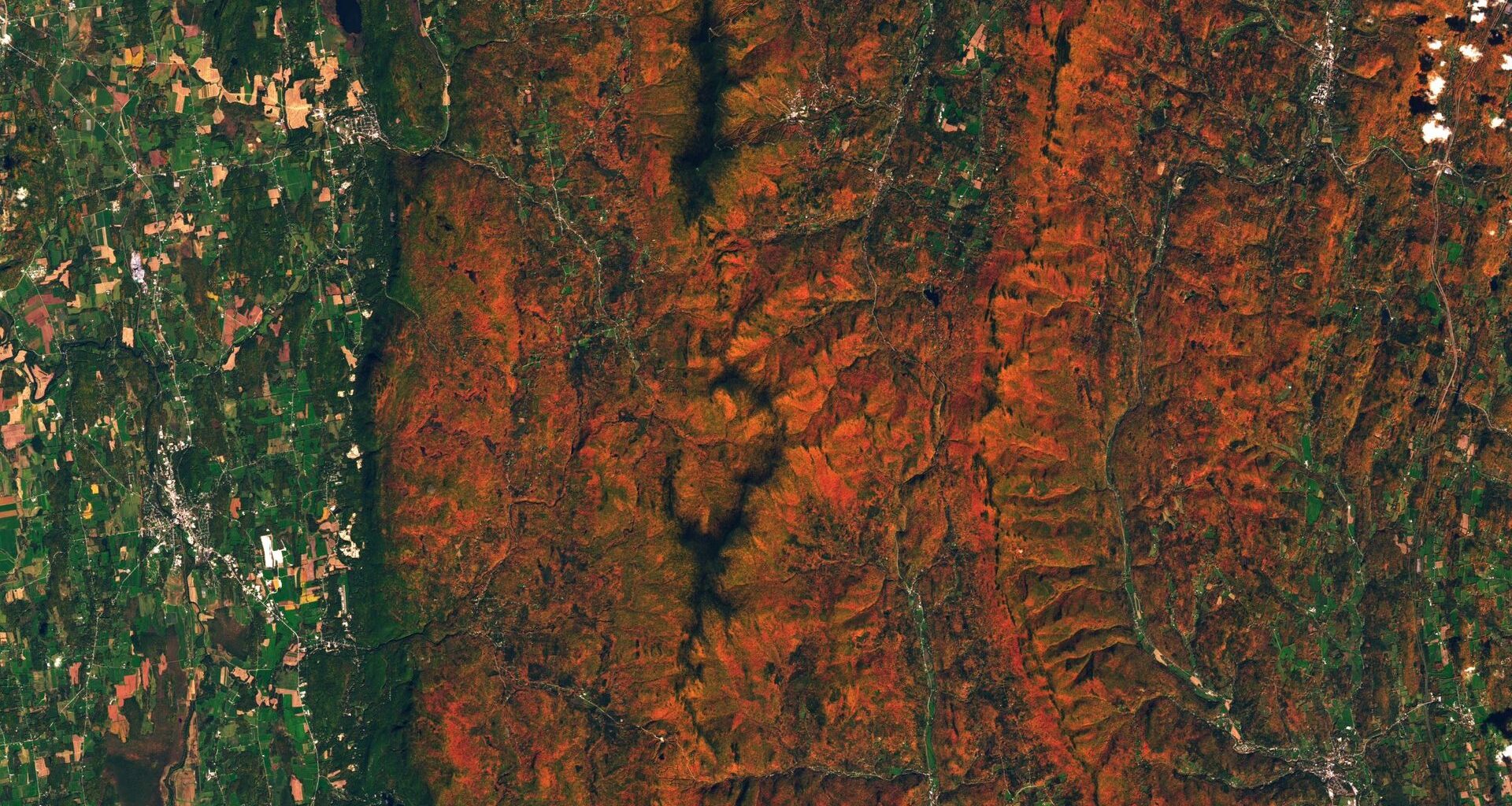
NASA satellites reveal how autumn foliage transforms landscapes across the Northern Hemisphere and how changing leaf colors may signal environmental stress.
Autumn arrives quietly at first. A few leaves turn yellow, patches of red appear among the trees, and then entire forests seem to change color almost overnight.
For centuries, people have traveled to witness this transformation. In Japan, the tradition of momijigari, or “red leaf hunting,” dates back more than a thousand years.
Today, NASA is giving autumn enthusiasts a remarkable new perspective.
A satellite orbiting Earth can track the changing colors of vegetation across entire continents, revealing how the season unfolds from north to south.
The observations are also helping scientists investigate what changing leaf colors reveal about plant health, climate, and the environment.
Watching autumn spread across Earth
NASA’s Plankton, Aerosol, Cloud, Ocean Ecosystem (PACE) satellite carries an instrument capable of detecting subtle differences in the light reflected by vegetation.
Called the Ocean Color Instrument (OCI), it measures light across 286 spectral bands, allowing scientists to distinguish between the pigments responsible for different leaf colors.
By comparing the amount of red and green detected in vegetation, researchers can identify where autumn colors are emerging, intensifying, or beginning to fade.
Satellite maps from late September and early October 2026 revealed particularly strong reds across northern Alaska, Canada, and Russia.
As October progressed, the changing colors spread farther south. In the United States, redness began fading in parts of New England and upstate New York while increasing across the Midwest and Mid-Atlantic.
The result is a sweeping picture of autumn moving across the Northern Hemisphere.
Why some forests turn bright red
Not every forest produces the same autumn display. The colors depend partly on which plants grow there and the pigments they contain.
In the northeastern United States, some of the most brilliant reds appear in regions dominated by maple trees.
New York’s Adirondacks, Vermont’s Green Mountains, and New Hampshire’s White Mountains contain abundant sugar maples (Acer saccharum) and red maples (Acer rubrum).
These trees are famous for producing vivid crimson foliage as the growing season ends.
Farther north, different plants create equally striking displays.
Across the tundra landscapes of Alaska, Canada, and Russia, blueberries, bilberries, sedges, mosses, and grasses likely contribute to the intense reds visible from space.
The satellite can detect these changes even across remote landscapes that few people ever visit.
A colorful view of Vermont
On October 3, 2026, NASA’s Landsat 9 satellite captured a particularly striking example of autumn color surrounding Ripton, Vermont.
The image, collected by the satellite’s Operational Land Imager, showed intensely red vegetation near the region’s seasonal peak.
Ripton has a special connection to America’s literary history.
Poet Robert Frost maintained a summer home and farm there and taught at Middlebury College’s Bread Loaf School of English.
His poems frequently explored the natural world, including the changing seasons and the fleeting beauty of autumn.
More than a century after Frost began writing about New England landscapes, satellites can now document those same seasonal transformations in extraordinary detail.
What makes leaves change color?
The science behind autumn foliage begins with chlorophyll, the green pigment plants use to capture sunlight for photosynthesis.
During spring and summer, chlorophyll dominates the appearance of leaves.
As daylight decreases and temperatures cool, trees produce less chlorophyll. The green pigment gradually breaks down, allowing other colors to become visible.
Carotenoids produce yellow and orange shades, while anthocyanins contribute brilliant reds and purples.
NASA’s PACE satellite is the first capable of monitoring all three major pigment groups – chlorophylls, carotenoids, and anthocyanins – across the entire planet every day or two.
Karl Huemmrich is a vegetation scientist at the University of Maryland, Baltimore County and member of the PACE science team.
“It’s the ability to collect time-series data of anthocyanins and carotenoids everywhere on Earth repeatedly that is game-changing,” said Huemmrich.
Repeated observations allow researchers to identify when vegetation reaches its peak redness or yellowness.
Autumn colors can reveal plant stress
Not every patch of red detected from space signals the arrival of fall.
Vegetation can also change color when plants experience drought, insect damage, or other environmental pressures.
“Changes in pigments can also occur when vegetation is stressed due to drought or insect damage,” explained NASA data scientist Skye Caplan.
These effects may explain why PACE detects unusually high redness in some agricultural regions of Brazil, Australia, and Canada, even when the changes do not match broader seasonal patterns.
Scientists hope pigment measurements will eventually help identify early signs of drought, plant disease, and insect infestations.
The observations could also improve understanding of wildfire risk and how seasonal vegetation changes influence Earth’s carbon cycle.
Helping NASA capture the changing seasons
NASA is inviting the public to contribute to this research through the GLOBE program’s North American Phenology Campaign.
Participants can photograph local vegetation, giving scientists valuable ground-level observations to compare with satellite measurements.
Dense forests are not required. Photographs of grasses, shrubs, crops, wildflowers, and evergreen trees can also provide useful information.
“The more photos we can get from the ground, the better,” Caplan said.
These contributions could help scientists understand how seasonal changes are shifting as environmental conditions evolve.
For anyone hoping to capture autumn’s brightest colors, timing remains everything.
“Color changes happen kind of slowly, then all at once, and then they’re gone,” Caplan said.
From ancient Japanese poetry to modern satellites, the fascination with autumn foliage continues.
The difference is that today’s colorful landscapes can reveal much more than the beauty of a changing season.
Image Credit: NASA Earth Observatory
—–
Like what you read? Subscribe to our newsletter for engaging articles, exclusive content, and the latest updates.
Check us out on EarthSnap, a free app brought to you by Eric Ralls and Earth.com.
—–