
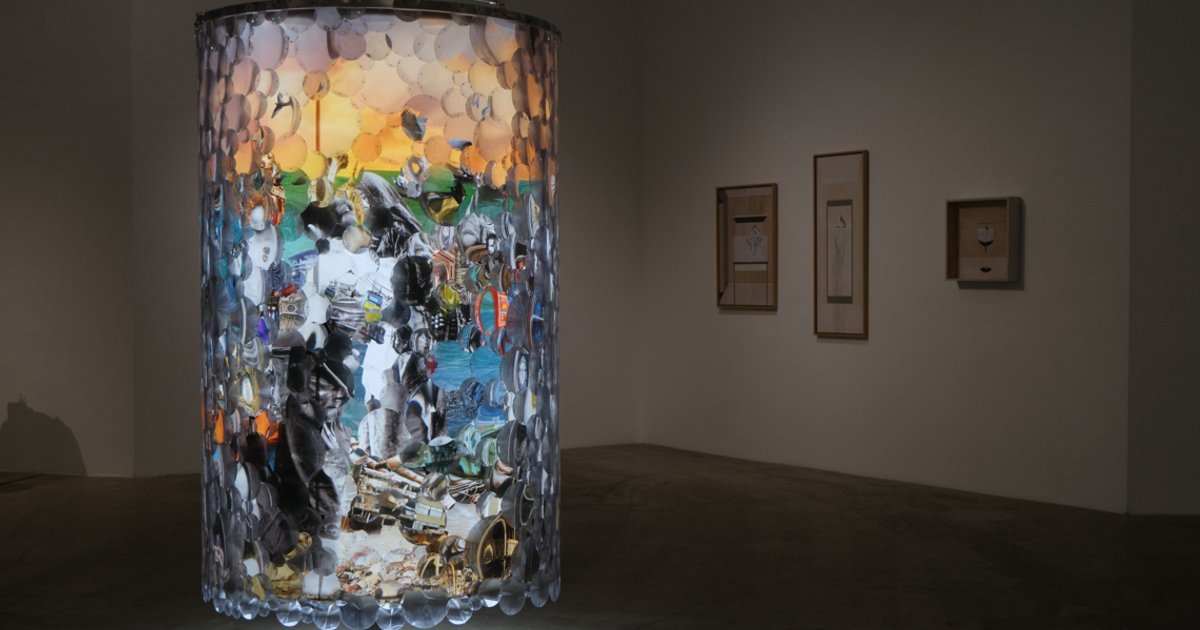
SINGAPORE – An exhibition of 15 women South-east Asian artists at Gajah Gallery is based on the story of Persian queen Scheherazade and how she transfixed others with her stories to protect herself and her loved ones.
Dramatis Personae: 1001 Lives opens on Oct 29 and is curated by Joyce Toh, marshalling works by women artists from seven South-east Asian countries. Like Scheherazade, who whetted the curiosity of her murderous husband king each night by leaving him on a cliffhanger with her fantastical tales, the works speak to women’s “strategies of survival”.
Toh, in a preview of the exhibition mid-installation, gestures at the eclectic contributions from ceramics, glazed and cracked to look like a flayed angel, to vessels woven from “creepy” human hair.
“Creating art is also in a way like creating yourself, and we all exist in different personae. We are introverted with a particular friend, then loud with others. It’s not hypocritical. We create new lives for ourselves,” says the independent curator.
The roster is an esteemed one, from the late I Gusti Ayu Kadek Murniasih from Indonesia and the Philippines’ Nona Garcia to Thailand’s Imhathai Suwatthanaslip and Singapore’s Suzann Victor.
Even when no human face is discernable, the works can be taken as revelatory self-portraits, Toh says.
In Garcia and Victor’s cases, their subjects’ faces have been deliberately obscured.
Garcia, who once fetched the highest prices in all of South-east Asia at auction, is known for her photorealist paintings of the back of people’s heads.
The work selected is from a rare series where Garcia applied her signature approach to her artist friends. Toh says Garcia would give these to her sitters for free – a strategy of collective survival.
“This was a remarkably generous gift. It’s interesting that at one point, especially in the 1990s, it was all these women artists from the Philippines who were fetching record-breaking prices.”
There is equal homage and solidarity in Imhathai’s offering, which uses hair collected from Murniasih’s home after her death to create porous, egg-holding vessels.
Toh says Imhathai has expressed anxieties about using her own hair as she ages, an artist reframing her sense of self as physiology changes.
“That really reflects the poignancy of an ageing body,” Toh says, and further speculates on the wooden eggs in the Murniasih hair vessels as a posthumous act of restitution: “One of the difficulties that Murniasih had in life was to be able to have children.”
Enthralled with the theme, Singapore artist Sarah Choo Jing has begun a new series, in which she has collected stories of women she met at various locations and crystallised them into stills reminiscent of Hong Kong film-maker Wong Kar Wai’s style, shot in Singapore supermarket aisles, a laundromat, stairwell and a theatre.
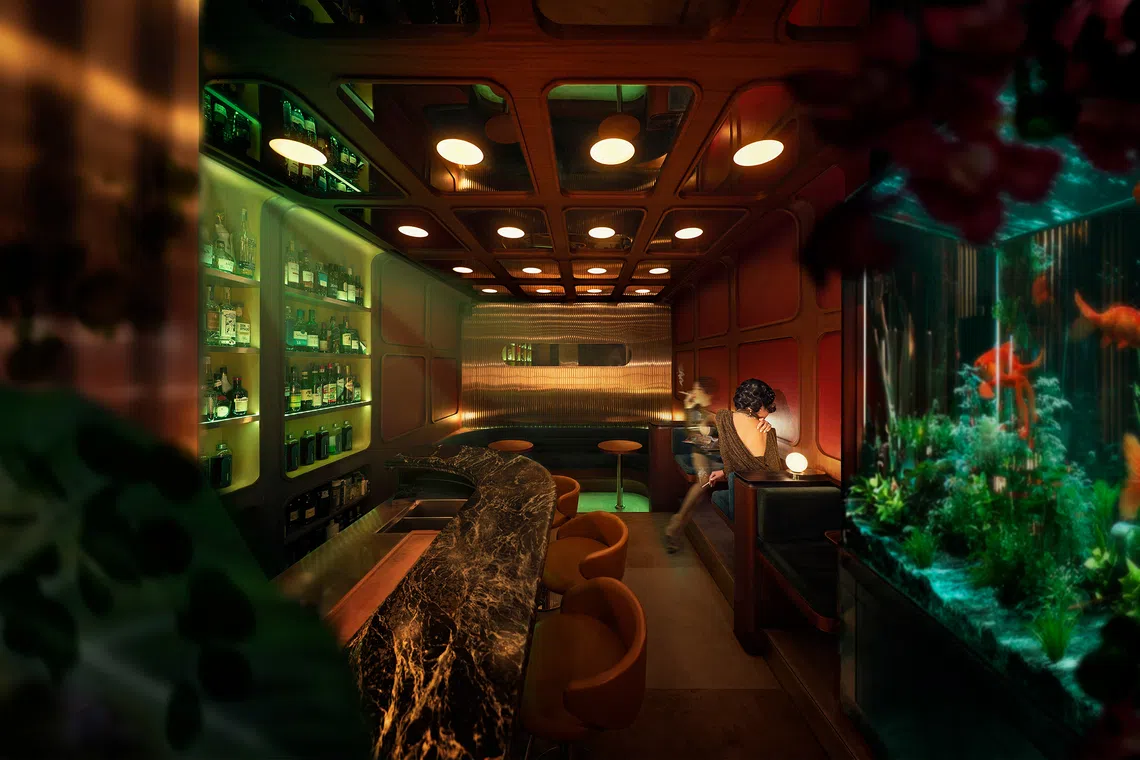
Sarah Choo Jing’s series features stories of women she met at various locations and crystallised into Hong Kong film-maker Wong Kar Wai-esque stills.
PHOTO: GAJAH GALLERY
These stylised figures with coiffed coloured hair, backless dresses and sunglasses look glamorous in their melancholy, and are sure to tempt visitors into reading the accompanying scripted text providing a window into their hidden stories.
Choo says each is a composite. “I am drawn to people who are often ignored or overlooked. They have very fascinating lives to me. I think also about how each individual becomes a performer, whether conscious or not. Even while talking to them, I’m very cognisant of that.”
She traces her filmic influences to Wong, but also American surrealist David Lynch, the attention to quiet rhythms of Belgian film-maker Chantal Akerman, Taiwanese film-maker Edward Yang’s sensitivity to the interiority of urban lives and American director Todd Haynes’ highly constructed visual worlds that creak with otherwise overlooked tensions.
“I’m not necessarily interested in recreating a particular cinematic aesthetic. What interests me is how these different visual languages can come together in a still photograph. Everything has to exist within a single frame,” she says.
Toh says she has tried to capture the breadth of South-east Asia in the selection of artists – who include one from Myanmar and another from Papua, Indonesia – but is not always successful. Brunei, Cambodia, Laos and Timor-Leste are absent from the line-up.
She prefers to think of the show as female-focused rather than a women’s artist show, what with all the preconceptions – including affirmative action – that come with such a label.
Dramatis Personae is a stage to reckon with the rich complexity of women’s subjectivity.
The artists here concern themselves with friendship, Freudian theory, motherhood, regional myth, artist rights and even the Galleon trade between Mexico and the Philippines over 250 years from the 16th to 19th centuries.
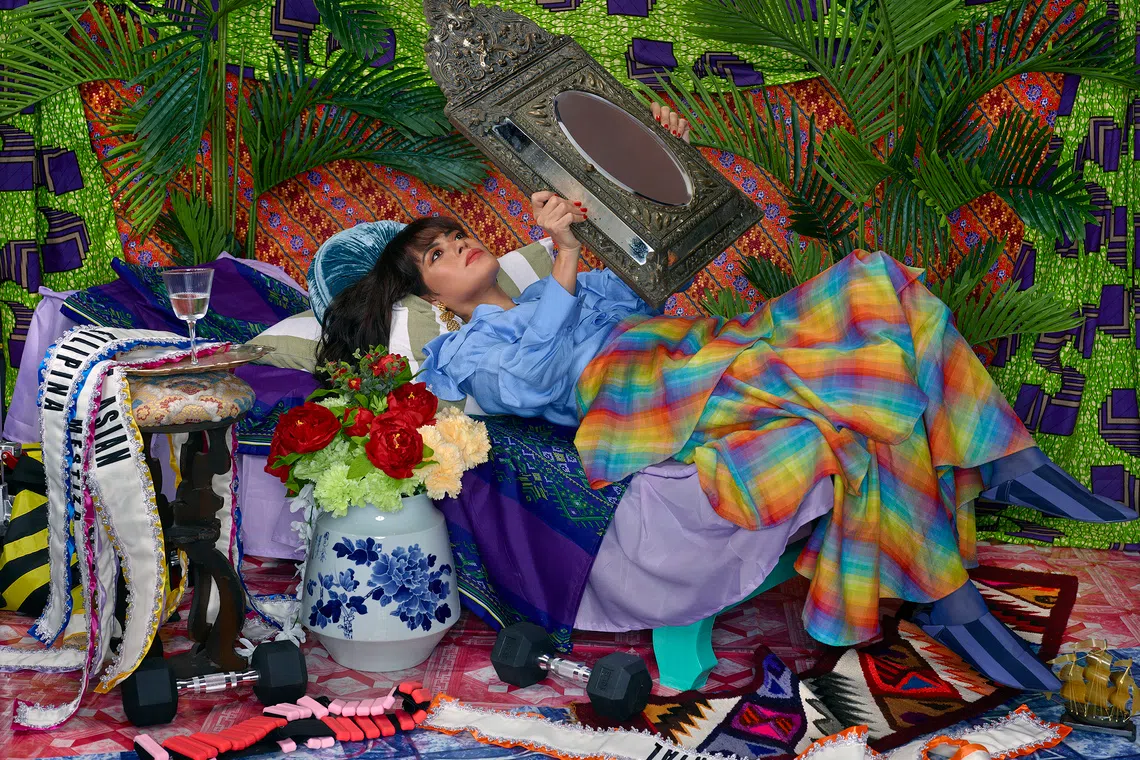
Wawi Navarroza’s Sheherazade: Nine Lives, A Thousand Faces (The Burden Of Representation, Self-Portrait).
PHOTO: GAJAH GALLERY
With the example of a maximalist self-portrait by Filipino artist Wawi Navarroza, who holds up a mirror while surrounded by Cebuano and batik textiles and pageant ribbons that read “Oriental” and “Filipina”, Toh bids visitors re-examine their instincts.
“At first, you go ‘Yes, of course, a female artist, totally self-absorbed.’ But bend a little closer and you will see the mirror’s facing the other way.”
Book It/Dramatis Personae: 1001 Lives
Where: Gajah Gallery, 03-04, 39 Keppel Road
When: Till Nov 29, 11am to 7pm (Mondays to Fridays), noon to 6pm (Saturdays and Sundays)
Admission: Free
Info: str.sg/uTCw