
Follow us
Add us as a preferred source on Google
Newsletter
Subscribe to our newsletter
When the sun inevitably dies, not even the outer solar system will be safe from the resulting chaos, new research hints.Scientists have long thought the outer solar system — which comprises the four giant planets Jupiter, Saturn, Uranus and Neptune — would mostly retain its present-day appearance for hundreds of billions of years to come. But a new study suggests that the outer giants may develop weirdly shaped orbits as the sun runs out of fuel, causing the planets to cross paths and destroy themselves through collisions within three billion years of the sun’s transformation into a red giant.
The findings, published Sept. 21 in The Astrophysical Journal Letters, could change our understanding of what kinds of exoplanets orbit certain stars.
Latest Videos FromLive Science
Solar recoil
You may like
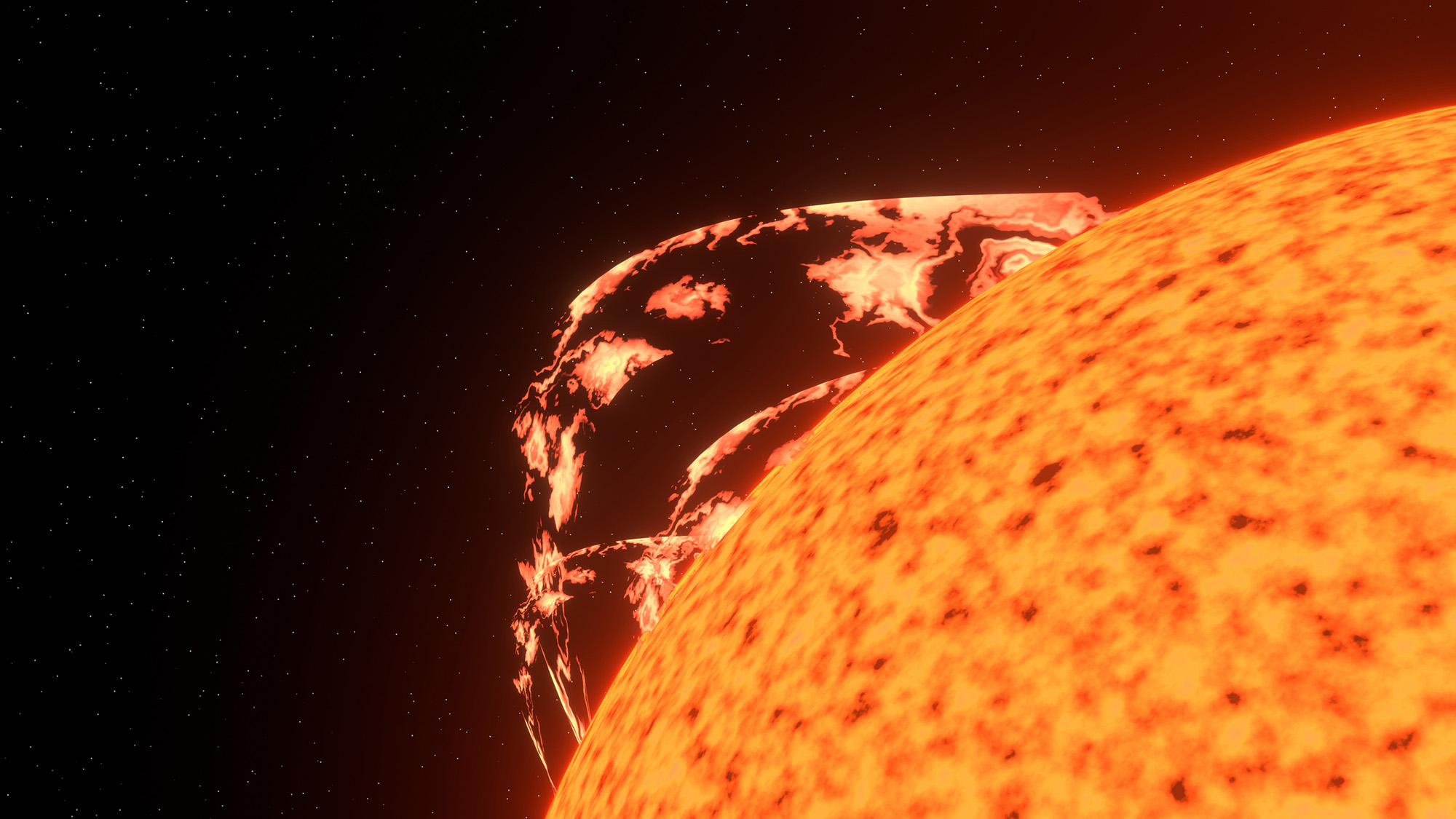
An illustration of the sun releasing a giant mass of plasma. As such large explosions increase in the sun’s dying days, the recoil could disrupt the gravitational balance of the outer solar system.
(Image credit: Chartchai Sansaneeyashewin via Getty Images)
Chaos at the edge of town
Batygin, K., Fuller, J., & Adams, F. C. (2026). Terminal instability of the solar system triggered by stochastic solar mass loss. The Astrophysical Journal Letters, 1009(2), L22. https://doi.org/10.3847/2041-8213/aea290