
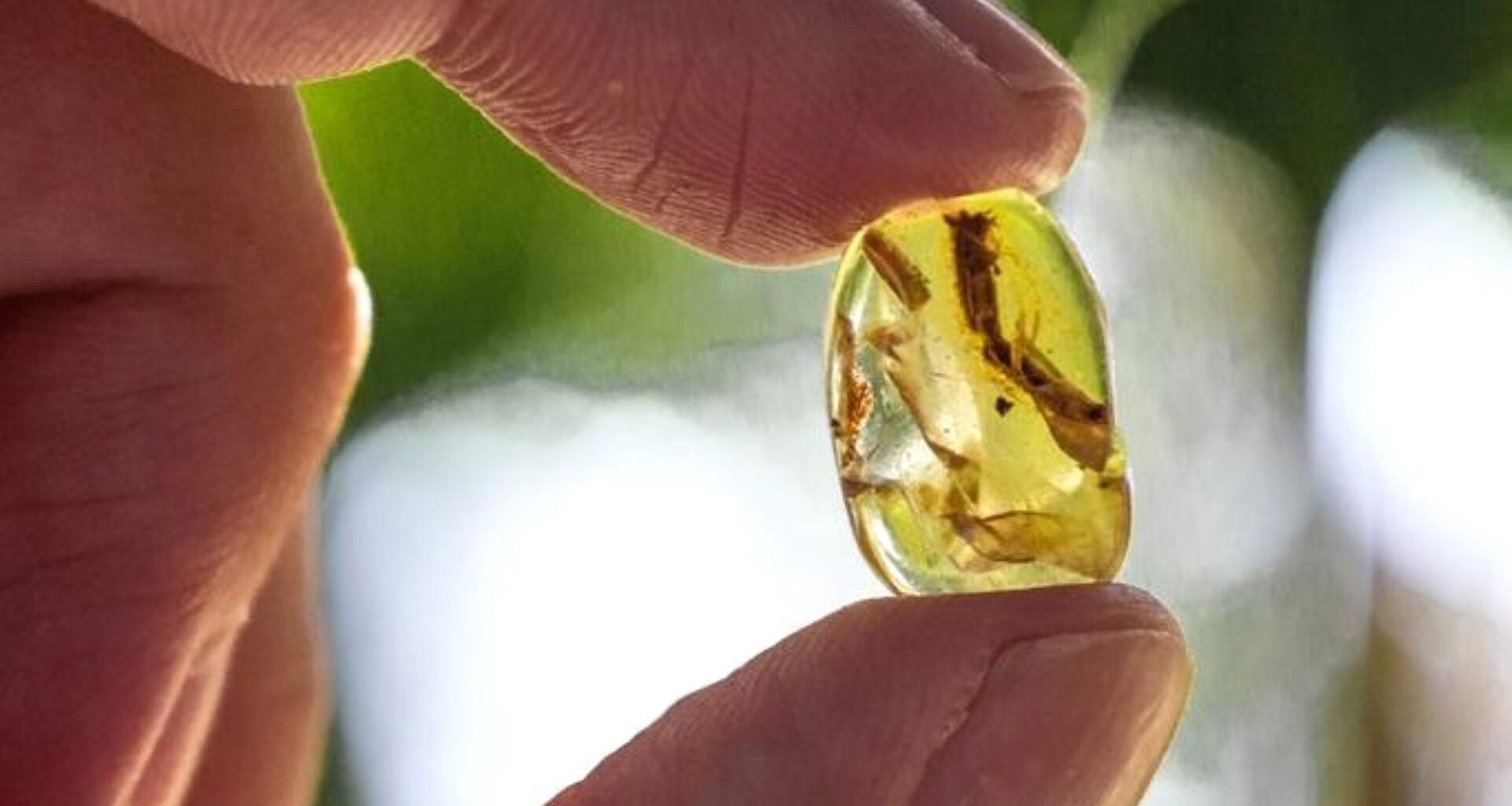
A tiny lizard tail preserved in 99-million-year-old amber reveals ancient evidence of a survival strategy still used by lizards today.
Plenty of people have watched a lizard dart away and leave its tail twitching on the ground.
Working out when lizards started doing that has been much harder, because old bones can show that a tail was built to break, not that it ever did.
A lizard tail sealed in amber about 99 million years ago shows that one did, so the defense is at least that old.
The amber is about 0.7 inch (18 millimeters) long, small enough to rest on a fingertip, and it came from northern Myanmar.
For years, nobody realized what it held. What looked at first like a tiny twig or a scrap of an insect caught the eye of Dolev Fabrikant, a PhD candidate at Tel Aviv University’s New Environmental School.
“I realized that what seemed to be a twig was covered in tiny scales,” he said. “It was a lizard’s tail.”
The twig was a tail
Fabrikant told his supervisor, Leonidas-Romanos Davranoglou of the university’s School of Zoology and the Steinhardt Museum of Natural History. The reaction came fast.
“I nearly jumped out of my chair,” Davranoglou said. “I instantly realized that this tiny fossil could open an extraordinary window into the past, helping us understand the history of one of the most widespread survival strategies among reptiles.”
“Until now, we could only speculate on whether ancient lizards could shed their tails. We now have direct evidence that one could.”
Researchers from the National and Kapodistrian University of Athens and Israel’s Volcani Institute joined the work.
According to the team, the fossil provides exceptionally well-preserved evidence of a lizard deliberately shedding its tail.
Amber from Myanmar has preserved other small animals from the same distant past, including a baby snake, a beetle, and a lizard once mistaken for a bird.
Insect larvae from amber in the region also carried spines and hairs that helped protect them from predators.
Bones reveal the weakness
Many living lizards have thin lines of weakness running across the bones of the tail, so the tail can break off. Biologists call them fracture planes.
In a study of geckos, researchers reported that the lizard tightens muscles around those lines to help the tail come away. The dropped tail can keep wriggling for up to 30 minutes, which pulls a predator’s attention away from the lizard as it runs.
Losing the tail still costs the lizard, because it uses the tail for movement and social standing, and some species store fat in it.
Fossil reptiles carry fracture planes too. A 2018 study found them in the tail bones of captorhinids, small reptiles from the Early Permian period. Other fossils show tails that grew back after a loss.
Fracture planes show that a tail was built to break, but they cannot prove that an ancient reptile actually shed it.
Fossils of regenerated tails provide evidence of earlier tail loss, but not necessarily how it happened.
Scans found a clean break
The amber is cloudy, and the tail inside is tiny, so an ordinary microscope showed very little.
The team turned instead to micro-CT scanning at the Volcani Institute, where Ahmed Nasser heads the Inter-Institutional Analytical Unit.
“Micro-CT takes X-ray images from many angles and combines them into a three-dimensional reconstruction,” Nasser explained.
“It allowed us to examine structures hidden by the amber without needing to cut this one-of-a-kind piece open.”
At the spot where the tail came off, the scans showed a ring of tissue like the one seen in tails dropped by living lizards.
The break was also fairly clean and symmetrical, lacking the damage expected from an accidental injury.
The researchers can’t say why the lizard dropped its tail. It may have gotten stuck in the sticky resin and pulled free by leaving the tail behind. Or a predator may have attacked it, and the dropped tail later landed in resin.
Nor can the fossil show whether the lizard survived or whether it later regrew its tail.
An unidentified ancient lizard
Apostolos Christopoulos, a PhD candidate at the National and Kapodistrian University of Athens, is one of the researchers on the team.
“Although we can securely identify this specimen as a lizard, we lack the skull and other skeletal features that would allow a more secure identification,” said Christopoulos.
“Possible affinities include the groups containing today’s wall lizards or, alternatively, slow worms and monitor lizards.”
Telling those groups apart would take a skull, or more of the skeleton than this piece of amber holds.
Although the lizard’s identity remains uncertain, its discarded tail provides a rare glimpse of a survival strategy that has endured for nearly 100 million years.
The full study was published in the journal Palaeontologia Electronica.
—–
Like what you read? Subscribe to our newsletter for engaging articles, exclusive content, and the latest updates.
Check us out on EarthSnap, a free app brought to you by Eric Ralls and Earth.com.
—–