

NASA’s Jet Propulsion Laboratory began with a small group of Caltech researchers, an experimental rocket motor and a dry creek bed. On Oct. 31, 1936, graduate student Frank Malina and his colleagues tested an alcohol-fueled motor in Pasadena’s Arroyo Seco, a dry creekbed north of the Rose Bowl. The test was brief, but it marked the start of work that would eventually send spacecraft to explore every planet in the solar system.
The group had moved its experiments off campus at the urging of their adviser, Caltech professor Theodore von Kármán, who saw promise in their work in rocket propulsion as few others shared his enthusiasm. He helped guide the early research and later helped establish the lab that became JPL. He is also remembered for the von Kármán line, the commonly used boundary between Earth’s atmosphere and space.
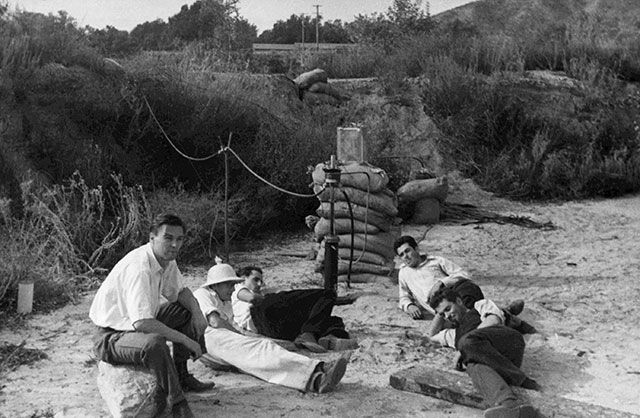 © Credit: Caltech/JPL
Their work soon attracted attention from the U.S. Army’s attention which was looking for ways to help heavily loaded aircraft take off from short runways during World War II, The project grew, and in 1943 it took the name Jet Propulsion Laboratory.
After the war, JPL’s work increasingly turned toward space. The lab helped build Explorer 1, the first successful U.S. satellite, launched on Jan. 31, 1958. Its cosmic-ray detector revealed unexpectedly intense radiation around Earth, leading scientists to identify the radiation belts now known as the Van Allen belts. That same year, JPL became part of the newly formed NASA
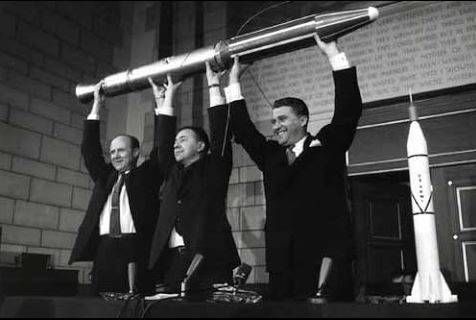 William Pickering, then director of JPL; James Van Allen, the University of Iowa physicist whose instrument aboard Explorer 1 led to the discovery of the Van Allen radiation belts; and Wernher von Braun, who led the Army rocket team that built the Jupiter-C launch vehicle. (© Credit: Caltech/JPL)
In 1962, Mariner 2 became the first spacecraft to successfully fly by another planet, sending back data about Venus. Fifteen years later, JPL helped launch the twin Voyager probes, which explored Jupiter and Saturn; Voyager 2 continued on to Uranus and Neptune, while both spacecraft eventually traveled into interstellar space. JPL’s Mars exploration has spanned generations of robotic explorers, from Sojourner to the Spirit, Opportunity, Curiosity and Perseverance rovers.
Today, the lab lists 40 active missions, spanning Mars rovers, Earth-observing satellites, the Europa Clipper mission to Jupiter’s icy moon, the Psyche asteroid mission and the Voyager probes traveling beyond the Sun’s neighborhood.
The Halloween Day birthday isn’t lost on JPL which hosts an annual pumpkin carving contest among employees drawing complex and creative entries.
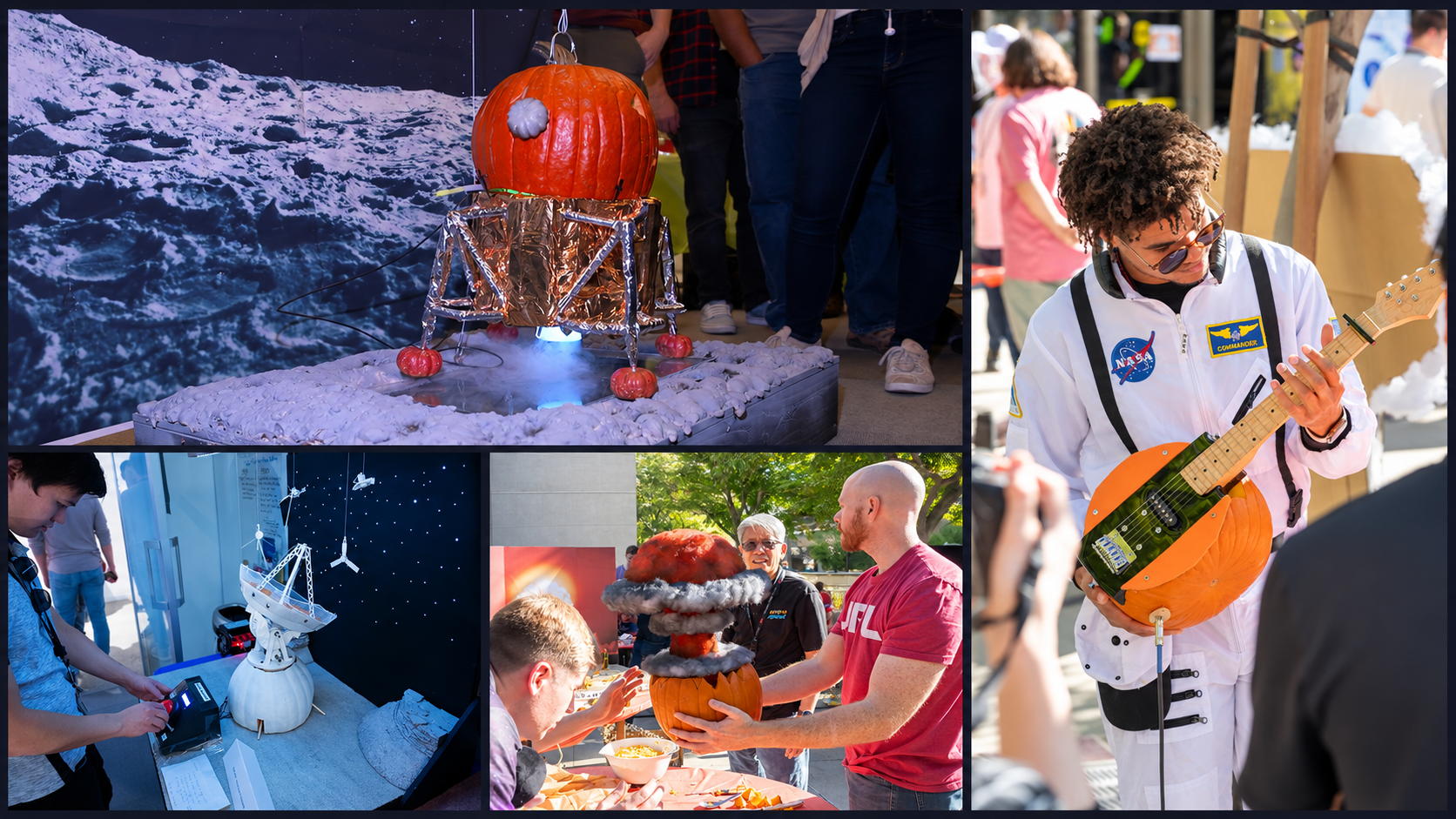 JPL’s annual pumpkin carving contest draws complex and creative entries from employees (© Credit: Caltech/JPL)
You can keep tabs on those missions via NASA’s Deep Space Network, a system of large antennas strategically placed around the globe to command those spacecraft and bring down terabytes of images and other data each day