
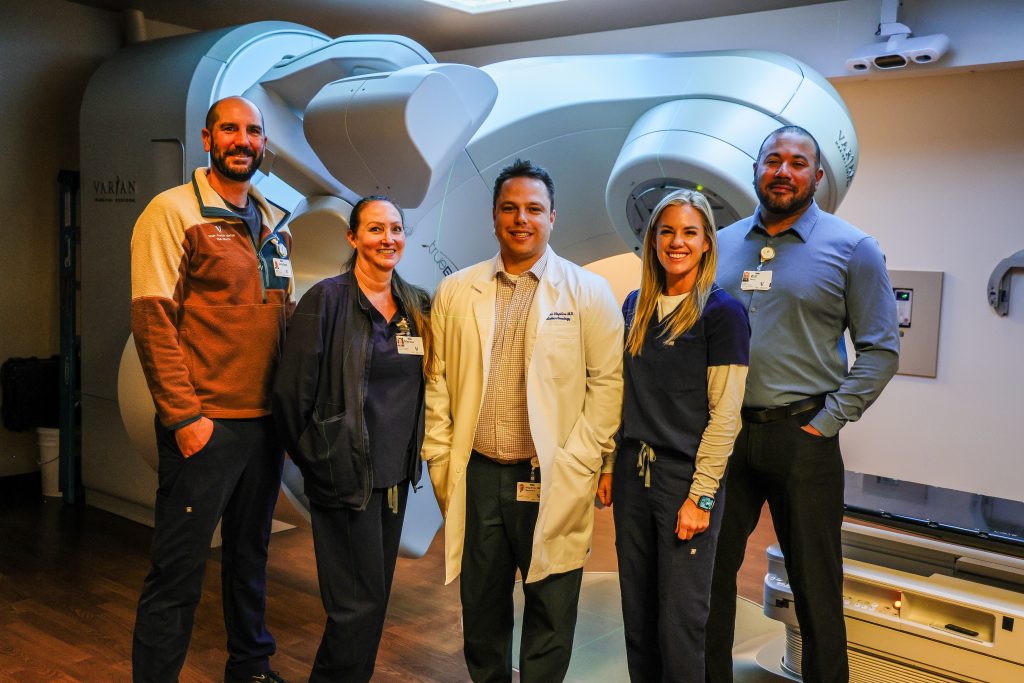
Howard and Mary Louise Shaw already played a large role in Eagle County when they approached their doctor, Jack Eck, about what they could do for the community. After losing their son to a car accident on Vail Pass, the Shaws contributed to Vail Health Hospital’s growth by donating funds for a new wing and serving on the hospital board. However, they wanted to do more, so Dr. Eck pointed them to cancer care in the valley.
At the time, the number of cancer patients was rising in the valley, but there was nowhere to go between Denver and Salt Lake City. In 2001, the Shaw Cancer Center opened with the aid of a $17 million contribution from the Shaw family. Twenty-five years later, the center has made significant progress as a high-quality practice in the Central Rockies.
The center offers a vast range of services for oncology care — screenings, therapies, surgeries, support groups, coordination of appointments, and counseling, to name a few. The center has received a gold accreditation from the Commission on Cancer, which is the highest recognition for quality of care from the professional organization.
Kim Sharkey, the director of oncology operations, has been at Shaw for 15 years and said that in the early years of the center, they introduced a “whole-person” approach to care, a healthcare model that looks beyond isolated symptoms, treating a person as a complete individual. Included in their care are services like dietitians, psychosocial support and an exercise clinic — something that Sharkey said is not in standard practice with cancer care.
“We like to think as a community cancer center, we are leading … across the country with some innovation,” she said.

Support Local JournalismDonate
The center has offered different ways patients can access cancer care. In 2007, the center introduced Jack’s Place, a cancer lodging house, after finding that many patients were sleeping in their cars to be near the center during treatment. In 2023, the center also started offering Shaw at Home, which brings treatment services to patients’ homes since many are too sick to go to the center itself.
“We’ve always maintained the patient-centered care, the whole-person approach. Every person that walks through our cancer center is so important to us and all the decisions we make every day revolve around our patients, and we’ve never lost sight of that,” Sharkey said.
And cancer treatment isn’t the only thing the center offers. Shaw is also a community infusion center. According to Sharkey, 30% of the center’s patients who come in for infusions come for noncancer treatments like multiple sclerosis. Shaw also has a high-risk program for people who haven’t been diagnosed with cancer but who have family history or genetic predisposition. Their medical oncology team also sees hematology patients, Sharkey said.
“It’s unusual that in a cancer center we have so many things under one roof,” said Karen Clous, who has been a registered nurse with Shaw for 15 years. “I think that’s what really makes Shaw special.”
Clous said that recruiting staff to the area hasn’t been easy, but over recent years the center has been able to provide in-house training to staff in an effort to expand what it can offer, rather than just sending patients to a Denver hospital.
One example is offering byspecific antibody treatment — an infusion treatment that targets a patient’s immune system like a vaccine to target the tumor. However, it can cause side effects like infections or multisystem shutdowns.
In the past, it has been offered in an inpatient setting where specialists can help care for the patient who might experience reactions to the treatment. In the last year, they’ve been able to develop a program to offer that care at Shaw.
“We’re one of the first cancer centers in an outpatient center to offer this treatment outside of a hospital, which is great for our patients,” Clous said. “We’re always trying to look at how we can keep our patients within our community (and) keep them close to our support services and their own home.”
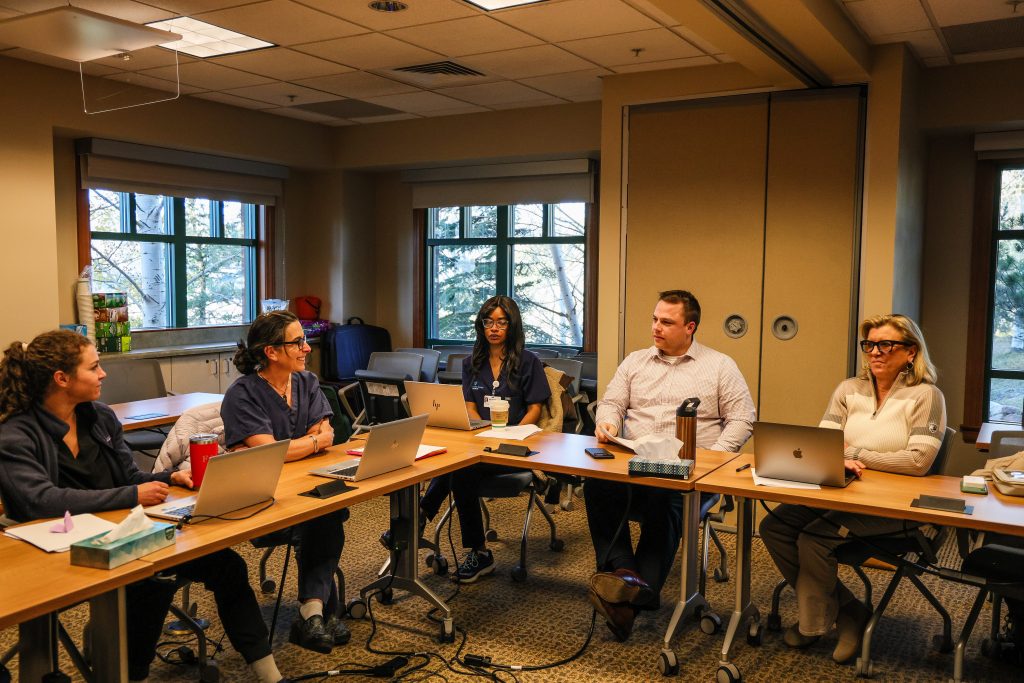 A tumor board meeting at the Shaw Cancer Center. Tumor boards are weekly multidisciplinary discussions among the center’s staff to review patient cases, evaluate diagnoses and develop treatment plans, according to the center’s website.Chris Dillmann/Vail Daily
Clous and Sharkey have been a part of Shaw Cancer Center for a majority of its life. However, Dr. Benjamin Hopkins has only just started in his role as a radiation oncologist, but can see just how much is poured into making the facility the best it can be.
“Early in my training, I had no idea that you could have a center like this,” he said. In his work, Hopkins has witnessed small centers that are stripped down, struggling to keep staff on or not being able to offer enough services for patients. Shaw, he said, has the same equipment, and even stronger staff and coordination of care than the universities he went to in California and Georgia.
“I was very confident coming here that I could do everything that I could possibly want for my patients, and that they weren’t … missing out on anything, which I think is amazing,” he said.
Hopkins said it’s unique for the center to have such strong coordination for every patient. He credits Dr. Patricia Hardenbergh and Dr. Alexander Urquhart, who have spent lots of time engaging with the community and raising funds to expand their efforts.
The center also has a robust research program which enables the center to work on the latest clinical trials, Hopkins said. Hardenbergh has even designed her own clinical trials, which Hopkins said he’s never seen a community center having.
“When I look at what this place has done in 25 years, I think a lot of people would say it’s impossible to do what they’ve done,” he said. “I think our patients really get the experience that I would want my family members to have.”