
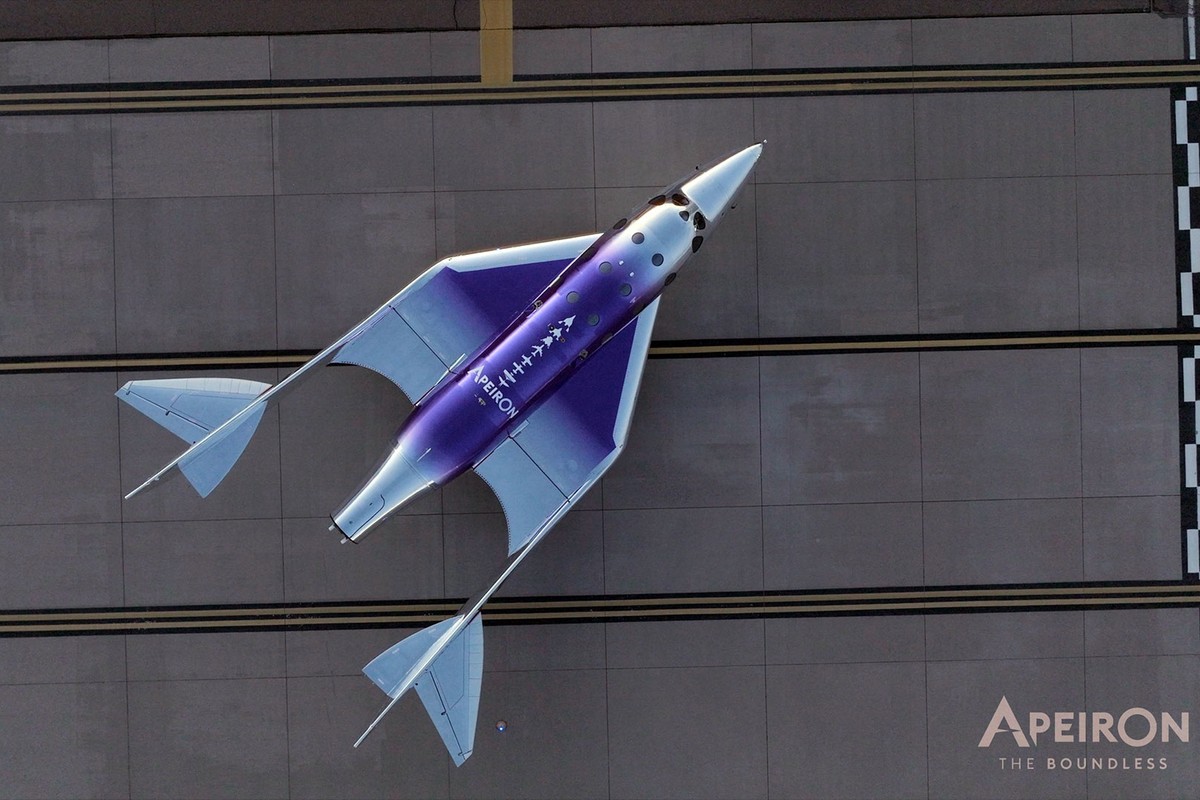
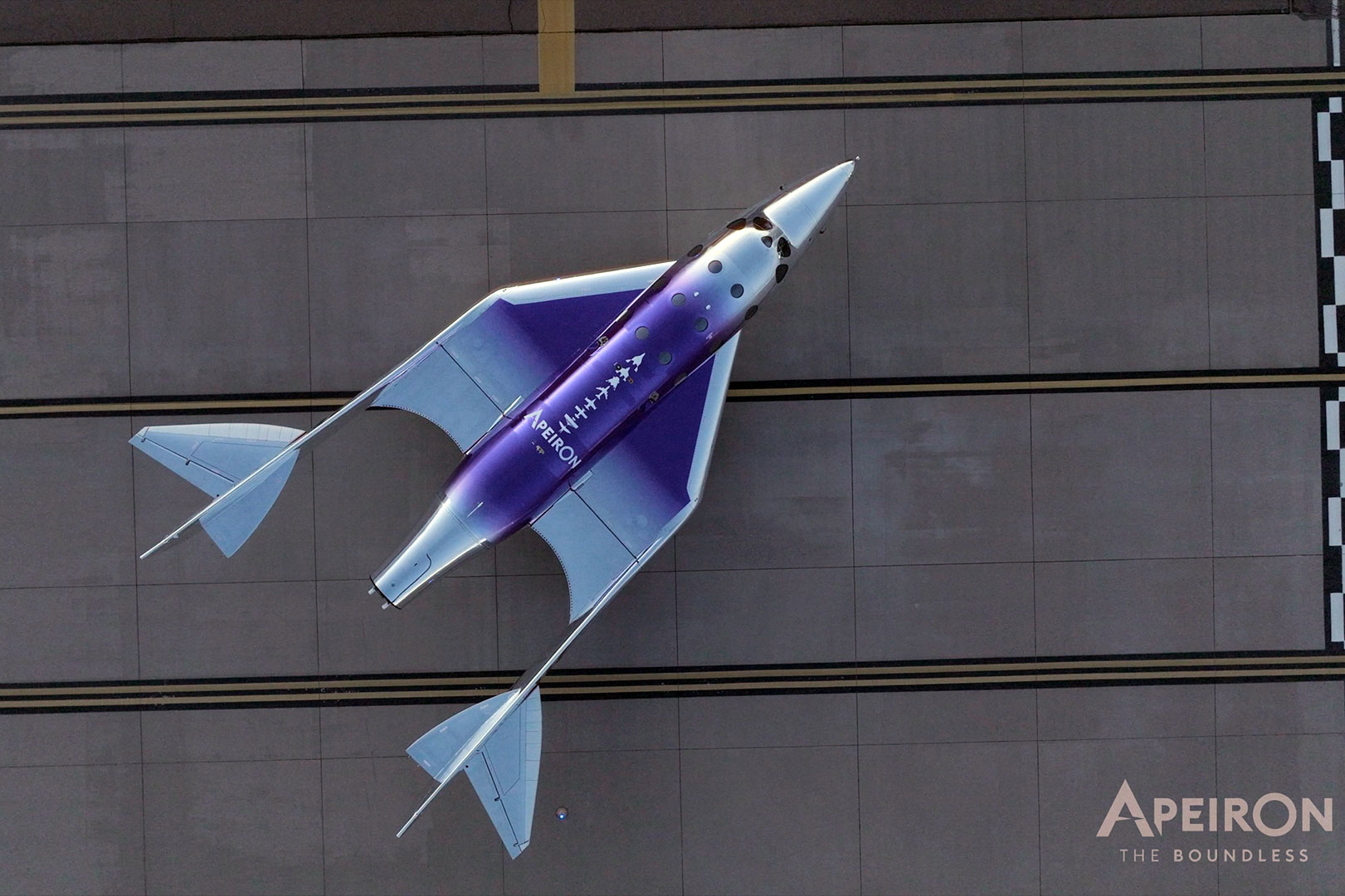
The Apeiron name was revealed on Oct. 26, chosen by public vote with participants from more than 80 countries. Source | Virgin Galactic
On Oct. 28, Virgin Galactic (Tuston, Calif., U.S.) successfully flew Aperion, the lead Spaceship in the company’s next-gen commercial spaceline fleet, to Spaceport America in New Mexico, its permanent home and base of operations.
With Apeiron now at Spaceport America, Virgin Galactic’s engineering team plans to complete avionics software integration and validation while conducting flight test preparations. Upon successful completion of the flight test program, Virgin Galactic plans to begin flying customers aboard Spaceship Apeiron, with commercial spaceflights expected to begin in early Q2 2027.
Apeiron is Virgin Galactic’s lead Spaceship, produced in partnership with major aerospace suppliers. Designed to fly twice per week with a vehicle lifetime of more than 500 missions, each Spaceship in the fleet is built to support the economics of a scaled commercial operation, with increased flight cadence and a cost profile “unprecedented in the industry.”
While the retired VSS Unity was hand-built as a single, custom monocoque carbon fiber composite structure that required extensive turnaround maintenance between flights, Virgin Galactic’s Delta Class spaceship represents an evolutionary shift into modular manufacturing. According to insights shared on LinkedIn and YouTube, the Delta Class vehicle retains an all-composite architecture but upgrades to an advanced bismaleimide (BMI) resin system woven with carbon fiber threads. This specialized material allows the spacecraft’s primary surface to withstand direct aerothermal heating at Mach 3 speeds without the added weight or complexity of an independent thermal protection system (TPS). By leveraging these lighter, heat-resistant composites and shifting to sub-assembly production, the Delta Class scales up passenger capacity from Unity’s four seats to six, while increasing launch efficiency from its limit of one flight per month to a rapid cadence of two flights per week
Production of the fleet is already moving forward. At the Spaceship Factory, assembly of the static test article and the second Spaceship is underway, and teams are preparing the rocket motor assembly line. The second Spaceship is expected to begin commercial operations in late Q2/early Q3 2027.