
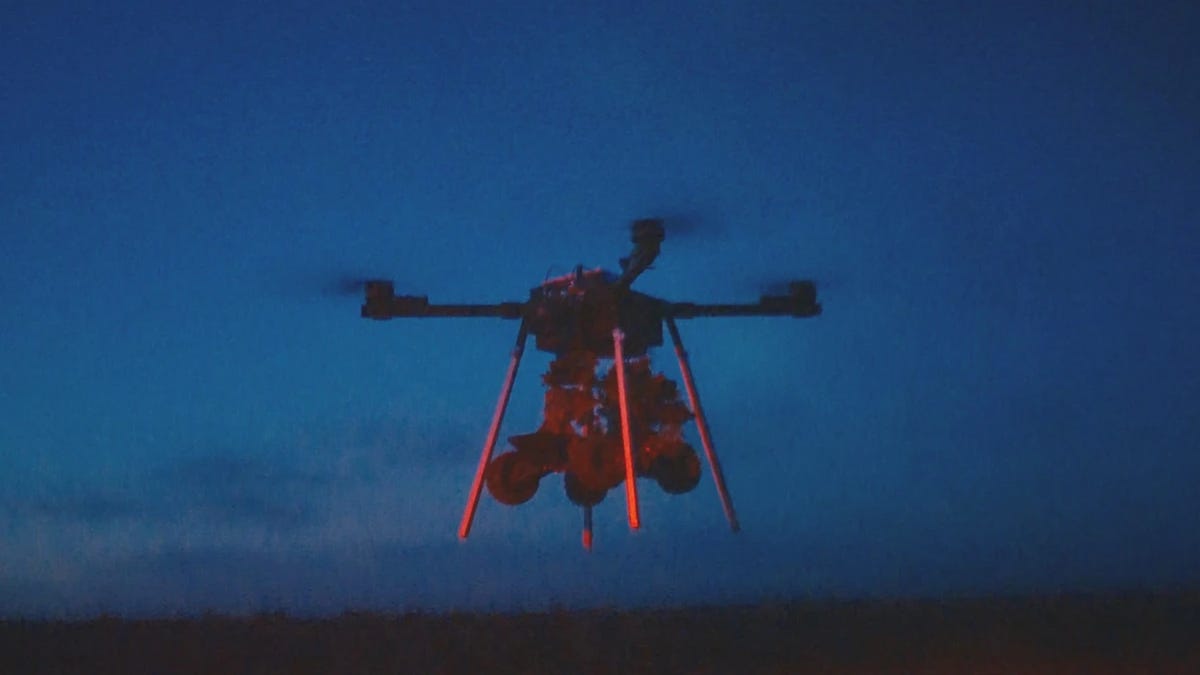
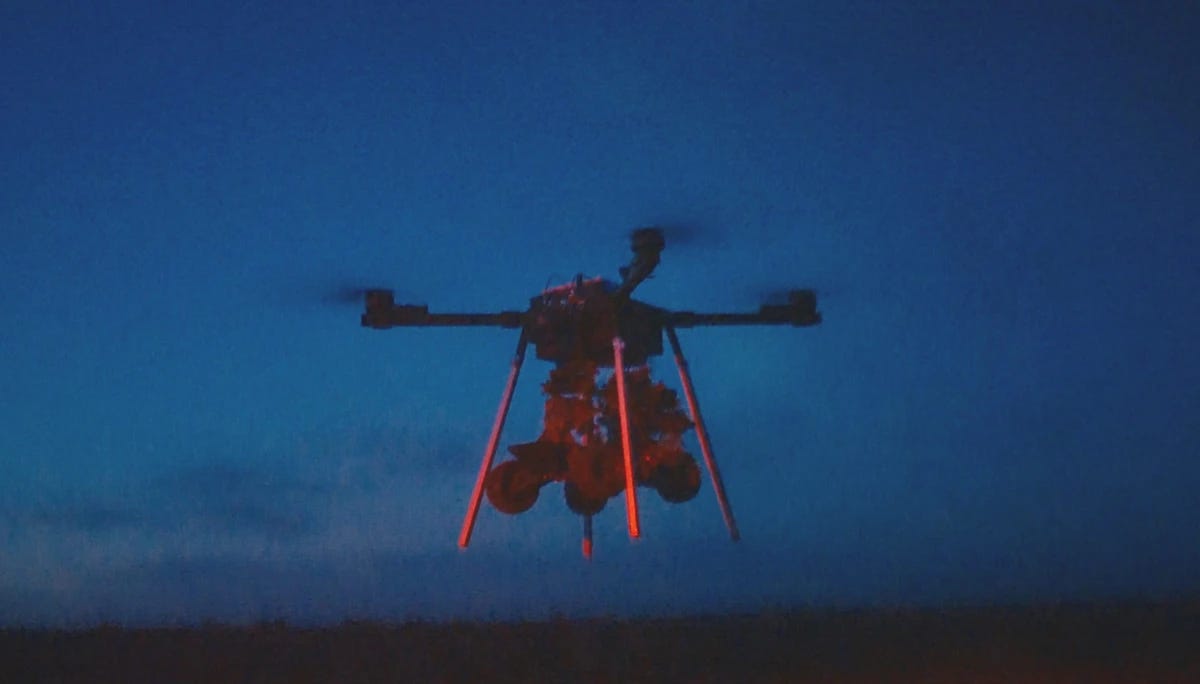
 Heavy drone carrying UGV. Image: 3rd Army Corps
Over the past ten days, I have been conducting a research visit to Ukraine and Israel. As always, these nations and the wars they are fighting provide a variety of lessons. While there may be different political imperatives, terrain and enemies, many of the insights about modern war they yield are similar. Whether it is the centrality of will, the need for good leadership or the influence of new technologies, the wars in Ukraine and the Middle East have a remarkable number of overlaps.
But perhaps the most important overlap is the importance of rapid, systemic learning and adaptation in war. Part of this is appreciating enemy adaption cycles, and this is the focus of my new article. As the old saying goes, the enemy always gets a vote. We might also add that the enemy always learns and adapts. In this piece, I explore whether Russia might be able to rapidly learn and adapt to emulate the evolved operational methods demonstrated by Ukraine in Operation Vivaldi.
Advantage in war is transitory and highly perishable. When an army finds a new way to solve a difficult operational problem, its enemy studies it, takes what it can and will set about reproducing it. As the scholar on military innovation Theo Farrell has noted, in war, competition and pressure over time lead to convergence as optimal ways of organising and operating are learned and copied.
Russia has learned and adapted, while regenerating military capacity, across multiple endeavours since 2022, and often faster than many Western analysts have expected. Thus, the question that follows Ukraine’s recent offensive success, and the focus of this article, is a simple one. Can the Russian military ‘fast follow’ Ukraine’s new offensive ground tactics that were demonstrated during the recent Operation Vivaldi and employ them against Ukraine on the eastern front?
Operation Vivaldi was the offensive executed by Ukraine’s 3rd Army Corps around Lyman in northern Donetsk Oblast. Alongside a smaller operation in the south that liberated more than 400 square kilometres, these offensives have challenged the lazy narrative of stalemate along the frontline. Brigadier General Biletskyi, claims that Ukrainian troops liberated 16 settlements and 277 square kilometres of territory across the four phases of Vivaldi. Further, enemy losses are claimed to have amounted to approximately 8,000 soldiers.
Four insights from the operation are relevant for this article.
First, these were counteroffensives rather than local counterattacks, prepared under tight operational security and deception. Ukraine learned the lesson about operational security the hard way in 2023, when months of open speculation gave the Russians seven months to prepare.
Second, the 3rd Corps reorganised its command systems before the offensive began. According to The War Zone’s account, it then used drones to strike Russian fuel pipelines and supply depots in depth, employed uncrewed ground vehicles (UGVs) extensively in support of its infantry, and positioned ground-based radio beacons to keep drones flying through heavy GPS jamming. This effort to shape the battlespace and suppress Russian drone operations was conducted before the first moves of troops commenced.
Third, the corps used UGVs as part of an evolved form of combined arms operations. It re-roled heavy bomber drones as motherships to carry UGVs to the flanks and rear of Russian positions, where they destroyed enemy drones as part of the reconnaissance battle. Ukraine also integrated breaching UGVs into assault operations. During the second phase of the operation, a limited but effective use of tactical mechanised manoeuvre was enabled by the shaping operations of ground and aerial drones.
Fourth, and most important, Vivaldi has shown that the ‘transparent battlefield’ is not the reality of modern war, and that offensive manoeuvre is still possible in contemporary land operations. In my September essay on these operations, I asked how long it would take the Russians to catch up. I expect them to try to copy these methods. Any answer to this must include how well, and how quickly, the Russians might ‘fast follow’ Ukraine’s new ground combat offensive methods.
In my recently published CSIS paper, I argued that fast following is now a core military competency. It is the deliberate practice of watching an innovation proven by someone else, then copying, improving and fielding it at speed. The innovator carries the cost and uncertainty of proving a concept. The fast follower waits for the demonstration, learns from its successes and failures, and enters with an improved version just as the idea begins to scale. This is not passive imitation. It is disciplined adaptation.
War removes most of the barriers that slow imitation in commercial markets. There are no patents, few capital barriers and relentless competitive pressure. The clock on adoption starts when an innovation’s potential becomes visible through use, not when it is tested internally. For drones, the gap between demonstration and adoption in Ukraine and Russia has often been measured in weeks. Russia has already copied Ukraine’s mobile anti-drone fire groups and its Unmanned Systems Forces model.