
Television has seen no shortage of groundbreaking police procedurals over the years. Shows like The Wire, The Shield, and even the Law & Order franchise have each redefined the genre for their respective eras. But long before prestige TV and serialized storytelling became the standard, there was a show that did it first and arguably did it best. When Hill Street Blues premiered on NBC in 1981, it reimagined what a cop drama could be, delivering a grittier, more complex series that focused on layered, deeply human characters rather than one-dimensional archetypes. Heck, a 1993 issue of TV Guide rated it the greatest cop show of all time.
Hill Street Blues was revolutionary because it changed how television portrayed police work. At a time when shows like Dragnet, Adam-12, and Starsky & Hutch stuck to tidy, case-of-the-week storytelling with flawless heroes and clear moral lines, Hill Street Blues broke the mold. Its handheld camerawork and overlapping dialogue made viewers feel like they were inside the precinct rather than watching from afar. Created by Steven Bochco and Michael Kozoll, it was the first of its kind to ever do it, and can now be found in the DNA of so many crime series that followed.
‘Hill Street Blues’ Broke the Mold for a Police Procedural in the 1980s
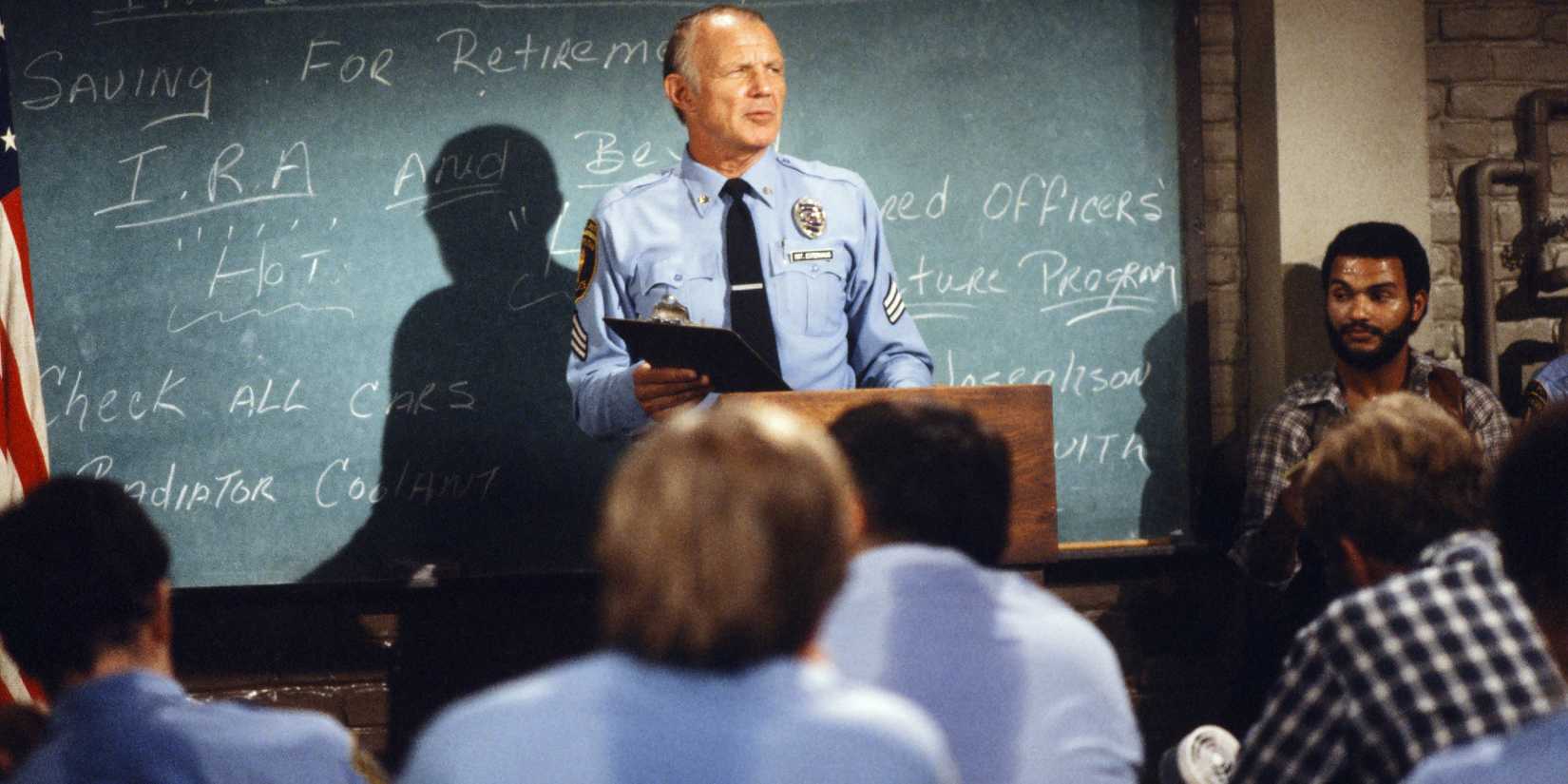
Michael Conrad as Sergeant Phil Esterhaus addressing the police officers in Hill Street Blues.Image via NBC Studios
Over seven seasons, Hill Street Blues chronicled the daily chaos inside a gritty urban precinct that could’ve existed in any American city. Even from its opening moments, it was clear the series wasn’t like any other show of its time. While some aspects definitely feel dated today, its influence remains undeniable, from its handheld cinematography to its layered writing and naturalistic performances. The series experimented with structure, intertwining multiple storylines that sometimes wrapped within an episode and other times stretched across a season. That serialized approach, now a lot more standard for television, was groundbreaking in the early 1980s.
It was also one of television’s first true workplace dramas to focus as much on the people doing the job as the job itself. Before Hill Street Blues, most procedurals centered on the cases, revealing little about whom the officers were beyond their job. Rarely did viewers see cops struggle with the emotional toll of their work or falter under the weight of it. Hill Street Blues changed that, showing its characters as flawed, human, and often exhausted. Its willingness to explore burnout, addiction and moral compromise made the series feel startlingly real and far ahead of its time.
Among its standout performances, Daniel J. Travanti anchored the series as Captain Frank Furillo, a weary but principled leader trying to hold his squad (and himself) together. His relationship with public defender Joyce Davenport (Veronica Hamel) gave the show its emotional core, depicting a partnership rooted in respect and shared ethics. Kiel Martin’s portrayal of the troubled J.D. LaRue, whose battle with alcoholism often clashed with the recovering alcoholic Furillo, delivered some of the most emotional beats of the show. Hill Street Blues was refreshing and way ahead of its time because it refused to rely on caricatures or clean-cut heroes. Every character, no matter how small, had layers.
‘Hill Street Blues’ Shaped Many of the Best Crime Shows Today
Being the first of its kind came with both rewards and challenges. Hill Street Blues captivated audiences and critics during its run, but as television evolved, it was gradually overshadowed by the very shows it inspired. Co-creator Steven Bochco carried its DNA into his later work, including NYPD Blue, another groundbreaking procedural that built on Hill Street Blues’ foundation. Its serialized storytelling, flawed heroes and moral gray areas helped define a new generation of TV dramas updated for modern times.
In 2014, a number of TV writers spoke about the influence Hill Street Blues had on their work and the business. The Shield creator Shawn Ryan credited the show as a major influence, saying he wanted to create something that would “compel people to come back episode after episode” just as Hill Street Blues did for him. You can see that influence clearly in The Shield’s handheld camera work and its willingness to explore how the job wears on the people behind the badge.
That legacy extends even further. David Simon, who created The Wire based on his years covering crime in Baltimore, has cited Hill Street Blues as a cornerstone of modern television, influencing writers like David Milch, who worked on NYPD Blue and went on to create Deadwood. Bochco’s series helped reshape not only the police procedural but the DNA of television itself. Even George R.R. Martin, whose work couldn’t be more different tonally, has credited Hill Street Blues with “raising the general level of television drama considerably.”
Over its seven-season run, Hill Street Blues earned 26 Emmy Awards out of 98 nominations, including multiple wins for Outstanding Drama Series — a testament to its reach and impact. For fans of today’s layered procedurals with complex, flawed characters, Hill Street Blues is absolutely worth a rewatch, if only to see how the shows that followed were inspired by the original more than 40 years ago. TV Guide called Hill Street Blues the greatest cop show of all time, and they were absolutely right. It didn’t just change how we see police drama, but it changed television itself.
NBC

Daniel J. Travanti
Frank Furillo
Michael Warren
Robert Hill