
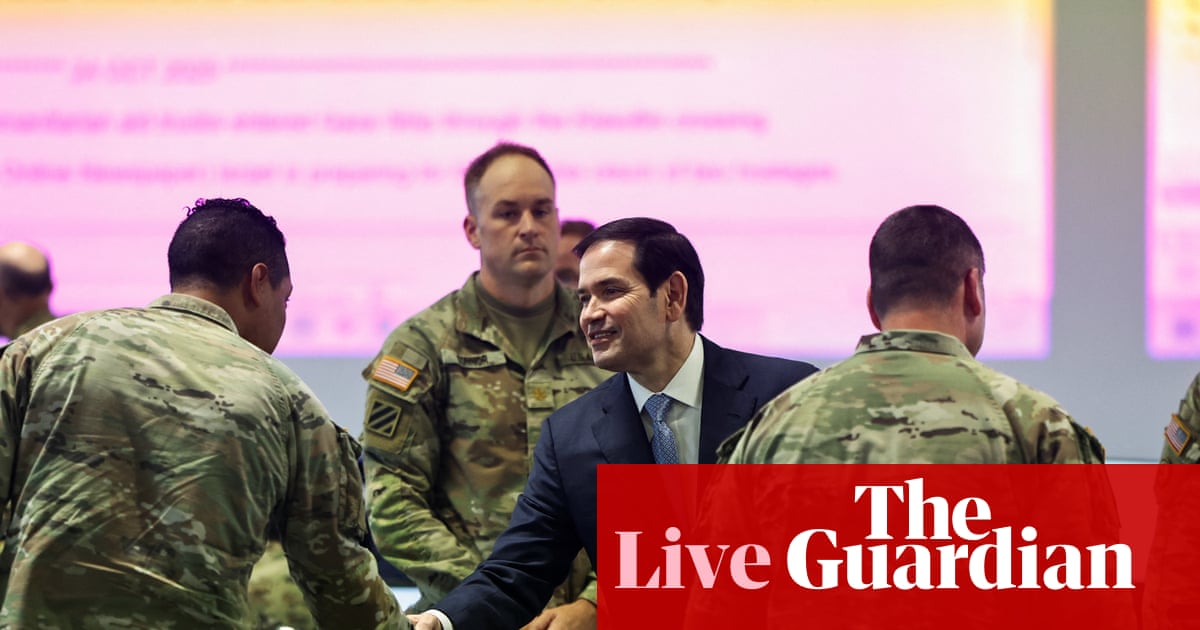
Hamas ‘cannot be involved in governing Gaza in the future’ says Rubio, as he rules out Unrwa having a role in the territory
US secretary of state Marco Rubio has said that Hamas “cannot be involved in governing Gaza in the future”.
Speaking during a press conference while on a visit to Israel, Rubio also said that the UN agency for Palestinian refugees (Unrwa) “cannot play a role in Gaza”, describing it as a “subsidiary of Hamas”.
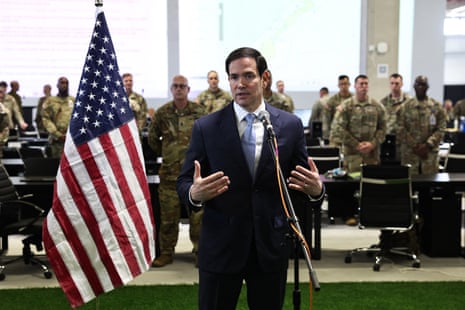 US secretary of state Marco Rubio speaks to the media after visiting the civil-military coordination centre in southern Israel on Friday. Photograph: Fadel Senna/AFP/Getty Images
Rubio added that Israel must be “comfortable” with members of an international Gaza force as he spoke from the building housing the US-Israel ceasefire coordination centre in Kiryat Gat.
Updated at 06.51 EDT
Key events
Show key events only
Please turn on JavaScript to use this feature
Closing summary
It has just gone 4.30pm in Gaza and Israel. This blog will be closing shortly but you can access all the Guardian’s Middle East coverage here.
Here is a summary of today’s main developments:
US secretary of state Marco Rubio has said that Hamas “cannot be involved in governing Gaza in the future”. Speaking during a press conference while on a visit to Israel, Rubio also said that the UN agency for Palestinian refugees (Unrwa) “cannot play a role in Gaza”, describing it as a “subsidiary of Hamas”.
Rubio said on Friday that Israel had to be at ease with the nations contributing to a future international security force in Gaza, after reports that prime minister Benjamin Netanyahu opposed Turkish involvement. “We haven’t formed that force yet, so there’s still work going on,” Rubio told reporters at a military coordination centre in southwestern Israel.
Rubio also added that more countries are ready to normalise relations with Israel but the decision would await a broader regional agreement. The US secretary of state said that a sustained end to the war would encourage more countries to join the Abraham accords, under which the United Arab Emirates, Bahrain and Morocco normalised ties with Israel in 2020.
Turkish president Recep Tayyip Erdoğan said the US and others must do more to push Israel to stop violating the Gaza ceasefire agreement, including the possible use of sanctions or halting arms sales. According to an official readout of his remarks to reporters on board a return flight from Oman, Erdoğan said Hamas was abiding by the agreement. In comments made before Rubio’s press conference, Erdoğan said that Turkey remains ready to support the planned Gaza taskforce in any way needed.
Netanyahu has ordered a halt to the advancement of parliamentary bills linked to the annexation of the West Bank after the US vice-president, JD Vance, described a vote on two bills in the Knesset as an “insult”. The bills applying Israeli law to the occupied West Bank, which would be tantamount to the annexation of land Palestinians want for a state, won preliminary approval from Israel’s parliament on Wednesday, barely a week after Donald Trump pushed through a deal aimed at ending a two-year Israeli offensive in Gaza.
The World Health Organization (WHO) has said that there has been little improvement in the amount of aid going into Gaza since the ceasefire took hold – and no observable reduction in hunger. Speaking on Thursday, WHO’s director general Tedros Adhanom Ghebreyesus told reporters that the aid situation in Gaza “remains catastrophic” and “there is not enough food” for those in the territory.
Adhanom Ghebreyesus also said that an estimated one million people in Gaza need access to mental health care. He said that the “destruction has been physical but also psychological”. While he welcomed the Gaza ceasefire, he warned that “the crisis is far from over and the needs are immense”.
Rik Peeperkorn, the WHO’s representative in the Palestinian territories, called for all crossings out of Gaza into Israel and Egypt to be opened up during the ceasefire – not only for the entry of aid but for medical evacuations too. “All medical corridors need to be opened,” he said, particularly to hospitals in the West Bank and East Jerusalem, as happened routinely before the war. He said opening the route would be a “gamechanger”.
West Bank residents fear they may be Israel’s next target after Gaza. Eager to avoid incurring the same wrath that Gaza suffered, voices of resistance have kept silent, even as the number of daily settler attacks and restrictions in the West Bank rises sharply.
Israeli settler violence targeting the Palestinian olive harvest in the occupied West Bank has continued unabated, according to Palestinian and UN officials. Since the harvest began in the first week of October, there have been at least 158 attacks across the Israeli-occupied West Bank, according to figures made public by the Palestinian Authority’s Colonization and Wall Resistance Commission (CWRC). Villagers told Reuters that a combination of military orders and settler violence had left them unable to access most of their olive crops.
After two years of war, Gaza is buried under more than 61m tonnes of debris and three-quarters of buildings have been destroyed, according to UN data analysed by Agence France-Presse (AFP). A preliminary analysis published by the UN Environment Programme (UNEP) in August warned the debris poses a serious health risk to the exposed population.
A human rights group has launched an attempt to mount a private prosecution alleging British citizens unlawfully went to fight for Israel. An application to a magistrates court for a summons against a named individual was lodged on Monday.
Delegations from Hamas and its rival Fatah met in Egypt to discuss postwar arrangements for Gaza, Egypt’s state-linked Al-Qahera News reported on Thursday. Under Trump’s 20-point plan, an international security force drawn from Arab and Muslim allies would oversee Gaza’s transition as Israeli troops withdraw.
The wife of high profile Palestinian prisoner Marwan Barghouti, Fadwa Barghouti, called on Donald Trump to help secure her husband’s release from his Israeli jail, her son Arab told AFP. Marwan Barghouti, from Hamas’s historic rivals Fatah, was among the Palestinian prisoners Hamas had wanted to see released as part of the Gaza ceasefire deal, according to Egyptian state-linked media.
At least 14 migrants died when their inflatable dinghy capsized in the Aegean Sea off the Turkish resort of Bodrum, the governor’s office said on Friday, raising an earlier toll of seven dead. “The lifeless bodies of 14 irregular migrants were recovered,” the office of the Mugla governorate said on X, quoting one of the two survivors as saying that 18 people had been on board when the dinghy went down. The fate of the other two remained unclear.
Updated at 09.31 EDT
WHO pleads for thousands of Palestinians in need of medical care to be allowed to leave Gaza
The UN’s health agency pleaded on Friday for thousands of people in desperate need of medical care to be allowed to leave Gaza, in what it said would be a “gamechanger”, reports Agence France-Presse (AFP).
The World Health Organization (WHO) has supported the medical evacuation of nearly 7,800 patients out of the Gaza Strip since the war with Israel began two years ago – and estimates there are 15,000 people currently needing treatment outside the Palestinian territory. But a US-brokered ceasefire that came into effect on 10 October has not sped up the process – the WHO has been able to evacuate only 41 critical patients since then.
Rik Peeperkorn, the WHO’s representative in the Palestinian territories, called for all crossings out of Gaza into Israel and Egypt to be opened up during the ceasefire – not only for the entry of aid but for medical evacuations too.
“All medical corridors need to be opened,” he said, particularly to hospitals in the West Bank and East Jerusalem, as happened routinely before the war. He added:
It is vital and is the most cost-effective route. If that route opened, it would really be a … gamechanger.
Speaking via video link from Jerusalem, he told journalists in Geneva that two evacuations were planned for next week, but he wanted them every day and said the WHO was ready to take “a minimum of 50 patients per day”.
At the current rate, he said evacuating the 15,000 people needing treatment – including 4,000 children – would drag on for a decade or so.
The WHO says more than 700 people have died waiting for medical evacuation since the war began. The UN health agency has called for more countries to step up and accept Palestinian patients from Gaza. While more than 20 countries have taken patients, only a handful have done so in large numbers.
Peeperkorn said only a fraction of Gaza’s health system remained in service – just 14 of 36 hospitals are even partially functional for a population topping two million.
Extensive damage seen inside al-Rantisi hospital in the al-Naser neighbourhood of Gaza City, as pictured on Thursday. Photograph: APAImages/ShutterstockShare
Updated at 09.26 EDT
At least one million people in Gaza need access to mental health care, says WHO
In a media briefing on global health issues that took place on Thursday the World Health Organization’s (WHO) director general Tedros Adhanom Ghebreyesus said that an estimated one million people in Gaza need access to mental health care. He said during the war, for those in Gaza the “destruction has been physical but also psychological”.
Adhanom Ghebreyesus said in his opening remarks:
The ceasefire announced in Gaza two weeks ago is fragile and has been violated, but continues to hold, which is great news for everyone. We welcome the return of hostages, the release of prisoners, the cessation in violence and the increase in aid flows.
But, the crisis is far from over and the needs are immense. More than 170,000 people have injuries in Gaza, including more than 5,000 amputees and 3,600 people with major burns. At least 42,000 people have injuries that require long term rehabilitation and every month 4,000 women give birth in unsafe conditions. Hunger and disease have not stopped and children’s lives are still at risk.
He added:
The destruction has been physical but also psychological. An estimated one million people need access to mental health care. The demands on the health systems are huge but significant parts of the system have been destroyed or badly degraded. There are no fully functioning hospitals in Gaza and only 14 out of 36 are functioning at all. There are critical shortages of essential medicines, equipment and health workers.
Since the ceasefire took effect, the UN agency has been sending “more medical supplies to hospitals, deploying additional emergency medical teams and scaling up medical evacuations”, said Adhanom Ghebreyesus.
After two years of war, Gaza is buried under more than 61m tonnes of debris and three-quarters of buildings have been destroyed, according to UN data analysed by Agence France-Presse (AFP).
The fragile ceasefire between Hamas and Israel, which came into effect on 10 October under pressure from US president Donald Trump, opens the way for the reconstruction of the devastated territory. This will require managing the immense amount of rubble.
As of 8 July 2025, the Israeli army had damaged or destroyed nearly 193,000 buildings in the densely populated territory, representing about 78% of existing structures before the conflict began on 7 October 2023, according to satellite analysis by the United Nations’ UNOSAT programme.
In an assessment of images from 22-23 September of Gaza City, the UN agency estimated that an even higher proportion – 83% – of buildings there had been damaged or destroyed.
An aerial view of the destruction around Masjid Ahl As Sunna, Jalal street, and Abu Hamid roundabout in Khan Younis, Gaza on 19 October 2025. Photograph: Anadolu/Getty Images
Nearly two-thirds of the debris was made in the first five months of the war, according to the UN Environment Programme (UNEP).
The destruction of buildings also accelerated in the months leading up to the current ceasefire.
Eight million tonnes of debris were generated from April to July 2025, mostly in the southern part of the territory between Rafah and Khan Younis, reports AFP.
A preliminary analysis published by UNEP in August warned the debris poses a serious health risk to the exposed population.
The UN agency suggests that at least 4.9m tonnes of debris could be contaminated with asbestos from old buildings, particularly near refugee camps such as those in Jabaliya in the north, Nuseirat and al-Maghazi in the centre, and Rafah and Khan Younis in the south.
UNEP also reports at least 2.9m tonnes of debris could be contaminated with “hazardous waste from known industrial sites”.
Updated at 08.38 EDT
The wife of high profile Palestinian prisoner Marwan Barghouti, Fadwa Barghouti, called on Donald Trump to help secure her husband’s release from his Israeli jail, her son Arab told AFP.
Marwan Barghouti, from Hamas’s historic rivals Fatah, was among the Palestinian prisoners Hamas had wanted to see released as part of the Gaza ceasefire deal, according to Egyptian state-linked media.
Rubio also added that more countries are ready to normalise relations with Israel but the decision would await a broader regional agreement.
The US secretary of state said that a sustained end to the war would encourage more countries to join the so-called Abraham Accords, under which the United Arab Emirates, Bahrain and Morocco normalised ties with Israel in 2020.
ShareGaza security force to include countries Israel ‘comfortable with,’ Rubio says
Under the ceasefire agreement an international stabilisation force, with robust powers to control security inside Gaza, is to be put in place.
Following reports that prime minister Benjamin Netanyahu opposed Turkish involvement, Marco Rubio said the force will have to be made up of countries that Israel is ‘comfortable with’.
“We haven’t formed that force yet, so there’s still work going on,” Rubio told reporters at a military coordination centre in southwestern Israel.
“There’s a lot of countries that have offered to do it. Obviously as you put together this force, it will have to be people that Israel is comfortable or countries that Israel is comfortable with as well.”
ShareHamas ‘cannot be involved in governing Gaza in the future’ says Rubio, as he rules out Unrwa having a role in the territory
US secretary of state Marco Rubio has said that Hamas “cannot be involved in governing Gaza in the future”.
Speaking during a press conference while on a visit to Israel, Rubio also said that the UN agency for Palestinian refugees (Unrwa) “cannot play a role in Gaza”, describing it as a “subsidiary of Hamas”.
US secretary of state Marco Rubio speaks to the media after visiting the civil-military coordination centre in southern Israel on Friday. Photograph: Fadel Senna/AFP/Getty Images
Rubio added that Israel must be “comfortable” with members of an international Gaza force as he spoke from the building housing the US-Israel ceasefire coordination centre in Kiryat Gat.
Updated at 06.51 EDT
US secretary of state Marco Rubio is giving a press conference during his visit to Israel, reports the Times of Israel.
The publication, which is live streaming the press conference and question and answer session with journalists, says that Rubio is speaking from the building housing the US-Israel ceasefire coordination centre in Kiryat Gat.
We will bring updates from this as soon as possible.
Delegations from Hamas and its rival Fatah met in Egypt to discuss postwar arrangements for Gaza, Egypt’s state-linked Al-Qahera News reported on Thursday.
Under US president Donald Trump’s 20-point plan, an international security force drawn from Arab and Muslim allies would oversee Gaza’s transition as Israeli troops withdraw.