
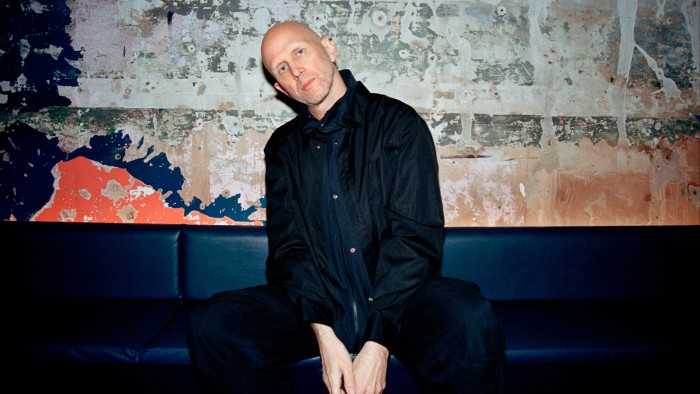
“Exhibitions on choreography and choreographers tend to be around scenography or costume design,” says Wayne McGregor, “the actual things that are part of performance, and maybe photography and film.”
McGregor, though, does things differently. Probably the best-known name in Britain’s dance world, a knight of the realm, resident choreographer at the Royal Ballet since 2006 (the first contemporary dancer to hold the post) and founder of his own Company Wayne McGregor, his work is now the subject of an exhibition at Somerset House, which opens later this month. At Wayne McGregor: Infinite Bodies the trappings and ephemera of theatrical performance will be in short supply.
“That’s not to minimise the significance of the stage work,” says McGregor, now 55, who has made at least 200 works in his 30-plus years of practice. “But my art-making is process-oriented, not product-oriented, and much of my work — with my dancers and with scientists — is about investigating physical intelligence. That’s what this exhibition is about.”
 Rebecca Bassett-Graham in Studio Wayne McGregor’s ‘No One Is an Island’ (2021) © Ravi Deepres
He believes that choreographic thinking pervades every area and moment of our daily lives. He wants us to leave Infinite Bodies not quite dancing, but more aware than ever of our bodies and the extraordinary sensibilities and possibilities they contain. At a time of AI, in which McGregor revels, he also wants to dig into the emotional and physical messiness that makes us unique.
McGregor’s practice has gone far beyond the traditional territories of ballet and contemporary dance. He has worked on Harry Potter movies, videos for The Chemical Brothers and Radiohead, fashion shows for Gareth Pugh, adverts for Selfridges, and the lifelike avatars that star in ABBA: Voyage, where the Swedish pop stars reappear in digitally spectacular form (thanks to the uber-technologists at Industrial Light & Magic) as their freshest twenty-something selves.
But equally (or indeed more) important to McGregor are the periods he has spent with cognitive neuroscientists in Cambridge trying, for example, to work out how we build images in our minds, or with roboticists working on empathetic connections. Meanwhile, with a Paris-based team at Google Arts & Culture Lab, he has developed a choreographic language agent called AISOMA — a tool that can, when fed endless moves, create and reiterate phrases and movements from a huge repository of dance data. Visitors to Infinite Bodies will get to try it for themselves.
 Wayne McGregor: ‘We have a responsibility to extend the conversation around dance-making outwards’ © Photographed for the FT by Suzannah Pettigrew
While ballet can be overly hidebound by tradition, the far reaches of the dance world can be just as elitist in their avant-garde inaccessibility. McGregor somehow manages to push at all the boundaries while keeping the public — to gauge by his audiences — involved. “We have a responsibility to extend the conversation around dance-making outwards,” he says. “Every one of us can move in some way, and has a physical imprint.”
In January next year, a book titled We Are Movement will be published by Bloomsbury. “It’s definitely not an autobiography,” says McGregor, himself a rangy 6ft 2 inches tall, often clad in flowing black Rick Owens get-ups. “It’s about how we think with our bodies, and how some physical habits get in the way of us experiencing life more fully. It’s an everyman’s guide to unlocking physical potential.” Infinite Bodies might be its parallel in exhibition form.
McGregor grew up in a working-class home in Stockport, near Manchester, and first found his way into dance through disco classes at his local dance school. He went on to take a degree in dance at Bretton Hall, a freewheeling arts institute outside Leeds, housed in a stately pile in its own park. (That building, a casualty of education cuts, is now being converted into a Yorkshire outpost of London’s Groucho Club.)
“I shared a house with a potter and a painter and a musician,” he says. “We all worked on each other’s projects; we weren’t confined by specific categories.” This tendency has infused McGregor’s work ever since. He has collaborated with artists (Tacita Dean, Olafur Eliasson), and musicians (Jamie xx, Thomas Adès), and adapted the work of writers such as Margaret Atwood into ballet form. (Reading Atwood, he says, “is like experiencing VR, but without needing the goggles.”)
 ‘Wayne McGregor: Infinite Bodies’ is at London’s Somerset House © Studio Wayne McGregor; Industrial Light & Magic
He loves the rigour these partnerships bring. “The best artistry — in music, fashion, art — is a combination of extreme creativity and incredible craft,” he says. “It’s the same in dance: you can’t fake technique, the hours of training are visible. But it’s nothing without imagination and intellect.” At the moment, his favourite downtime TV programme is a BBC documentary series on the Japanese restoration master Koji Mayuyama. “It’s so beautiful to watch him at work, taking a tea bowl that’s been messed up by a previous restoration, seeing him bringing it back to life.”
At Somerset House, visitors will be thrown into McGregor’s universe from the very first room. There they will encounter an endless pas de deux performed by two of his dancers — Italian Salvatore de Simone and the ice-white-haired Rebecca Bassett-Graham — whose bodies fold, turn and swoop across a state-of-the-art screen, their figures rendered hyper-real by a new performance-capture system developed by ILM. It is, in truth, McGregor’s entrepreneurial partnerships with technologists that will make this an exhibition unlike anything seen before.
“I’ve been thinking about virtual presence since the early ’90s,” says McGregor, his Stockport accent softened, but not erased, by his years down south. “As humans we have looked for ways to re-represent the body since the beginning. From cave drawings to Frankenstein, it’s about getting closer to ourselves through an alternative version.” This is taken to its state-of-the-art apotheosis in On the Other Earth, which premiered in both the Venice Dance Biennale and the Venice Film Festival this summer, a post-cinematic experience that immerses viewers in a wraparound stereoscopic panorama.
 Wayne McGregor’s ‘On the Other Earth’ (2025), performed by Hong Kong Ballet © Ravi Deepres
 A dancer turns to pixels in ‘On the Other Earth’ © Ravi Deepres and Luke Unsworth
“I’ve never been able to find an equivalent to live performance before,” McGregor says. But here, within a circular 12K LED screen (cinemas have 4k), an audience of up to 20 people can both feel and see the dancers around them, every hair and pore of their bodies clearly visible, every intake of breath.
“You can have the dancers pass through the audience — it’s as though they are there,” says McGregor. At other moments, their bodies appear to granulate into flurries of dots that swirl through the darkened room and flutter past your shoulder. I saw it in Venice and found it both extremely discombobulating and utterly amazing. Here, it will be in an off-site venue on London’s Shaftesbury Avenue, now called Stone Nest, but known to those of my generation as the Limelight club. It’s as good a place as any to break down the fourth wall.
If such whizz-bang tech can create a chilly experience, here the post-human embrace promises a little more warmth. And besides, the infinite bodies of the exhibition will include the visitors, as well as the dancers from McGregor’s company who will perform in the galleries of Somerset House throughout the three-month run. “I think they’re excited about it,” says McGregor when I ask if the company might find it a chore or even an imposition to dance their way through unsuspecting crowds. “I attract dancers who are intellectually and creatively curious. They are up for other things apart from being on a stage or in a rehearsal room.”
And visitors will be performing too, recording a few steps in a high-tech set-up, and having them played back, matched or enhanced by the McGregor AISOMA archive. “I’ve been giving it my best moves,” says Cliff Lauson, the Somerset House curator who is responsible for getting the show on the road. At other times, dancers from McGregor’s company will grab those phrases and give them a whirl, too.
 Wayne McGregor, photographed for the FT by Suzannah Pettigrew
“The exhibition really offers a triangulation of body, movement and technology,” says Lauson, who has previously curated big shows with living visual artists including Gerhard Richter and Bridget Riley. “It completely subverts the monolithic characteristic of the standard art exhibition. It’s alive in lots of parts. It will be different every time you visit, if you come more than once.”
But for those wanting something real, McGregor’s notebooks will be on display. “Cambridge took all my choreographic notebooks away and analysed how I think with paper,” says McGregor of a team of cognitive neuroscientists. “They offer an analogue window into my world.” Who could resist taking a look?
‘Wayne McGregor: Infinite Bodies’, Somerset House, London, and ‘Wayne McGregor: On The Other Earth’, Stone Nest, London, October 30 to February 22 2026, somersethouse.org.uk
Find out about our latest stories first — follow FT Weekend on Instagram, Bluesky and X, and sign up to receive the FT Weekend newsletter every Saturday morning