Israel News Beep | NewsBeep.com
  • News Beep
  • Israel
  • Headlines
  • Business
  • Entertainment
  • Health
  • Science
  • Sports
  • Technology
Israel News Beep | NewsBeep.com
  • News Beep
  • Israel
  • Headlines
  • Business
  • Entertainment
  • Health
  • Science
  • Sports
  • Technology

Browsing Category

Science

49167 posts
SScience
The Blueprint
Read More

Scientists watch electrons assemble and reassemble in real time

  • August 9, 2026
A new experiment offers scientists an unprecedented look at how different electronic phases emerge, disappear, and re-form inside…

SSpace
Elon Musk says SpaceX will hit $1 trillion in revenue by 2030 and build factories on the moon
Read More

Elon Musk says SpaceX will hit $1 trillion in revenue by 2030 and build factories on the moon

  • August 9, 2026
Elon Musk loves a bold prediction. From humans colonizing Mars to flooding U.S. roads with robotaxis by 2020,…
WWildlife
Operation Beluga -- or how a Soviet ice breaker played music to thousands of ice-trapped whales to save them from starving
Read More

Operation Beluga — or how a Soviet ice breaker played music to thousands of ice-trapped whales to save them from starving

  • August 9, 2026
Credit: Library of Congress collection. The Soviet Union now belongs largely to memory and history books, and many…
SScience
What if The Brain Doesn't Create Consciousness? Scientist Proposes It Might Be The Fabric of Reality Itself : ScienceAlert
Read More

What if The Brain Doesn’t Create Consciousness? Scientist Proposes It Might Be The Fabric of Reality Itself : ScienceAlert

  • August 9, 2026
For decades, neuroscientists have searched the brain for the biological basis of consciousness, assuming our thoughts, emotions, and subjective…
SSpace
For roughly a billion years of Earth’s deep past, the Moon’s ocean tides may have slowed the planet while a Sun-driven atmospheric tide sped it up, holding the day near 19 hours — but the rocks preserve a hypothesis, not a stopwatch
Read More

For roughly a billion years of Earth’s deep past, the Moon’s ocean tides may have slowed the planet while a Sun-driven atmospheric tide sped it up, holding the day near 19 hours — but the rocks preserve a hypothesis, not a stopwatch

  • August 9, 2026
We built clocks around the day and then quietly began treating the day as though it were a…
WWildlife
Punch The Baby Monkey: Punch, the baby monkey, turns 1: His childhood loneliness has turned him into a baby protector and he’s received 25000 birthday cards on his special day
Read More

Punch The Baby Monkey: Punch, the baby monkey, turns 1: His childhood loneliness has turned him into a baby protector and he’s received 25000 birthday cards on his special day

  • August 9, 2026
Punch, the orphaned baby Japanese macaque at Ichikawa City Zoo, Tokyo, who conquered the hearts of millions while…
SScience
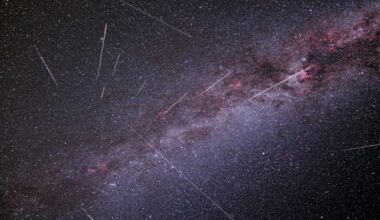
A composite image showing the peak of the Perseid Meteor shower, 12-13 August 2023, captured by Greg Meyer from Phoenix, Arizona, USA. Taken with a Canon Rebel and 14mm Rokinon lens at 2.8, ISO 1600, 90 sec exposures on a Star-Adventurer Star Tracker.
Read More

Want to see a solar eclipse and a meteor shower in one day? US astronomer reveals all you should know to enjoy the stargazing event of the year

  • August 9, 2026
August will bring two opportunities to look skyward as a solar eclipse and the annual Perseid meteor shower…
EEnvironment
Plastics contamination an ‘overlooked’ concern in food waste schemes, experts say | Food waste
Read More

Plastics contamination an ‘overlooked’ concern in food waste schemes, experts say | Food waste

  • August 9, 2026
Plastic contamination should be a central concern in efforts to deal with food waste, which campaigners call one…
SSpace
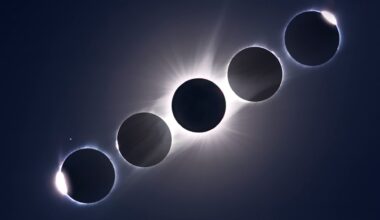
A composite image of 5 sun/moon conjunctions showing the stages of a total solar eclipse arrayed in a diagonal line in a dark sky, with the point of maximum eclipse in the middle.
Read More

Here’s what to expect from 5 stages of the total solar eclipse 2026

  • August 9, 2026
We’re just a few short days away from the Aug. 12 total solar eclipse, when millions will watch…
SScience
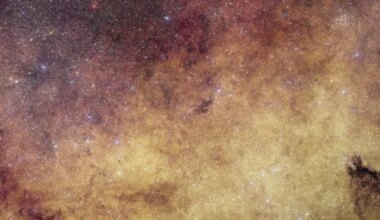
This image by ESA’s (European Space Agency) Euclid (with color added using ground-based images) provides an earlier snapshot of a region of our galaxy that NASA’s Nancy Grace Roman Space Telescope will repeatedly observe during the upcoming years. Euclid spent one day taking a series of nine individual images near the heart of the Milky Way. Its wider image has resolution similar to Roman’s, though it’s also shallower and lacks some of the colors Roman will see. At the right of the frame, Euclid looks through the dense foreground of the Milky Way’s galactic plane, where thick molecular clouds appear as dark patches that obscure parts of the galactic bulge beyond. Toward the left, the view rises to higher galactic latitudes: the yellow glow of the bulge becomes clearer, with fewer and more isolated foreground clouds interrupting the starlight. Image credit: ESA/Euclid/Euclid Consortium/NASA, CFHT, image processing by J.-C. Cuillandre and E. Bertin (CEA Paris-Saclay)
Read More

Euclid View of Milky Way Heart Previews Core Survey by NASA’s Roman

  • August 9, 2026
A new look at the heart of our Milky Way galaxy by Euclid, an ESA (European Space Agency)…
EEnvironment
St Pete Beach owners charged with allegedly dumping mothballs near bird nests
Read More

St Pete Beach owners charged with allegedly dumping mothballs near bird nests

  • August 9, 2026
NEWYou can now listen to Fox News articles! Two Florida business owners have been charged with third-degree felonies…
SSpace
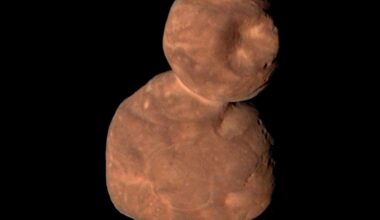
NASA’s New Horizons spacecraft flew past Pluto in 2015 and kept going, and in January 2019 it photographed a small icy world called Arrokoth four billion miles from the Sun, the most distant object ever visited, shaped like two snowballs gently stuck together since the solar system’s birth
Read More

NASA’s New Horizons spacecraft flew past Pluto in 2015 and kept going, and in January 2019 it photographed a small icy world called Arrokoth four billion miles from the Sun, the most distant object ever visited, shaped like two snowballs gently stuck together since the solar system’s birth

  • August 9, 2026
At 5:33 UTC on 1 January 2019, NASA’s New Horizons spacecraft passed roughly 3,500 kilometres from a small…
Israel News Beep | NewsBeep.com
www.newsbeep.com