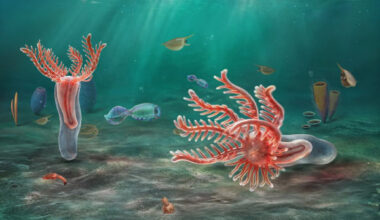
SScience Read More Early Cambrian Fossil Rewrites Starfish Family TreeOctober 21, 2026 A 518-million-year-old ambulacrarian fossil from China suggests that the common ancestor of starfish and their relatives was not…
SScience Read More Scientists find evidence for an ancient supercontinent that covered 80 percent of Earth’s surfaceSeptember 14, 2026 A new global isotopic map has revealed vast fragments of ancient Gondwanan crust buried beneath younger mountain belts…
SScience Read More 520-Million-Year-Old Fossil from China Fills Gap in Evolutionary History of CephalopodsJuly 30, 2026 Paleontologists have identified the earliest-known cephalopod equipped with a siphuncle — a tubular extension of the mantle found…
SScience Read More Ancient Sea Creature Pushes Back Origins of Spider Fangs to 518 Million Years AgoJuly 1, 2026 Urokodia aequalis, an early Cambrian marine predator from the Chengjiang biota of China, preserves the earliest known evidence…
EEnvironment Read More Earth’s Earliest Animals May Have Thrived Too Easily to EvolveJune 11, 2026 Fossils from some of the oldest-known animals on Earth, dating from 574 million years ago (Ediacaran period), suggest…
SScience Read More Complex Colonial Life Was Already Thriving during Cambrian ExplosionJune 3, 2026 Tiny colonial animals called bryozoans were long thought to have appeared tens of millions of years after the…
SScience Read More 490-Million-Year-Old Arthropod Fossil Fills Puzzling Gap in Fossil RecordMay 29, 2026 A new species of corcoraniid arthropod that lived during the Furongian epoch, between 497 and 487 million years…
SScience Read More Rethinking the Cambrian Explosion: Before Shells and Limbs, There Was the BrainMay 6, 2026 A new hypothesis proposes that the Cambrian Explosion — the sudden burst of animal diversity 500 million years…
SScience Read More Ediacaran Fossils from China Rewrite Timeline of Animal EvolutionApril 7, 2026 An assemblage of more than 700 Ediacaran fossils from the end of the Ediacaran period indicates that key…
SScience Read More Paleontologists Find Traces of Chitin in Cambrian Trilobite FossilFebruary 9, 2026 The detection of chitin in an Olenellus trilobite from the Carrara Formation (514.5 to 506.5 million years ago)…
SScience Read More Over 500 Million Years Ago, Early Vertebrates Had Four Eyes That Could See 360 DegreesJanuary 30, 2026 General morphology of the lateral eyes and pineal complex with their preserved melanosomes in two species of Myllokunmingidae…