SScience Read More Dark energy could lead to a ‘Big Crunch’ end for our universe: StudyDecember 29, 2025 For nearly three decades, the scientific world has operated under an assumption: the universe is flying apart faster…
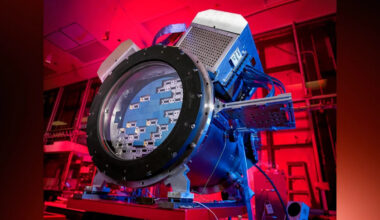
SSpace Read More NASA Completes Nancy Grace Roman Space Telescope ConstructionDecember 4, 2025 NASA’s next big eye on the cosmos is now fully assembled. On Nov. 25, technicians joined the inner…
SSpace Read More You’re Living Alongside Invisible Wormholes, Scientists Say—and They May Be Warping Your RealityNovember 18, 2025 Churning nano-wormholes could explain the clash in our cosmological constants. The wormholes add magnitude to a math parameter…
SSpace Read More Scientists Think They Figured Out How and When the Universe Will EndNovember 6, 2025 Here’s what you’ll learn when you read this story: A new paper adjusts an equation that defines our…
PPhysics Read More Scientists May Have Found the Smallest Clump of Dark Matter Ever Seen — and It’s Still a Million Times Heavier Than the SunOctober 19, 2025 Overlay of the infrared emission (black and white) with the radio emission (colored). The dark, low-mass object is…
SSpace Read More Information could be a fundamental part of the universe – and may explain dark energy and dark matterOctober 13, 2025 When you buy through links on our articles, Future and its syndication partners may earn a commission. An…
SSpace Read More Physicists Predict When The Universe Will End in a Reverse Big BangOctober 9, 2025 If recent discoveries that dark energy is evolving hold any water, our Universe will collapse under its own…
SScience Read More Is Dark Energy Born inside Black Holes?October 5, 2025 Black holes are eaters of all things, even radiation. But what if their rapacious appetites had an unexpected…
SScience Read More Cosmic ‘big crunch’ may end universe in 20 billion years: PhysicistOctober 2, 2025 The universe may not expand forever as scientists once believed. According to new calculations by Cornell physicist Henry…
SSpace Read More Most detailed universe simulation yet: ESA’s Euclid project maps 3.4 billion galaxiesSeptember 27, 2025 The catalogue describes each galaxy using more than 400 properties, including brightness, shape, velocity, and star formation rate.…
PPhysics Read More The observable universe is just 5% of reality, 95% remains invisible!September 9, 2025 Ordinary matter, also called baryonic matter, consists of protons, neutrons, and electrons. This is the material that emits…
PPhysics Read More Observable universe is 93 billion light years wide but what’s beyond it? Here’s what we can’t see…September 8, 2025 One of the most important pieces of evidence for this limit is the cosmic microwave background radiation, faint…