SScience Read More Connecting Polarization To Exoplanet Yield Calculations For Habitable Worlds Observatory (HWO)June 14, 2026 Overview of the simulation pipeline components used in this work. The modeling begins with hwo pol, a Poke…

SScience Read More Japan’s Possible Contributions For Coronagraph Of The Habitable Worlds Observatory (HWO)June 13, 2026 Example of the optical design for the NIR coronagraph. (Top) Overall layout of the optical system, where the…
SScience Read More Predictive Rankings of the Probability for Temperate Terrestrial Worlds for the HWO ExEP Mission Star ListJune 5, 2026 The simulated occurrence rates of planets in both simulated (blue) and known (orange) planetary systems around nearby stars.…
SScience Read More The Unique Ability Of The Hubble Space Telescope To Characterize Young Exoplanet EnvironmentsMay 30, 2026 Modified Pass et al. (2025) Figure 2 showing an updated Cosmic Shoreline for exoplanets orbiting full convective M…
SScience Read More HWO Target Stars and Systems: Activity and Rotation Catalog (ARC) of Potential Target Stars for the Habitable Worlds ObservatoryMay 25, 2026 Upper panels: Equatorial rotational velocity (veq) vs. projected rotational velocity (v sin i) for stars in Tiers 1,…
SScience Read More PEEPSS: Photonic-Enabled ExoPlanet Spectroscopic Sensor for the Habitable Worlds ObservatoryApril 30, 2026 The complete proposed wavefront sensing process. (Starting from the top left and going around clockwise) The full coronagraph…
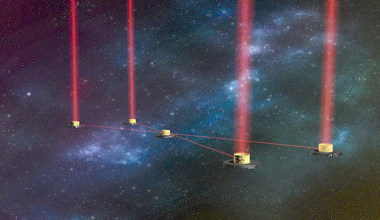
SScience Read More Continuing To Advance European High Contrast Imaging Research And Development Towards HWO And LIFEApril 20, 2026 Artist’s impression of the LIFE nulling-interferometry mission, consisting of four collector spacecraft in a rectangular array configuration sending…
SScience Read More Searching For Life-As-We-Don’t-Know-It: Mission-relevant Application of Assembly Theory For Exoplanet Life DetectionMarch 14, 2026 Potentially habitable worlds – Grok via Astrobiology.com This white paper introduces a framework for applying Assembly Theory (AT)…
SSpace Read More Space telescopes at light speedFebruary 5, 2026 Light is the fastest phenomenon in the universe, clocking in at just under 300,000 kilometers per second. The…