Israel News Beep
  • News Beep
  • Israel
  • Headlines
  • Business
  • Entertainment
  • Health
  • Science
  • Sports
  • Technology
Israel News Beep
Israel News Beep
  • News Beep
  • Israel
  • Headlines
  • Business
  • Entertainment
  • Health
  • Science
  • Sports
  • Technology

Browsing Tag

Marshall Astrophysics

8 posts
SSpace
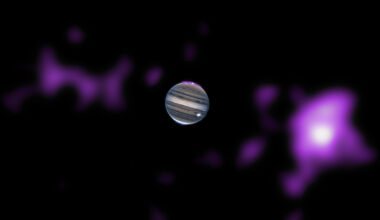
Three new Chandra sonifications of data of Jupiter, Saturn, and Uranus have been released. Planets and other Solar System bodies can reflect X-rays given off by the Sun, which Chandra can detect. Sonification is a process that translates data captured by Chandra and other telescopes into sound. In addition to X-rays from Chandra, these new sonifications contain data from Hubble, Cassini, and Keck telescopes. In this image, the amount of diffuse X-rays from a donut-shaped ring of energetic particles around Jupiter, seen on the left and right side of the planet, has been enhanced compared to the amount of X-rays from the planet's auroras, seen at the poles. As the scan moves left to right, it encounters X-rays that bracket the planet on either side, and this plays as woodwind sounds. As we pass over the planet itself, seen in an infrared image from NASA’s Hubble Space Telescope, the sounds become fuller as the infrared data is represented by other instruments. Since Jupiter is tilted slightly, the pitch descends as the scan passes over the bright band near the equator and through the Great Red Spot. On the other side, more X-ray data from Chandra flanks the planet and can be heard as gusty wind sounds at the end.
Read More

Listen to This Month’s ‘Planetary Parade’ With NASA’s Chandra

  • February 26, 2026
In late February, people in the Northern Hemisphere can look up for a special sight: six planets will…
SScience
HD 61005 in X-ray and Infrared light.
Read More

Young ‘Sun’ Caught Blowing Bubbles by NASA’s Chandra

  • February 23, 2026
For the first time, a much younger version of the Sun has been caught red-handed blowing bubbles in…
SSpace
This image contains lower-, medium-, and higher-energy X-rays in red, green, and blue respectively.
Read More

NASA’s Chandra Releases Deep Cut From Catalog of Cosmic Recordings

  • January 24, 2026
Like a recording artist who has had a long career, NASA’s Chandra X-ray Observatory has a “back catalog” of cosmic…
SScience
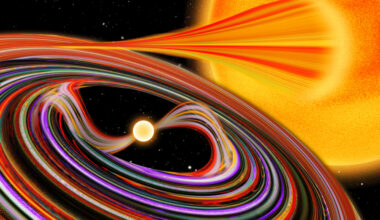
This artist’s concept depicts a smaller white dwarf star pulling material from a larger star, right, into an accretion disk. Earlier this year, scientists used NASA’s IXPE (Imaging X-ray Polarization Explorer) to study a white dwarf star and its X-ray polarization.
Read More

NASA’s IXPE Measures White Dwarf Star for First Time

  • January 5, 2026
By Michael Allen  For the first time, scientists have used NASA’s IXPE (Imaging X-ray Polarization Explorer) to study a…
SScience
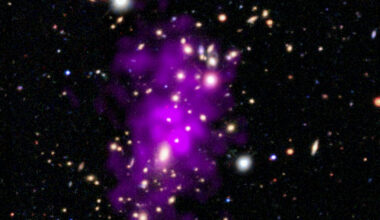
This release features a composite image of a galaxy cluster first discovered on New Year's Eve day, 2020. The cluster appears here as a large collection of brilliant white lights, each a distinct galaxy. A neon purple cloud stretches across the cluster's crowded core. Many of the hundred-plus galaxies in the cluster are in two clumps of galaxies towards the top and bottom of center. Some are encircled by a faint glowing haze, while a few foreground stars gleam with diffraction spikes. Some of the smaller galaxies are tinted blue, orange, or red, and some appear more oblong than round, suggesting spiral shapes viewed edge-on. The neon purple cloud sits at the heart of the image, surrounding the most densely-packed part of the cluster. This cloud, which spreads vertically across the cluster, is multimillion-degree gas observed by Chandra. The two clumps of observable galaxies, and the spread of superheated gas, reveal that the Champagne Cluster is in fact two clusters in the process of colliding. With the two clusters of sparkling light clinking together, and the auspicious discovery date, astronomers have dubbed the merged cosmic structure "The Champagne Cluster".
Read More

NASA’s Chandra Rings in New Year With Champagne Cluster

  • December 30, 2025
Celebrate the New Year with the “Champagne Cluster,” a galaxy cluster seen in this new image from NASA’s…
SScience
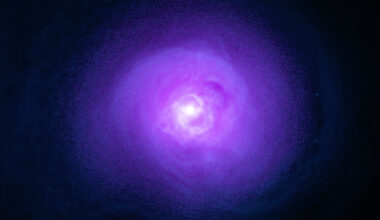
Chandra & IXPE composite image of the Perseus Cluster.
Read More

NASA IXPE’s Longest Observation Solves Black Hole Jets Mystery

  • December 16, 2025
Written by Michael Allen An international team of astronomers using NASA’s IXPE (Imaging X-ray Polarimetry Explorer) has identified…
SSpace
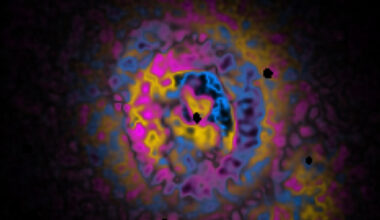
Painting Galaxy Clusters by Numbers (and Physics)
Read More

Painting Galaxy Clusters by Numbers (and Physics)

  • December 10, 2025
Galaxy clusters are the most massive objects in the universe held together by gravity, containing up to several…
SScience
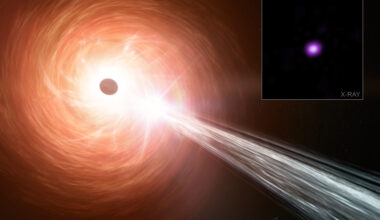
An artist's concept of a supermassive black hole, a surrounding disk of material falling towards the black hole and a jet containing particles moving away at close to the speed of light. This black hole represents a recently-discovered quasar powered by a black hole. New Chandra observations indicate that the black hole is growing at a rate that exceeds the usual limit for black holes, called the Eddington Limit. Credit: NASA/CXC/SAO/M. Weiss
Read More

NASA’s Chandra Finds Black Hole With Tremendous Growth

  • September 18, 2025
A black hole is growing at one of the fastest rates ever recorded, according to a team of…
Israel News Beep
www.newsbeep.com