
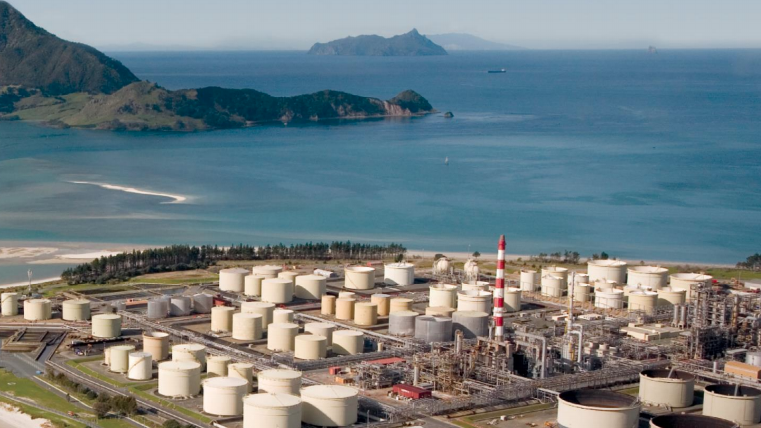
So, what was it New Zealand? Did our economy tank 0.9% in the June quarter? Or was the real GDP figure, as Westpac economists now think, a fall of about 0.1%? And what’s the now closed Marsden Point oil refinery got to do with it?
Westpac senior economist Michael Gordon has done a very comprehensive crunch on our GDP figures, trying to get behind why they have in the recent past become so volatile.
And he’s come up with what look like compelling and very interesting reasons.
For the March quarter of this year the official figures showed that our GDP rose by a reasonably encouraging 0.9%. However, the June quarter results released last month in a hailstorm of negative publicity showed our economy dropping, stone-like by, well, 0.9%.
Economists generally were disinclined to believe our economy really grew 0.9% in the March quarter and even more disinclined to think it shrank 0.9% in the June quarter. But clear cut reasons were not really on offer.
Now Gordon has drilled down on the stats and produced eminently plausible explanations.
It’s very technical, and my apologies for my efforts to simplify.
Fascinatingly, a key reason for the volatility has been the after-effects of the now long-closed Marsden Point oil refinery. This has all got mixed up with the ‘chain-linking’ statistical method, and with seasonal adjustment.
Here’s Gordon’s explanation:
Total GDP is not simply the sum of the individual parts. Instead, it uses a more roundabout approach called chain-linking, which works as follows:
Calculate the percentage change in real (inflationadjusted) output for each industry
Assign a weight to each industry based on its share of GDP in nominal (dollar value) terms.
Calculate the weighted-average growth rate.
Apply this growth rate to the previous level of GDP to get the new level.
As Gordon goes on to say the use of both real and nominal values is what makes the results differ from a straight add-up of output by industry. The difference that we get between the total (chain-linked) GDP and the simple sum of the industries is given the name of “the balancing item”.
A point I add here for an attempt at further clarity is that Stats NZ does the chain-linking process first – and then applies seasonal adjustment. The reason for saying that becomes clear shortly.
For the September quarter every year Stats NZ makes its annual revisions to GDP, to incorporate more detailed but less timely information. That includes updating the industry weights that are used in chain-linking.
The weights are drawn from the national accounts for the previous March year, or the latest year for which the data is available.
Things started getting strange
In September of last year, (and this is me talking not Gordon), something pretty screwy started happening and the ‘balancing item’ started getting way more variable and displaying a marked seasonal pattern.
Here’s Gordon again: “What this tells us is that there’s been a change in the seasonality of GDP that the algorithm isn’t fully capturing, which is detracting about 0.5% from reported growth in June quarters while adding about 0.5% in December quarters.”
Gordon says it’s a reasonable guess that the change in seasonality stems from a change in the industry weights.
“…We believe that it’s due to the absence of an industry – namely, the closure of the Marsden Point oil refinery, which previously accounted for about 0.6% of GDP,” Gordon says.
“Crucially, the refinery’s output had no seasonal pattern to it, so its closure meant a slight increase in the average degree of seasonality across the economy. The use of chain-linking amplified this effect.
“Once the refinery’s weight dropped to zero, this meant that the weights for every other industry – including those that do have strong seasonal patterns – went up.
“The result was that the amplitude of the seasonal pattern in GDP increased by about 0.6 percentage points. That might seem like a small effect, but that’s the magnitude of the change that we’re trying to explain.”
The refinery’s gone, but its effects linger…
Gordon notes that there is one seeming challenge to this story, namely that the refinery was closed in March 2022 – so why is it only in the last year that it has had this effect on GDP?
“The reason again relates to the chain-linking method: the closure wasn’t reflected in the industry weights until the national accounts for the year ended March 2023. And those figures weren’t available until late 2024, in time to be included in the September quarter 2024 release.
“The last piece of the puzzle is the seasonal adjustment algorithm. Because its calculations are based solely on historic data, it can take several years for it to recognise that a structural change has occurred. Given another few years, the seasonal adjustment would gradually catch up with the new reality, and the volatility in quarterly GDP would dampen down again,” Gordon says.
“To sum up: (1) the closure of the refinery increased the average seasonality across industries, (2) the effect was both delayed and amplified by the chain-linking process, and (3) the seasonal adjustment has yet to recognise this change. Not one single cause, but an interaction between three factors, which is what made it so hard to identify.”
Okay, so, that’s the problem, I think convincingly identified. The solution?
Well, at the moment Stats NZ does the chain-linking first and then does seasonal adjustment. Gordon says you simply swap these steps, IE do the seasonal adjustment first and THEN the chain-linking.
“…By first removing the seasonal pattern from every industry, a change in the industry weights could no longer introduce a new seasonal pattern into the total,” Gordon says.
What are the real figures then?
By using this method and also through identifying “some industry-specific timing issues that have had an impact on quarterly growth rates”, the Westpac economists have adjusted that 0.9% June quarter GDP drop to just a 0.1% drop, while using the same method they’ve produced (downwardly adjusted) gains of 0.2% and 0.4% in the two previous quarters.
Gordon says this “still points to a mid-year loss of momentum, but less dramatically than in the official figures”.
He says though that while the 0.1% drop they’ve calculated for the June quarter is “quite different from the -0.9% that was officially reported”, it’s still a disappointing result, “coming at a time when we would’ve hoped to see the economy gaining some momentum on the back of lower interest rates”.
“And our downward adjustments to the December and March quarters show that the economy’s initial recovery wasn’t all that convincing in the first place.”
So, there we have it. Our economy is not doing great, but it didn’t tank in the June quarter either.
The truth is stranger.
The aftermath of the closure of the Marsden Point refinery has apparently messed up our measurement of GDP.