
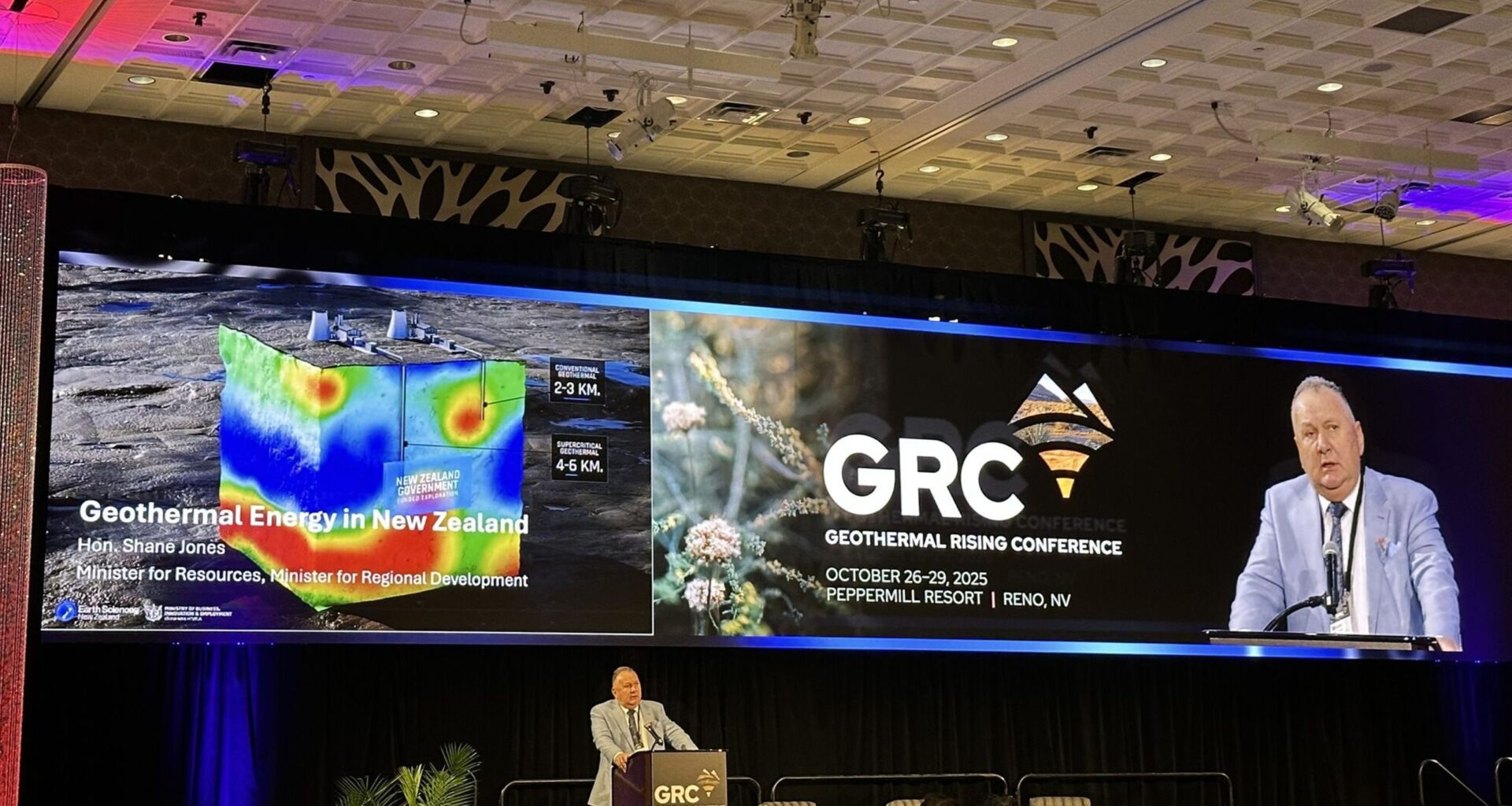
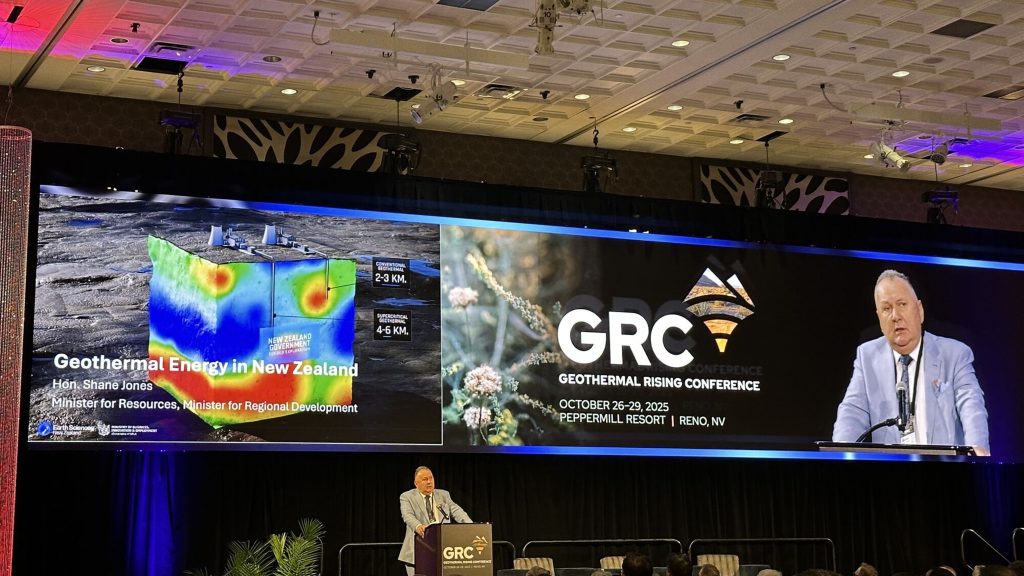
New Zealand Resources Minister Shane Jones at the Geothermal Rising Conference 2025 in Reno, Nevada (source: Earth Sciences NZ via LinkedIn)
The international expert panel to support New Zealand’s supercritical geothermal work has been announced, chaired by Stanford’s Professor Roland Horne.
New Zealand Resources Minister Shane Jones has announced the members of the international review panel for the country’s pioneering supercritical geothermal exploration project.
Stanford University earth science and engineering expert Professor Roland N Horne will chair the international review panel. He will be joined by geologist Dr Omar Friðleifsson and well engineer Kristinn Ingason who both work for the Iceland Deep Drilling Project. The fourth member of the panel is United States geochemist Dr Darrell Gallup.
The announcement was made during the Minister’s keynote speech to the 2025 Indigenous Geothermal Symposium, part of the Geothermal Rising Conference held in Reno, Nevada.
“We’ve also appointed a top-tier New Zealand team of technical experts who will design the well, the equipment needs, and the steps to get us to the extreme depths for accessing supercritical geothermal fluids. It’s exciting to see such high-powered collaboration for the greater good of energy security, not just for New Zealand but for the world,” added the Minister.
The technical design team for the supercritical geothermal project has now been assembled and comprises experts from Mercury NZ, Contact Energy, Upflow NZ, Geode Well Engineering and Earth Sciences NZ. Some weeks ago, an announcement was made that the site for the first drilling operations has already been determined within the Rotokawa Geothermal Reservoir. Last year, Minister Jones announced that the New Zealand government ring-fenced up to $60 million from the Regional Infrastructure Fund to explore the potential of supercritical geothermal technology.
“Although geothermal energy has been a steadily growing energy source worldwide for more than 70 years, new technology and new ideas have opened new doors and led to renewed interest in its global potential,” said Prof Horne. “New Zealand was at the forefront of the first geothermal revolution in the 1950s and is now well placed to lead the move forward to superhot, supercritical geothermal resources, which are bigger and more efficient.”
“This is one of the most technically demanding frontiers in geothermal technology and science. It represents a bold and globally significant step forward in the pursuit of clean, resilient and reliable renewable energy and shows how science, innovation, and partnership with M?ori can shape a sustainable energy future,” said Mr Jones.
Source: Beehive.govt.nz