
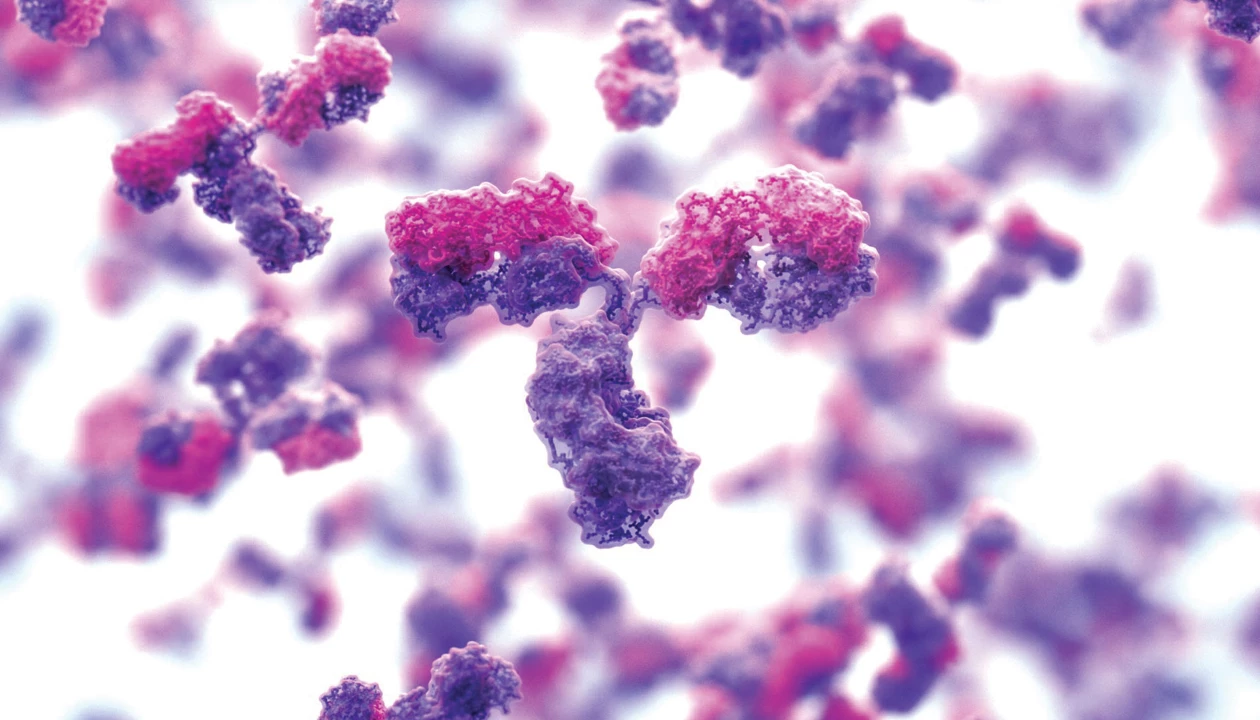
Researchers from the University of Washington’s Institute for Protein Design have developed a new variation of diffusion-based de novo protein design to generate new antibodies (Nature 2025, DOI: 10.1038/s41586-025-09721-5). The researchers are also making the new algorithm, RFantibody, fully available to researchers.
Researchers at the lab of Nobel laureate David Baker have already developed protein minibinders that perform a similar function to an antibody. But Robert Ragotte, one of the authors of the new paper, says artificial intelligence–designed antibodies have a few advantages over the minibinders.
Because humans already make their own antibodies, antibodies are less likely to be immunogenic because the body is more familiar with them. Additionally, antibodies are already widely used in the pharmaceutical world, while the minibinders would be an entirely new modality. But antibodies have eluded AI protein design programs because of their complementarity-determining region loops, which are flexible. Flexibility introduces uncertainty into the design process, as “there isn’t one true structure,” Ragotte says.
The Baker Lab is not the only academic lab releasing new results in recent weeks. At the end of October, the Boltz team, led by Massachusetts Institute of Technology professors Regina Barzilay and Tommi Jaakola, released its latest model.
BoltzGen, developed by PhD student Hannes Stärk, is an all-atom generative model for designing proteins and peptides to bind a wide range of biomolecular targets.
“The emphasis here is on unsolved problems,” Barzilay said on a call with reporters, which she joined straight from teaching a class on AI and drug discovery. That’s why, she says, the Boltz team is focusing on finding solutions to currently undruggable targets. The work is described in a preprint that has not yet been peer-reviewed.
Chemical & Engineering News
ISSN 0009-2347
Copyright ©
2025 American Chemical Society