
Stay informed with free updates
Simply sign up to the Climate change myFT Digest — delivered directly to your inbox.
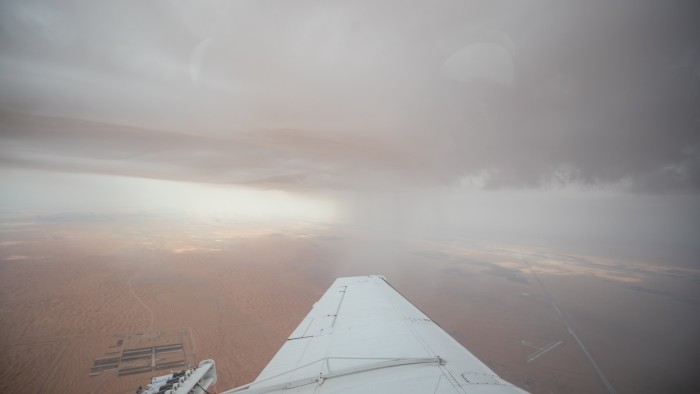
Wherever a dark cloud forms above the barren mountains of the United Arab Emirates, a pilot stands ready to jump into a propeller plane and shoot the fluffy formation with salt — all in the hope of making it rain.
The operation, called cloud seeding, costs the arid Gulf state millions of dollars each year to boost freshwater supplies.
The technique — in which potassium chloride is added to the cloud to trigger the formation of raindrops — is controversial, with some critics blaming it for exacerbating extreme weather events. Yet cloud seeding is increasingly used by many states struggling to adapt to a changing climate.
“Cloud seeding is seen as an additional potential tool for boosting water supply,” says Orestes Morfín, senior expert in water resources and infrastructure risk management with the Climate and Water Initiative, an Arizona-based non-profit.
 © Andrea DiCenzo/Getty Images
The process is also used to mitigate “extreme weather events” — for example, to reduce the force of hailstorms in the US and Canada, he says.
For the UAE, cloud seeding is part of its “adaptation strategy to face climate change,” says Alya Al Mazrouei, director of the UAE Research Program for Rain Enhancement Science (UAEREP).
Saudi Arabia also launched a cloud seeding programme in 2022, aiming to increase rainfall and vegetation cover.
The UAE has long faced water scarcity. The desert state receives less than 100mm of rainfall per year and has limited natural groundwater recharge, so it depends heavily on large desalination plants to supply drinking water.
But since the early 2000s, UAE authorities have sought to increase rainfall by inducing clouds to release more water. Today, the UAE’s rain enhancement programme has 10 pilots and four Beechcraft King Air C90s, which Mazrouei says are prepared 24/7.
“Whenever we have the opportunity to do it, any weather condition, whenever we have the seedable clouds to do it, we don’t usually miss any opportunity,” she says.
 Alya Al Mazrouei oversees research into boosting water supplies through cloud seeding
Each hour of flight costs $8,000, and the programme conducts an average of 1,100 flight hours annually — equivalent to nearly $9mn. Although this appears costly, Mazrouei argues that the cost per cubic metre of additional water is lower than for desalination. Meanwhile, she adds, the UAE has funded $22.5mn worth of research grants to improve cloud seeding technology.
The science behind cloud seeding is relatively simple, and the phenomenon can sometimes occur accidentally. For example, in 1990, a scientist in South Africa observed that a wood-pulping factory was inadvertently boosting cloud formation.
In the UAE, an aircraft swoops across the base of a convective cloud — a cloud formed by rising warm air — which is chosen for its water mass and the strength of the up-draft, or rising air current. That up-draft is critical because it carries the agents fired out by the aircraft.
Recommended

These agents are salt particles, which cause the water vapour in the cloud to coalesce into raindrops. Rain can begin within about 15 minutes for the cloud to rain, Mazrouei said, although success is not guaranteed.
According to scientists linked to the rain-enhancement programme, the technique is having an effect: a 2021 peer-reviewed study found that rainfall in areas targeted by cloud seeding, increased by an average of 23 per cent, while storms that had been seeded generated a 159 per cent larger volume.
Scientists at the UAE’s National Centre of Meteorology (NCM), subsequently estimated in a 2023 study that the country’s cloud seeding programme could enhance harvestable water volumes by anywhere between 84mn and 419mn cubic metres per year.
However, researchers caution that outcomes vary and exact gains are difficult to quantify. “It’s not quite a precise return on investment,” says Morfín.
Recommended

The technique has its critics — including those concerned about the impact on the environment of the chemicals used to seed clouds.
Some even blamed a devastating storm that struck the UAE last year on cloud seeding, although the NCM denied any seeding activity had been conducted and other scientists said climate change and urbanisation were the more likely causes of the record rainfall.
Supporters argue that misconceptions are obscuring cloud seeding’s usefulness. “As imprecise as it may be in certain contexts, it’s a tool that you can use and has been proven to work,” says Morfín.
Europe’s Climate Leaders
The FT is compiling its sixth annual list of Europe’s climate leaders. We’re looking for those companies that are making the most progress in cutting greenhouse gas emissions and remain committed to reducing their impact on the environment. For more information on how to register, click here. The deadline for entries is November 15.
Climate Capital
Where climate change meets business, markets and politics. Explore the FT’s coverage here.
Are you curious about the FT’s environmental sustainability commitments? Find out more about our science-based targets here