
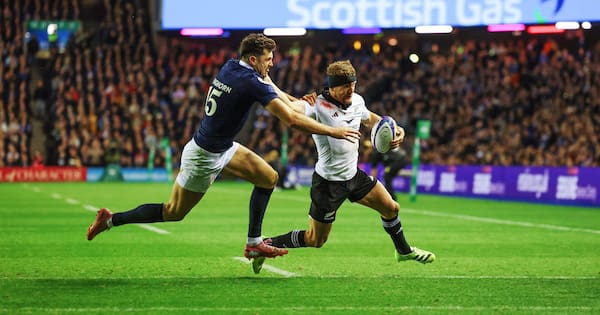
Damian McKenzie’s stunning cameo off the bench against Scotland has highlighted a significant development for the All Blacks this year.
With two Tests remaining in 2025 against England and Wales, the All Blacks’ bench has already provided more attacking impact than it did last year
Crossing the opposition tryline in the final quarter was a real problem for the All Blacks in 2024, head coach Scott Robertson’s first in charge.
Last year, they scored only nine tries in the last 20 minutes of their 14 Tests. Two of those came against Japan, currently ranked 13th in the world.
Moreover, they failed to score in the last quarter of six Tests, including a stretch of five in a row against Argentina (twice), South Africa (twice) and Australia in the Rugby Championship.
There is a sense that the bench got the All Blacks out of jail in both their recent victories in Chicago and Edinburgh, with McKenzie stealing the show in the latter at the weekend,.
But dominating the final stages of Tests is critical and was a hallmark of the World Cup-winning teams of 2011-2015.
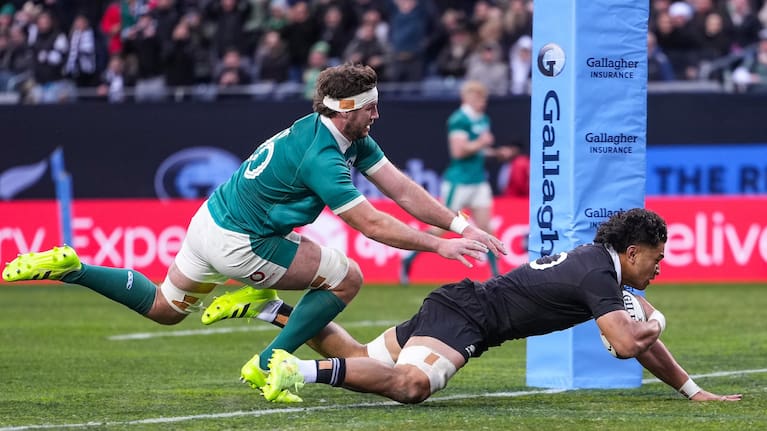
In their 11 Tests this year, the All Blacks have scored 12 tries in the final quarter, including three against Ireland.
Significantly, they failed to score in the final 20 minutes of only two Tests – the first of the season against France and the meltdown against South Africa in Wellington.
The balance for Robertson and his fellow selectors is weighing up how to reward the form of their reserves with the requirement for having experience and ability on the bench to make a late impact. A good example is loose forward Wallace Sititi, who was excellent off the bench against Ireland and promoted to a starting spot against Scotland ahead of the fatigued Simon Parker.
“They swing momentum and stay on top of it and execute at key times,” Robertson told reporters in London as his side prepare to play England at Twickenham on Sunday morning NZT.
“It’s something that we’ve focused on – it’s critical for us.
“Test matches are won in the last 20 aren’t they?”
Robertson revealed the coaches used former All Blacks hooker Keven Mealamu as an example of the selflessness of a player who had put their own ambitions aside for the team.
Mealamu, who played 132 Tests in total, was on the bench behind Dane Coles for all three knockout matches of 2015 World Cup – his final Tests for the All Blacks.
“Who’s done that previously? We’ve looked at Keven Mealamu as a prime example,” Robertson said. “A real humble hero – tough – [an attitude of] whatever is best for the team. He’s a fine example of it.”
A more recent example, and a man whom Robertson knows closely from his time at the Crusaders, is lock Sam Whitelock, who played 153 Tests and finished his international career in 2023 as the most capped All Black.
Whitelock started the World Cup semifinal against Argentina that year but was named on the bench for the quarter-final against Ireland and final against South Africa behind current skipper Scott Barrett and Brodie Retallick.
Some players, however, are just too important to take off when games are in the balance, and halfback Cam Roigard now fits that profile.
Roigard, who scored the All Blacks’ opening try and made a critical cover tackle on Scotland wing Darcy Graham, played 80 minutes at Murrayfield and 78 minutes against Ireland at Soldier Field a week earlier.
“It’s tough on [back-up] Cortez [Ratima]… but we just know the value of experience and keeping the continuity,” Robertson said. “That’s the art of it… but he’s got the job done.
“He’s the complete athlete in that regard and he can play some pretty good footy as well. We’re pleased he’s fit and controls our game. We’ve had seven or eight halfbacks already this year so it’s nice to be able to keep one on the field.”
For midfielder Billy Proctor – on the bench at Murrayfield but a possibility to start at Twickenham as the selectors re-shuffle a backline to cope with the absence of left wing Caleb Clarke – composure is paramount.
“There were a lot of positives that came out of that game… obviously, gaining the momentum back once Scotland came back to 17-all as the boys stayed composed and finished the game,” he said.
“You can see the damage we can do when we execute the options that are there for us. It’s our ability to do it more consistently or more often [that is key].”