
But Beck hinted strongly at it, saying: “We’ve seen what happens when others rush to the launchpad with an unproven product and we just won’t do that.
Rocket Lab founder and chief executive Sir Peter Beck in the Neutron’s fairing.
“We don’t want to learn something during Neutron’s first flight that could be learned on the ground.”
Rocket Lab chief financial officer Adam Spice was asked if Neutron was still within its original US$250-US$300 million ($443-$531m) development budget. He said total research and development (R&D) and capital expenditure (capex) costs would be US$360m by the end of this year.
Beck said: “The financial and long-term impact are insignificant to take a little bit more time to get it right.
“I want to give some context here. The labour cost for the [Neutron] programme is about US$15 million per quarter – which we’ll make back four times over a single launch anyway.”
Record revenue
Investors seemed happy to buy that argument as Rocket Lab reported third-quarter numbers that beat Wall Street estimates and came in at the high end of its guidance.
Rocket Lab’s Nasdaq-listed shares rose 0.5% in regular trading to US$51.90 (for a $25.1 billion market cap) then spiked as much as 8.95% in after-hours trades as the third-quarter numbers were reported – which eased back to a 3.65% after-hours gain as Beck discussed the Neutron delay.
Third-quarter revenue jumped to a record US$155.0m from the year-ago US$104.9m. The firm had forecast US$145-155m.
Rocket Lab’s share price has rocketed up but it’s delayed the first flight of its crew-capable Neutron project from the end of this year until next year. Source / Rocket Lab Q3 2025 investor presentation
Fourth-quarter revenue was forecast at US$170-180m, putting the firm on track for record annual revenue of US$592-$602m.
Its adjusted ebitda loss narrowed to US$26.3m (or 3 cents per share) from the year-ago US$30.9m. The analyst consensus was a 6c per share loss.
“We need a bit more time to retire the risks and stick to the meticulous Rocket Lab process,” Beck said on today’s conference call, addressing the latest Neutron delay. Photo / Rocket Lab
The Kiwi-American firm has long said it won’t break into the black until after Neutron is launched.
Free cashflow was -US$53.2m from the year-ago -US$69.4m.
But cash and equivalents, buoyed by a US$700m rights issue, increased from the year-ago US$271m to US$808m.
Beck said the Neutron would be the largest carbon composite craft ever made (SpaceX’s Starship is made from much heavier stainless steel). Its “hungry hippo” nose faring, designed for releasing satellites, would be another first. Photo / Rocket Lab
“We’ve built up our dry powder for future M&A [mergers and acquisitions] with more than US$1b in liquidity,” Beck said. He would not give details on future deals but said: “There’s movement in the pipeline.”
In the second quarter, Rocket Lab closed a deal to pay US$275m for Arizona firm Geost, a maker of electro-optical and infrared sensors used in missile warning, tracking, and space domain awareness.
A second deal – to buy Munich-based laser communications firm Mynaric for US$75m – was delayed after it faced a “sovereignty test” from German authorities. Spice said a Mynaric “financial restructure” had paved the way for the dela to complete shortly.
Today, Beck reiterated his view that the Geost purchase positioned his company for a potential role in US President Donald Trump’s envisioned multi-billion-dollar “Golden Dome” missile defence project.
“We’re in a very strong position to provide critical services there,” he said.
Details remain sketchy over how exactly Trump will pursue the project.
US Govt shutdown
Asked about the impact of the US Government shutdown, Spice said, “We got a very large cash payment from SDA on Friday. The spigot has not been shut off.”
The SDA or Space Development Agency handles contracts for the US Department of Defence, including the Proliferated Warfighter Space Architect programme that “supports terrestrial missions”. Rocket Lab’s deal to build satellites for the SDA is its single largest contract.
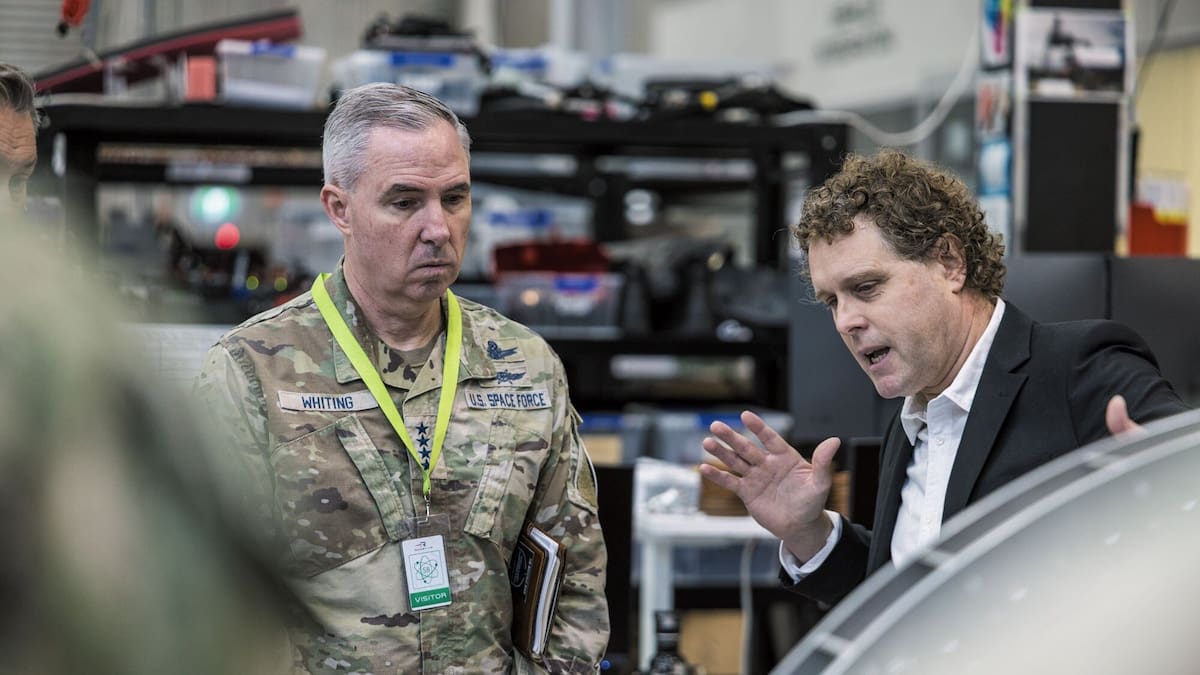
It was an honor to host Gen. Stephen Whiting, Commander of U.S. Space Command, for a recent tour of the production line for our Electron and HASTE launch vehicles. We’re proud to support both national security and commercial missions with responsive launch, innovative… pic.twitter.com/itz1Vixf2z
— Rocket Lab (@RocketLab) July 9, 2025
Although the US Federal Aviation Authority banned commercial space launches from Monday, it seems a Blue Origin New Glenn rocket that will carry two Mars-bound Rocket Lab satellites will have another attempt at a launch on Thursday morning NZT after Blue Origin liaised with the Federal Aviation Administration (FAA).
Spice said pending US Government contracts could be impacted if the shutdown continued, but he saw “encouraging signs”.
Yesterday, a group of Democrat Senators broke ranks and joined Republicans to pass legislation that would see the US Government funded through to January 30. The stopgap still has to pass the House of Representatives.
A Starlink competitor?
Beck has recently dropped hints that Rocket Lab – which has a growing business making satellites and spacecraft components for others – could create its own version of SpaceX’s Starlink constellation of broadband satellites.
“At some point, do you want to own your own constellation and sell that as a service?,” a Morgan Stanley analyst asked on the conference call.
Beck’s answer boiled down to that it would shortly have the capability to do so, but was still thinking about whether it’s the right move.
“We’re just sort of quietly and methodically going about making sure we have all the strategic elements we need to ultimately deploy things at scale,” the Rocket Lab CEO said.
“Low-cost, rapid and reliable access to space is the place you start and Neutron gives us that multi-tonne capability.
“And then, if you look at space systems, I don’t think there’s any satellite we can’t grow and build. I mean, we’ve got two going to Mars shortly.
“So from an engineering perspective and a component perspective, all of those bases are loaded and we’ll be very strategic about how we think about the next step – which would be building our own constellation – and whether we would provide services or infrastructure has yet to be determined.”
In September, SpaceX bought US$17b worth of wireless spectrum from EchoStar, a US satellite TV provider that has hit hard times.
The spectrum will be used to boost Starlink’s Direct-to-Mobile service.
Beck was asked if Rocket Lab would follow suit.
Here, he was black and white. “We’re not going to go out and buy billions of dollars of spectrum, speculatively,” Beck said.
Backlog swells
Analysts and investors seemed reassured that although Neutron’s first launch has been delayed, customer contracts are already in the bag.
Rocket Lab’s overall backlog had grown 56% to US$509.7m.
In response to a Goldman Sachs analyst question on the conference call, Rocket Lab chief financial officer Adam Spice said the forward business pipeline included contracts for two Neutron launches.
A third contract was signed but not yet added to the official backlog tally because it was a “rideshare” that had yet to be fully booked.
Spice earlier said Rocket Lab will charge US$50m to US$55m for a Neutron flight which will be able to carry a 13-tonne payload (including crew) into orbit, undercutting SpaceX’s Falcon 9 (which has a 16-tonne payload capacity).
Rocket Lab charges about US$7.5m for its smaller Electron rocket today, which can carry a payload of about 300kg.
Ocko exits
One of Rocket Lab’s earliest backers, Silicon Valley-based venture capitalist Matt Ocko, will resign from the board as of November 30 after an eight-year stint.
Ocko – a frequent visitor to New Zealand who has become a native forestry advocate – is also a member of the investment committee for the Government-owned New Zealand Growth Capital Partners’ Elevate fund.
Ocko’s venture capital fund, DCVC, has also been a major investor in Halter, founded by ex-Rocket Lab engineer Craig Piggott and also backed by Beck.
Chris Keall is an Auckland-based member of the Herald’s business team. He joined the Herald in 2018 and is the technology editor and a senior business writer.