
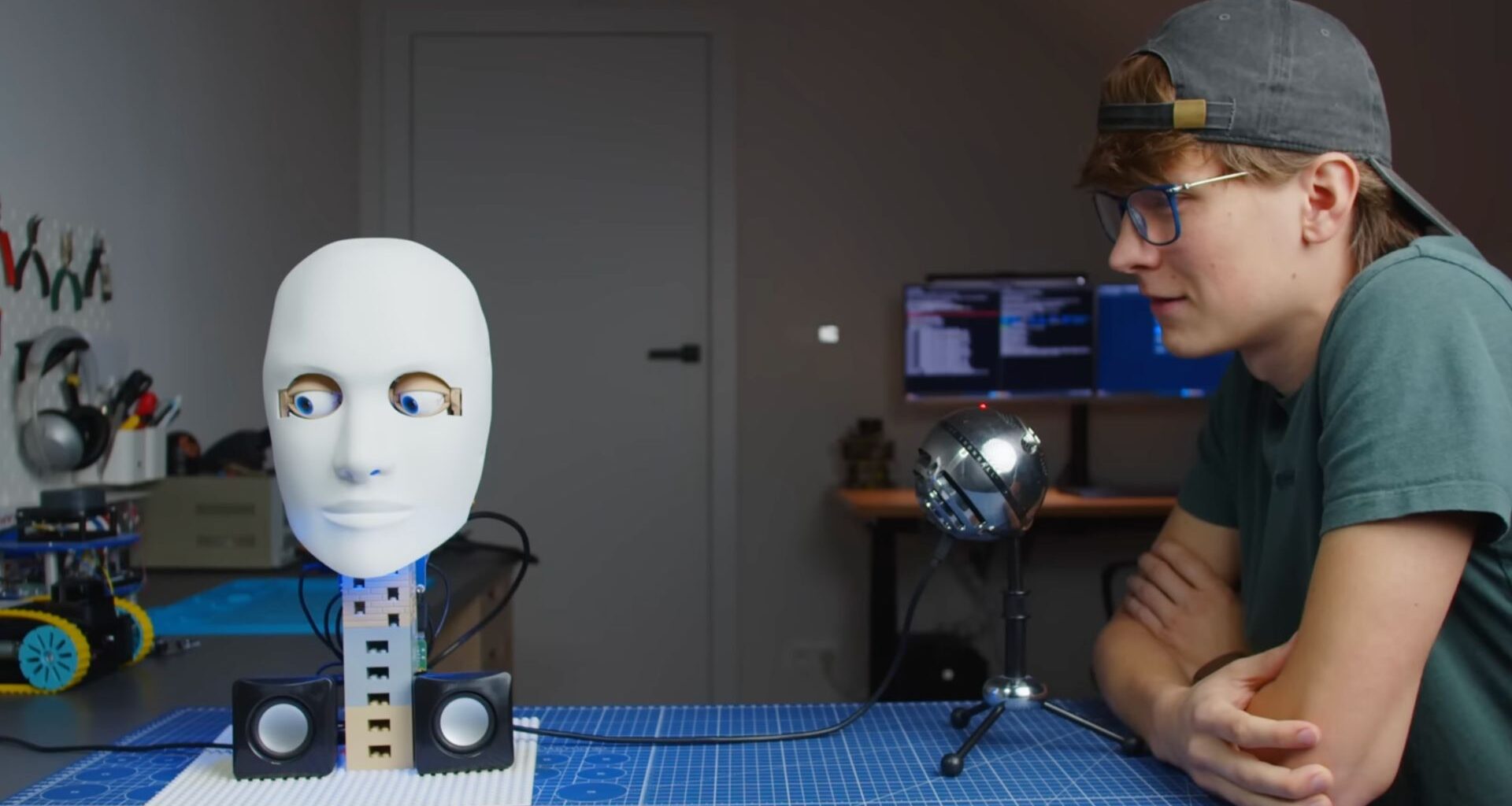
Polish maker Nikodem Bartnik has created a robot head that can answer questions like an ancient Greek philosopher.
The robot has a metal mask with 3D-printed moving eyes, LED lights behind its mouth, and an artificial brain running on Bartnik’s computer. The head responds in real time, creating the feeling of a live conversation that could last for hours.
Bartnik’s idea started with a quote from Steve Jobs about putting Aristotle into a computer. He wanted to see if it was possible to combine a voice, a face, and a brain into one device, all running independently on his own machine.
His goal was to create a self-contained system that didn’t rely on cloud services.
Lifelike eyes and a custom mask
The robot’s moving eyes were designed by Will Cogley, who shares animatronic designs online. Six small motors make the eyes wobble naturally as they follow whoever is speaking.
A Raspberry Pi handles the signals to the motors and keeps the robot focused on the user. Bartnik spent just over an hour assembling the eyes and tuning the servos for smooth motion.
For the face, Bartnik used a pre-made 3D-printable mask. He modified the eye sockets to achieve the right look and kept the design thin so the internal components remained hidden. A small cutout behind the mouth allows LEDs to shine through, giving the robot a subtle glow as it speaks.
How the robot talks
The robot listens through a microphone connected to the Raspberry Pi. The audio is converted to text and sent via Wi-Fi to Bartnik’s computer.
Using open-source software, the computer processes the text through the Google ‘Gemman 3’ model, which generates responses based on Greek philosopher logic. The responses are then sent to ElevenLabs, where a lifelike voice brings the robot to life.
Originally, Bartnik planned to display a moving waveform on a small screen, but the screen did not work well. He replaced it with a ring of programmable LEDs controlled by a Raspberry Pi Pico. The lights flash in time with the robot’s speech, enhancing the illusion of a living presence.
Customizable personality and open-source design
Bartnik prefers running the system on his own hardware. This avoids the cost and restrictions of cloud-based services while allowing the robot to answer a wide range of questions. The system can shift from giving calm lectures on philosophy to joking about world domination.
As reported by Techeblog, he also built a simple web interface that lets him switch the robot’s personality on demand. The hardware remains the same, but the instructions change, turning the robot from a Greek scholar to an ordinary grumpy person.
Despite its polished behavior, the robot has a DIY feel. Wires, breadboards, and LEGO pieces hold the components together, and the mask sits on a wooden board. But the moment it looks at you and speaks, the prototype feel disappears.
Bartnik shared all the files and scripts on GitHub so anyone with a 3D printer and a spare computer can create their own version.