
In September, Catherine Murupaenga-Ikenn was convicted of graffiti vandalism and ordered to pay Te Papa $1,500 in reparations for her 2023 protest.
There I was, inside Te Papa at its Te Tiriti o Waitangi: Signs of a Nation exhibit with a grinder in hand, poised over governor Hobson’s draft treaty of Waitangi text hanging on the wall, ready to make some corrections.
Led by a group of Māori climate justice activists and tangata Tiriti allies under the banner of Te Waka Hourua, our objective was to artfully redact the large English text of Hobson’s draft. It was an act of artivism, aimed at exposing a lie that had sat unchallenged for over 20 years: that Māori had ceded our sovereignty.
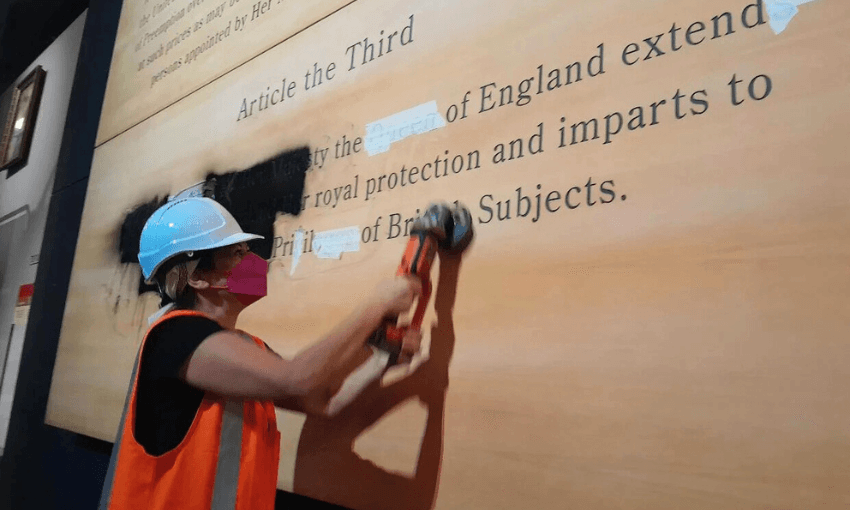
 The artivism in action. (Image: Supplied).
Almost two years later in September 2025, I found myself in court being convicted of graffiti vandalism. The day coincided with another case worthy of note involving four Greenpeace activists who were convicted with trespass. In 2024, they locked down the offices of Straterra, a mining industry group who lobbied the New Zealand government to allow Trans-Tasman Resources to excavate the South Taranaki Bight seabed.
The two cases involve different scenarios that share many common themes. Chief among them is how the state weaponises disinformation and narrative framing to advance political and corporate agendas that undermine the wellbeing and interests of ordinary people in Aotearoa New Zealand.
In the case of the Te Papa exhibit, the state audaciously masqueraded the erroneous English draft as a faithful translation of our country’s one and only legally binding founding agreement – te Tiriti. It also promoted the zombie myth that Hobson’s draft is a legal instrument equal in status with te Tiriti. These lies helped successive governments normalise the colonial fiction of legitimate Crown dominance, while gaslighting Māori and all New Zealanders about our nation’s true history.
In a similar way, with the Greenpeace case, the government’s deceitful rhetoric around seabed mining’s apparent economic benefits masks the elites’ nefarious ecological-plunder-for-profit agenda as something ordinary folks should gratefully embrace.
In both instances, state doublespeak is the weapon – twisting the truth, and using populist language that sounds reasonable while confusing the population – distracting from reality or obscuring the harm those words can cause.
The victim statement Te Papa presented at my sentencing hearing provides numerous examples. The institution lamented that it was the “casualty of property destruction” – a bit of the pot calling the kettle black given for over two decades, the museum was knowingly complicit in the much weightier sin of vandalising the true meaning of te Tiriti. Any alleged negative impact to the display panels we caused is miniscule in comparison to the irreparable destruction of the actual Tiriti which was left rat-eaten and water-damaged while in the care of the state.
“Ration the Queen’s veges” was what the third article read following the action. (Image: Supplied).
Te Papa claimed the actions of Te Waka Hourua caused over $15,000 worth of deinstallation costs, and forced a redeployment of staff to help with the development of “the replacement experience”. However, Te Papa was silent on the fact that the museum had assured Te Waka Hourua in 2021 of its commitment to review and correct that display. With deinstallation already intended –and presumably budgeted for – any complaint about Te Papa suffering extra costs to remove the redacted panels is just theatre. All we did was ensure the panels were replaced with an improved display (although concerns still exist about its content).
I empathise with staff who reportedly experienced stress, anxiety and hurt as a result of the incident. With time and consideration, I hope those feelings can be eased through a deeper understanding of our intentions for the truth to be told about our shared history, opening the way for a more harmonious future.
We must also remember there were – according to information we received – staff who were long-upset with the way that particular exhibit misrepresented te Tiriti and how their concerns were ignored. This is hardly surprising, given that exhibition concepts were developed in discussions that didn’t involve Māori staff.
Te Waka Hourua deliberately used humour in our artistic redactions of the exhibit. We wanted to lighten what is often perceived as a heavy, even intimidating, topic in te Tiriti. By using wit and creativity, we hoped to invite more people to linger in the space, reflect, and safely discuss the deeper meanings behind our redactions. In particular, we left visible on the Third Article panel the words “ration the Queen’s veges”. We chose this phrase because it spoke to a shared, persistent human experience of ordinary people suffering under systems of colonial power that privilege few at the expense of many. It evoked historic moments like the Irish potato famine of the 1840s, when ordinary families starved while royalty and the elites hoarded resources to preserve their insulated lives of luxury, security and control.
Our redaction drew a parallel to Aotearoa’s own story: Māori have long endured a vast and deliberate wealth transfer — from hapū and iwi to the New Zealand nation, its corporate sector and elites — all expedited by generations of classical imperialist colonisation. Today, under the modern wave of neoliberal, corporate disaster capitalism, this process has evolved into fascistic colonisation 2.0, reaching beyond Māori to exploit poor, working- and middle-class New Zealanders alike.
Tangata whenua have long warned that our story is a profound cautionary tale – a kind of spoiler alert – showing what happens when the coloniser eventually comes for everyone’s wealth, not just that of Māori. This ongoing process of unjust enrichment, whether driven by monarchs or corporations, created the entrenched power asymmetry that still defines this country. For Māori, it remains the discriminatory economic foundation on which New Zealand was built. But now, increasing numbers of ordinary Kiwis are feeling that same pinch of exploitation.
From the suffragettes who marched for the vote and tangata whenua leading countless land occupations, to today’s te Tiriti artivism, environmental protests and young people striking for the climate — these are the immune responses of a healthy democracy, reminding power where its authority comes from. They mirror a rising consciousness about the kind of nation we want, and point to how tangata whenua and tangata Tiriti alike can build solidarity against our common adversaries for a fairer te Tiriti-based future for Aotearoa New Zealand.