
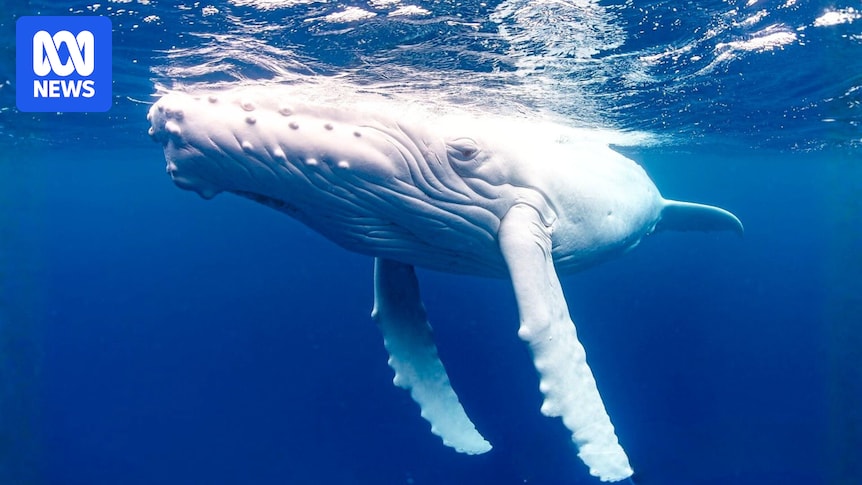
Scientists are concerned for a rare albino humpback whale calf after it was seen travelling up the New South Wales coast when most whales are heading south to cooler waters.
The juvenile albino humpback, known as Siale, was spotted off Catherine Hill Bay, on the NSW Mid Central Coast, over the weekend.
Scientists are urging the community to monitor the calf’s movements.
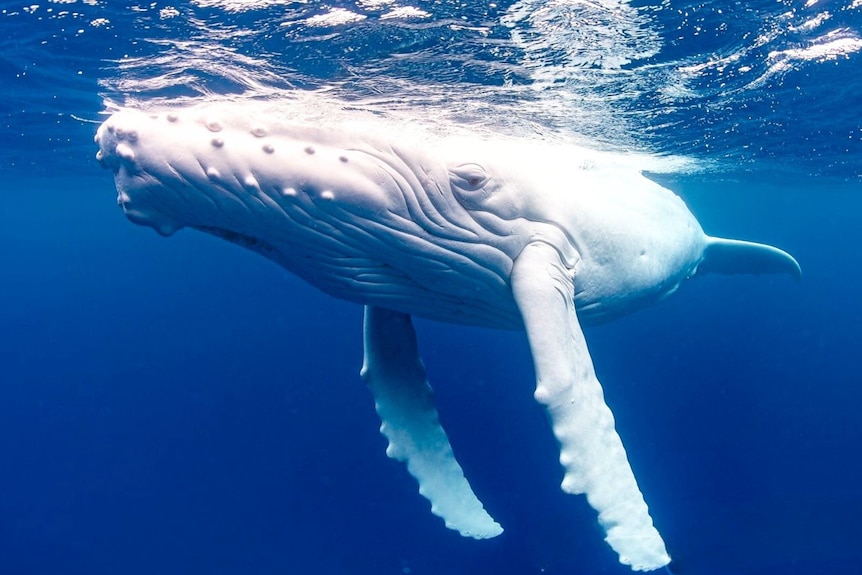
Siale, the albino female humpback whale, was born in Tonga last August. (Supplied: Tristin Sheen)
Pip Jacobs, from the Organisation for the Rescue and Research of Cetaceans (ORRCA), said it was a mystery why the juvenile whale was heading north.
“It’s highly unusual because this is the time of the year that they migrate to Antarctic cold water, where their primary feeding grounds are,” she said.
“She is still travelling north and we really need her to turn around and find some friends and hopefully find her food sources.”
Loading…
Vanessa Pirotta, a scientist at the Centre for White Whale Research, said she was “quite worried” about what impacts continuing to travel north would have on Siale’s health.
“[Siale] already looks a little thin and continuing her journey north may worsen her body’s condition,” Dr Pirotta said.
“We’re unsure on why she is where she is; she shouldn’t be so close to the east coast when she needs [to go] further south, where the krill and fish are.
“She needs to turn around and have the ultimate Christmas dinner for the next few months and gain a lot of weight.”Not the famous Migaloo
An albino male known as Migaloo was the first white whale documented when he was spotted in Byron Bay in 1991.
For almost three decades, Migaloo was the only white humpback seen off Australia’s east coast.
But he has not been seen since 2020.
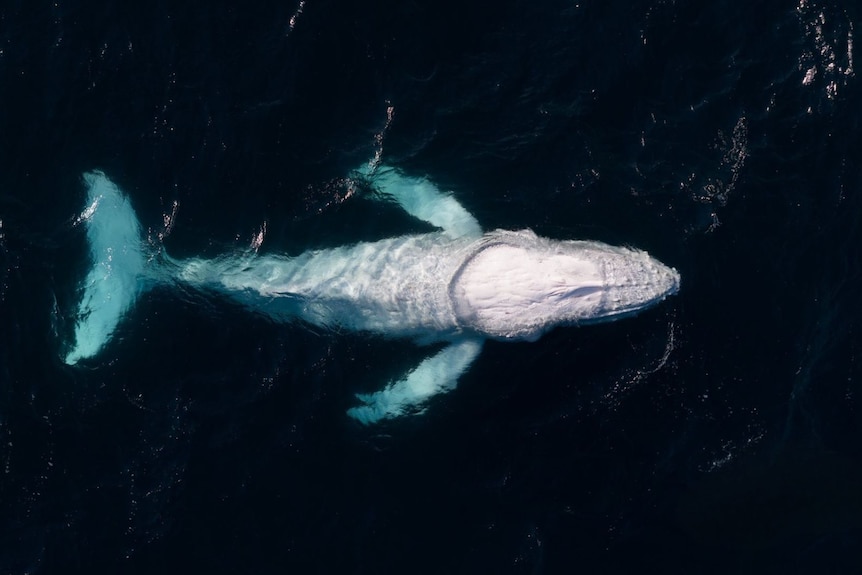
Siale was last seen on the New South Wales Central Coast heading north. (Supplied: Scott Robert)
Ms Jacobs said scientists used tail flukes and artificial intelligence to confirm Siale was not Migaloo and was born off the coast of Tonga last year.
“The way you identify whales is you take photos of their tail flukes — so, tail flukes for whales are like an individual fingerprint,” she said.
Ms Jacobs said only one in 40,000 humpbacks was born with the albinism trait.
“It’s really exciting to see [Siale], but we still don’t know so much about them; that’s why we’re trying to get as much information from the public as we can,” she said.
“It’s quite easy to spot an albino whale. It’s almost like looking at a little iceberg out in the ocean.”
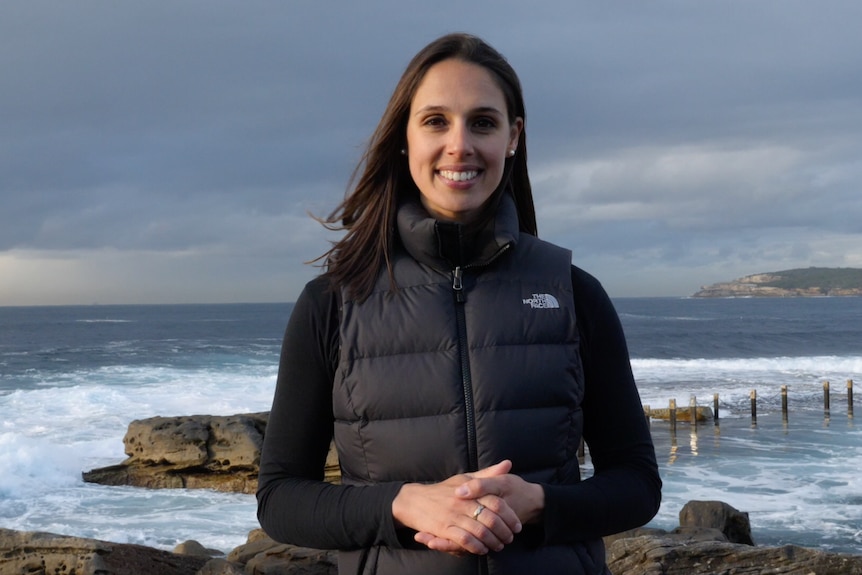
Vanessa Pirotta says albino whales have a higher risk of attracting predators. (Supplied)
Dr Pirotta said an albino’s hyper-pigmentation had its pros and cons.
“It’s a gift to us [researchers] because they look so different. They’re easy to identify and document,” she said.
“But it also puts them at a higher risk of attracting predators because they’re so visible.”
Dr Pirotta is reminding spectators and ocean-goers to avoid getting close to the white whale if they do happen to see her and to never attempt to chase or feed her.
“I saw her on Friday off Sydney. She was frolicking, breaching, pec slapping — it was so cool to see her, but we must admire her from a distance.”
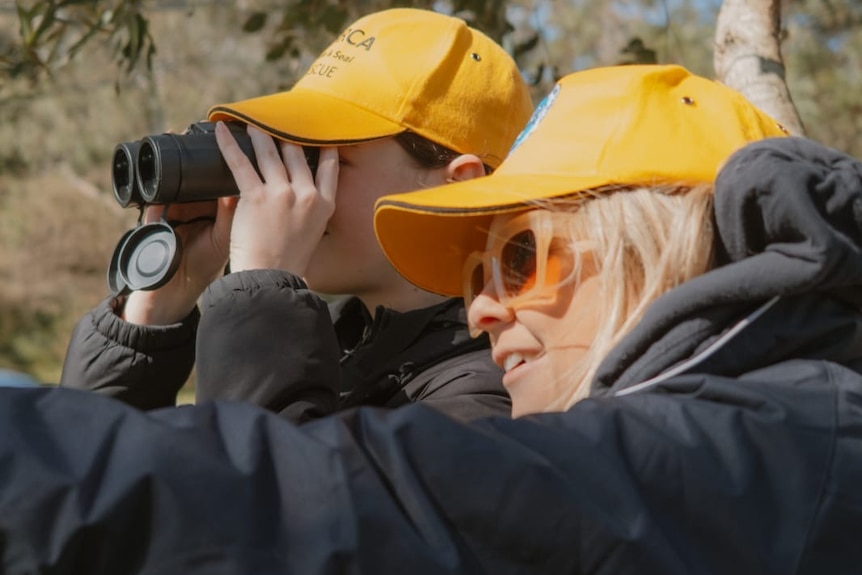
Pip Jacobs says it has been confirmed that the albino whale is not Migaloo. (Supplied: ORRCA)