

Mark Zandi, Chief Economist at Moody’s Analytics, believes that the likelihood of the U.S. avoiding a recession in the coming year is not high;
Artificial intelligence contributed 0.63 percentage points to U.S. economic growth, but the trend of deglobalization may weaken its boost effect.
Without artificial intelligence, the U.S. economy might already be in recession. However, even with AI continuing to thrive next year, it may still struggle to sustain the U.S. economy—this is the pessimistic view held by Mark Zandi, Chief Economist at Moody’s Analytics.
Can AI save the U.S. economy?
 Since the beginning of this year, Zandi has repeatedly issued warnings, stating that the U.S.’s economic strength is weakening amid an increasingly severe external environment.
This week, he again posted that the likelihood of the U.S. avoiding a recession in the next year is not high—unless everything goes perfectly smoothly and no headwinds emerge.
Zandi noted that this year, artificial intelligence contributed 0.63 percentage points to U.S. economic growth. Without AI, the U.S. economy would likely have already fallen into a recession.
However, while the AI boom has indeed provided a boost to the economy, this positive effect could be diminished by another global trend—’deglobalization.’
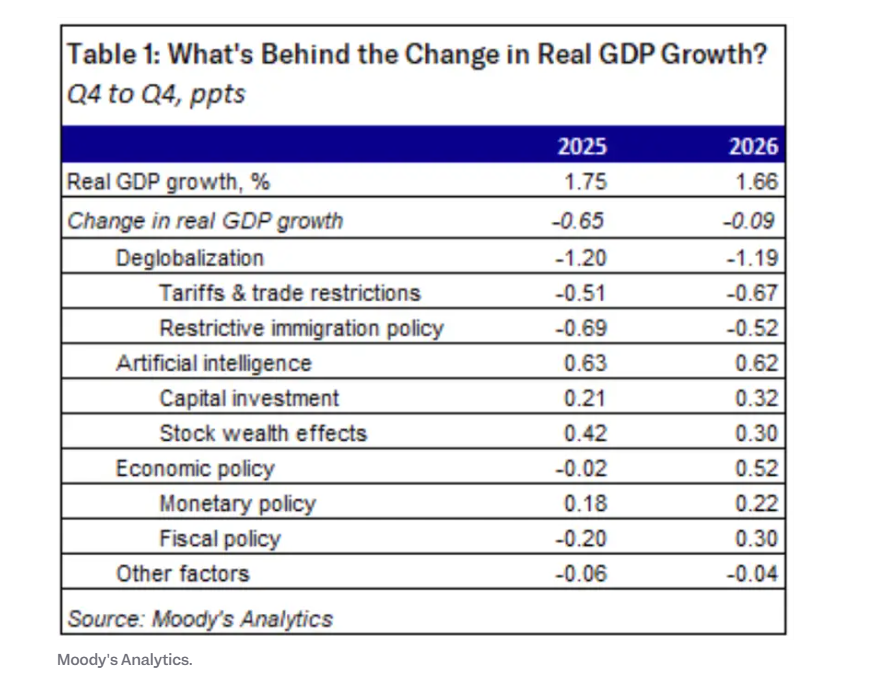
Moody’s analyzed the impact of deglobalization, AI, and economic policy on the U.S. economy.
“Whether the economy can achieve growth and successfully navigate the various challenges posed by deglobalization and artificial intelligence depends on no unforeseen circumstances arising.” He stated, “Of course, regarding tariff issues, the situation might be different.”
Zandi expressed concerns that Trump’s trade policies could accelerate the U.S. economy’s descent into a recession.
The economic shock from Trump’s tariffs
He believes that, at present, the trend of deglobalization is becoming an increasingly severe threat to U.S. economic growth, as tariffs and stringent immigration policies increase costs and place pressure on the labor market. By next year, deglobalization will create further headwinds for economic expansion.
“In 2026, deglobalization will remain a significant drag, reducing the U.S. real GDP growth rate by 1.19 percentage points.”
He went on to note that although American tech companies are making substantial investments in artificial intelligence (AI), the benefits of AI to economic growth may take some time to materialize. He cited examples of other ‘groundbreaking technologies’ — many innovations only drive growth after being more fully integrated into businesses.
Moreover, Zandi also voiced concerns that the benefits of AI are concentrated primarily among the wealthy, with little impact on low-income groups — especially given that AI has already significantly driven up U.S. stock prices, from which low-income Americans largely cannot benefit. This could limit its contribution to overall U.S. economic growth and exacerbate the ‘K-shaped’ divergence in the U.S. economy.
He predicted: “Our already highly unequal distribution of income and wealth will become even more pronounced. The economic and political struggles between the rich and the poor will intensify, which will be detrimental to everyone.”
Zandi also indicated that the macroeconomic impact from the U.S. government shutdown could also derail the economy from its normal trajectory, despite the government’s preparations to resume operations this week.
On November 12 local time, the U.S. House of Representatives passed a temporary federal government appropriations bill previously approved by the Senate, marking a decisive step toward ending the longest government ‘shutdown’ in U.S. history. The bill will provide continuing appropriations for the federal government, allowing most government agencies to secure operational funding until January 30, 2026. The White House stated that U.S. President Trump would sign the bill on the evening of November 12, restoring full government operations.
Editor/melody