
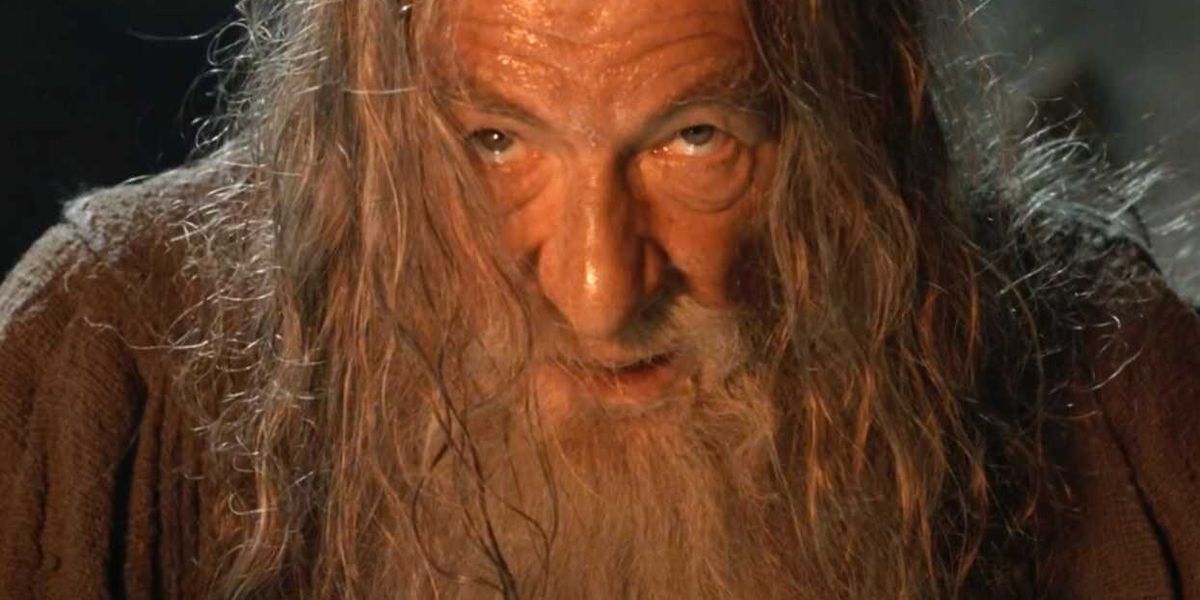
In some movie scenes, all cinematic elements come together in their most refined form and create something majestic. And when that happens in a movie that is basically a 3-hour-long fever dream, the effect can be unimaginable.
Something similar happens with the scene featuring the standoff between Gandalf and Balrog in The Lord of the Rings: The Fellowship of the Ring (2001). When Balrog lunges at the fellowship, Gandalf, standing alone on the bridge of Khazad-Dûm—a prologue to both his fall and rebirth—stomps his staff, draws his sword, and thunders:
“YOU SHALL NOT PASS!”
Here, those who have already read Tolkien’s epic might notice something feels different from the book. Of course, movie adaptations are famously known to turn out pretty different from their books, but here, something feels different in a good way. Something that feels more reassuring, more powerful than it did when they read the book. What could be the reason? What changed?
Well, that’s where the story gets interesting.
The Power of a Single Word
Before New Zealand’s beautiful setting became the backdrop for the movie’s epic drama, and state-of-the-art special effects further heightened it, Tolkien had already given the story its very own linguistic special effect. And no, I am not only talking about the “conlang” that went into Middle-earth’s worldbuilding. Tolkien’s characters spoke in such ways, using specific words, that reinforced readers’ understanding of them.
However, there are instances where the written words of the book didn’t seem to be big enough or bold enough for the magnitude of the big screen. In no way were these words inadequate; they just had more literary temperament than cinematic disposition. This is one such example.
Tolkien’s Original Text
In the novel, when Gandalf faces Balrog, Tolkien describes the moment in these words:
‘You cannot pass,’ he said. The orcs stood still, and a dead silence fell. ‘I am a servant of the Secret Fire, wielder of the flame of Anor. You cannot pass. The dark fire will not avail you, flame of Udûn. Go back to the shadow! You cannot pass.’
While this is still dramatic, the tone of the moment here feels less assertive. If you remove the tonal and narrative context, the words “you cannot pass” might seem like a simple refusal or even just an observation. As if Gandalf, calm and paternal, is laying down the rules. We can credit this muted assertiveness to the British restraint, where Tolkien strives to derive power from the situation rather than the linguistic forcefulness.
Reasons Behind Tolkien’s Words
But don’t make the mistake of thinking this is an area of improvement for Tolkien; far from it. His choice of words was neither incidental nor peripheral; it was intentional. Tolkien’s background as a philologist may have prompted his narrative style to favor understatement over high-sounding declarations.
In the book, Gandalf’s words, “you cannot pass,” are more indicative of the destiny that is fixed. The line between good and evil has already been drawn by an entity that is bigger than both of them, i.e., Gandalf and Balrog. And this proposition makes Gandalf’s words less an altercation and more a commandment rooted in deep wisdom.
Cinematic Reimagining: The Screenwriter’s Deliberate Choice
The writers, Philippa Boyens, Fran Walsh, and Peter Jackson, understood this gap and realized they needed to amplify the volume and intensity of Gandalf’s authority. A writer can count on readers’ imagination; a filmmaker, however, has no such liberty.
So, in order to match Gandalf’s force of personality and command over the situation with Balrog’s imposing size and huge destructive power, they tweaked the sentence a little, and it became:
“YOU SHALL NOT PASS!”
By changing the verb from “cannot” to “shall not,” they flipped a passive statement into something assertive and final, and by doing so, weaponized Gandalf’s authority. Now, on screen, it looked like a battle of equals.
Forging the Legend
This scene is one of the most memorable ones from the movie. And, like I said at the beginning, the power of some scenes is the result of several artistic disciplines converging perfectly. The insightful writing aside, the filming of the scene is a prime example of flawless delivery, sound design, cinematography, and visual effects.
Ian McKellen’s Performance
The line worked because McKellen gave the line the weight it deserved. And the intensity could have been the mixed effect of the gravity of the moment and the chaos of filming. When he says the line, you can see in his eyes the fury, the urgency, and a father’s protectiveness. This kind of intensity is hard to come by without formal training in the classical theater.
Sound Design
McKellen’s delivery was an actor’s genius, but what put the spotlight on it was the sound design. In the scene, his words have a rumbling quality that creates a tremendous dramatic effect. Even the crack of his staff sounds like a gunshot, or the crumbling of the bridge feels like the earth is collapsing into itself. Howard Shore’s mournful score punctuates all these sound cues and makes you shudder.
Visual Effects
The framing of the shot employs forced perspective to exaggerate Gandalf’s size in Balrog’s comparison. His grey cloak stands stark against Balrog’s red inferno, a visual war between mortal courage and ancient fury.
The Immortality of a Choice
Gandalf’s “You shall not pass!” startled the Balrog, and it also changed the course of storytelling. A one-word replacement has left such a big pop culture impact that many writers and filmmakers still think of it as transformative.
Ultimately, this line is a testament to the fact that something truly magical can come out if you can achieve a creative balance between literary tradition and cinematic innovation.