
“Weeks before I got my audition, I actually said in an interview, ‘I’m really interested in the idea of the collective versus the individual.’ So I’m a witch, and I conjured it, is what I’m saying.”
Photo: Apple TV+
This interview discusses events from this week’s episode of Pluribus.
In many regards, Vince Gilligan’s Pluribus is a one-woman show. Cheekily referred to as “the most miserable person on Earth” in the vague description that Apple TV initially provided, Carol Sturka (Rhea Seehorn) is the grumpy hero at the show’s center, a cynical fantasy-romance writer who suddenly finds herself one of 13 fully conscious and in-control humans left on Earth — the other seven-odd billion having been subsumed into a peaceful hive mind. Carol has lost everyone she has ever known to either death or assimilation, but you get the sense that only one loss really matters: the death of her manager and romantic partner, Helen.
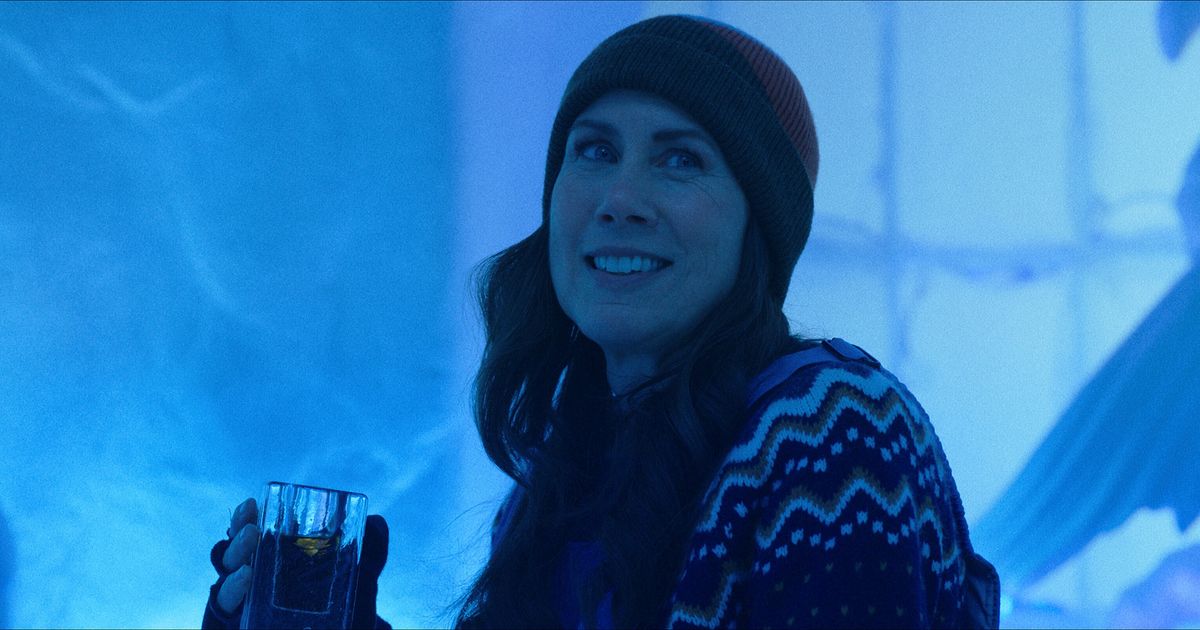
As played by Miriam Shor, Helen shares Carol’s dry sense of humor but possesses an openness and warmth that doesn’t come as naturally to her partner — as well as an unwavering belief in Carol as a writer and a person, whether or not Carol shares those beliefs. In their few scenes together, you really understand the dynamic between the two, to the point that Helen’s death already hurts in episode one. During this week’s cold-open flashback to a stay at an “ice hotel” in Norway, Carol can’t stop obsessing about her position on the best-sellers list, but Helen forces her to take in the gorgeous view of the northern lights. “Helen does call her on her bullshit but also believes that she wants to witness the beauty of the world, even when she says she doesn’t,” Shor says. “Carol needs that.”
How did this whole process kick off for you?
Oh, how the dream-come-true job came about? The audition was super-secret, really cloak-and-dagger. They were like, “Do you want to audition for Vince Gilligan’s new show?” I was like, “Yeah. Why would you even ask that?” The scene I got was just something they wrote to approximate the relationship that Helen and Carol were going to have. I had no background, no knowledge of what the show would be, but I knew exactly what the relationship between these two people was from the dialogue. Thank God, because I have gotten scenes before where they’re like, “We don’t know what this is or who’s doing it, just say the line!” And you’re like, “What is happening?”
So that sample scene isn’t in the show?
They wrote it for the audition only. It was similar to some stuff that was in the show, but it had no information. It was just about a person who is saying to another person, “I think what you have to offer the world is important and valuable, and I know you don’t feel that all the time, but I’m here to tell you, I will always remind you of that.” That’s Helen’s job.
When they said, “Oh, yeah, you’re the one they want to do this,” I was like, “Well, that is ridiculous.” In the best way.
Had you been a fan of Breaking Bad and Better Call Saul?
Well, I’ll go back further. I was a huge X-Files fan. Like, dork of the first order. So I know Vince from that era. Of course, I knew he was a genius from Breaking Bad and Better Call Saul, and don’t even get me started on Rhea, because she’s such an actor’s actor. But the fact that it was going to tap into that world sent me completely over the moon. It was like Vince Gilligan crawled into my brain and wrote the show I wanted to see. Weeks before I got my audition, I actually said in an interview, “I’m really interested in the idea of the collective versus the individual.” So I’m a witch, and I conjured it, is what I’m saying.
When the hive mind infects people, they start convulsing in this very specific way. How were you directed to do the shaking? It felt like everyone was given the exact same physical directions.
We were. I had some training with a movement coordinator. It’s not that long that I’m doing it onscreen, but that was nights and nights of me doing that for hours and hours. It’s interesting what happens to your body when you put it through that. It’s a total-body workout, shaking uncontrollably. Really works the core. [Laughs] But it actually really does. I was so sore after those nights. There were a lot of times where they’re like, “Could you make your feet shake less? Okay, now make your hands shake more. Don’t make your head shake quite so much.” It gets very, very specific. You’re like, What do I do for a living?
Did you have a chemistry read with Rhea?
I didn’t. Rhea did watch my tape and okayed it, and everybody seemed to like me from that. When I got cast, Rhea called me just to say hi, because she’s the nicest human on the planet other than Vince Gilligan, and within three seconds, I was like, “Oh, this is an old friend I just met. This is my best friend that I’ve just made an acquaintance with.” I think she felt a similar instantaneous connection. That was really lucky, because we had to create this sense of a long, storied history between these two people. When you already have this weird sense that this is someone who I’ve always known, it just makes it easier. And it’s not that hard to be in love with Rhea Seehorn. Masses are shouting in the background in agreement.
One of my favorite moments in the premiere is Carol silently waiting for Helen to give her book a more favorable shelf spot. And Helen says, “I’m gonna get some gum.”
And then I give her a piece of gum, because we probably have some stank breath from traveling. I love that moment, too, because I’m willing to do that as her person professionally, but also as her person in the world.
I related a bit to Carol’s reaction to the ice hotel, because I would never choose to go somewhere like that, but as a viewer, you’re almost on Helen’s side because you want Carol to just sit down and try to enjoy herself. She can’t be in the moment. Why do these two very different people connect?
They have a language between them that is unspoken. What I love about that scene — and this is true of all Vince Gilligan’s work and the writers that he brings onboard for his projects — is that they don’t write a scene about the thing that the scene is about. They write a scene about all these other, maybe seemingly mundane things through which they give you a sense of it. So you’re the detective finding out these things, because you’re looking at human behavior, not because someone is saying a line that describes it to you.
So really, if somebody was like, “Let’s go on vacation to the coldest place on the planet,” yeah, there would be a part of me that would be like, Really? We’re not on a beach in the Bahamas? We’re going to sit on a bed made of ice? But what Helen does is say, “Shut up, sit down, and look at the northern lights. Look at this thing that is singular, and will take you out of everything that makes a person miserable, and will force you to see the wonder of it all. Yeah, you’re going to keep throwing a tantrum, and I’m not taking that personally, because I know you need to see this. And you need to see it with me.” She’s so good-natured about it. I think there’s actually a part of her that finds it adorable and hilarious. And because Helen does, we can.
What about on Carol’s end?
Carol really trusts Helen, and she doesn’t trust anybody. That’s the shorthand that gets you into that relationship quickly. The fact that Carol even went to this place because of Helen — we know that bond is strong. Helen does call her on her bullshit but also believes that she wants to witness the beauty of the world, even when she says she doesn’t. Carol needs that.
Where was that filmed?
We spent a long day in a fake ice palace in way too much clothing for the actual temperature. I lost, like, 50 pounds in sweat that day. I’m not really a purple-crystal, woo-woo kind of person, but this was sort of weird and mystical: We were watching the northern lights over and over and over again, and then left the set very late, and they were like, “There’s a weird anomaly where you can see the northern lights in the southern part of the United States.” That was the first that I had heard of that. So after watching the northern lights all day, we could see them in Albuquerque. I was like, Is someone up there messing with us?
On film and TV alone, you’ve appeared in such a wide variety of projects from so many genres. You’ve been in Marvel movies —
Another nerdy dream come true for me.
Where does your experience working with Vince on Pluribus fit into that? Did it offer something new?
There are a lot of tropes around genius artists. Vince would hate anyone calling him a genius, but tough titty, because he is. One of the things this really solidified for me — and I know this because I have been working for a long time — is that to be a truly brilliant artist and auteur, you can still be a kind, generous, inclusive human. There’s a narrative out there that pushes against that, and it’s wrong. I would present exhibit A, Vince Gilligan, and exhibit B, Rhea Seehorn, and then you would just have to shut up.
There’s a lot riding on this for Vince, and it’s all on Rhea’s shoulders. I can’t even fathom the stress of that, and still, they always went out of their way to ensure that every single person they encountered on that set felt valued. I’m also a director, and as you’re finding your way, you really can still be a kind person and deep-thinking visionary. That’s a wonderful thing to have solidified for you.
I first really became aware of you from your role on Younger, so I wanted to end by asking what you imagine Diana Trout is up to these days.
I don’t think Diana will ever stop telling people how to do the things she needs them to do correctly. I think she’s still somewhere in the book world. What’s strange is, I’ve had several projects where I’m in the publishing industry — there’s Younger, American Fiction, Pluribus — and one of the first jobs I almost took when I first moved to New York was a lowly copy editor at a publishing house. I had to decide if I wanted that or to wait tables to free up my days to pursue acting. Books were the road not taken, but they mean a lot to me. We got to explore the world of publishing, and nerdy, wonky me was so into that aspect of it. I totally understand why Vince made Carol an author. It feels like the purest form of storytelling.
What a great character, Diana Trout. What I always loved seeing were the chinks in the armor. She has a great deal of humanity underneath all of that. You’re like, What are the battles she had to wage that forced her to feel like she had to wear that armor? That’s the best part of any show. That is for certain how Vince Gilligan creates his shows: starting from a place of character. This idea that proximity to an artist makes you question your life. I loved everything I got to do on Younger, and playing the kind of character who fully believes in herself was new for me. I second-guess myself 24 hours a day. I undercut my own worth happily. That is something Diana Trout never does.
Related