
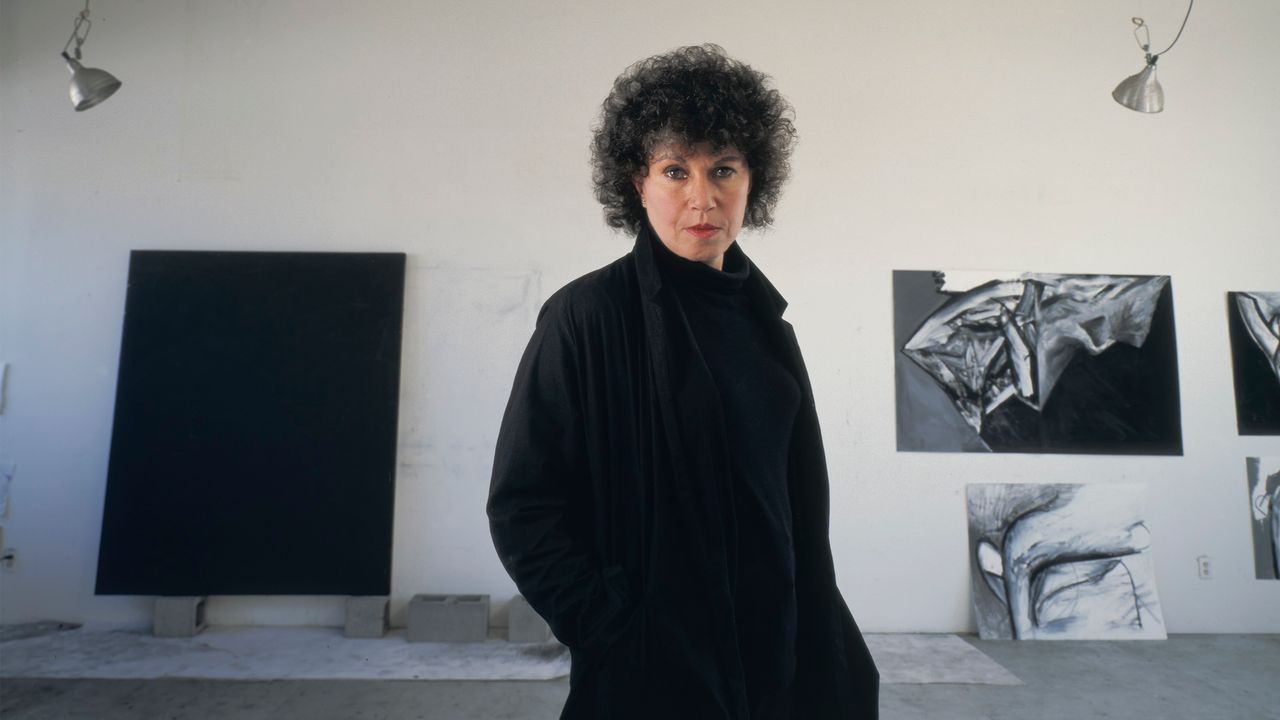
“The paintings of the ’80s have their own vocabulary and their own transgressions,” says Leah Levy, the executive director and a trustee of the Jay DeFeo Foundation, who worked with DeFeo in those years she returned to oil. “There was this attempt to figure out a different way to have a relationship with the materials that would move her forward, rather than take her back to something that she had completed.”
Though these paintings contain that same searching quality at the heart of The Rose, they look nothing like her magnum opus. For one, DeFeo brought in fierce color—red and umber and marigold, with accents of sapphire atop muddled grays. And instead of a starburst center, these works play with complex shapes that tumble across the surface. They harken back to the bravura brushwork of Abstract Expressionism, which was the name of the game when DeFeo first entered the art world in the 1950s.
In the gallery’s main room are the large, grand canvases, with some as tall as seven or eight feet. Paintings like Verdict No. 1, Geisha II, and La Brea are jolts to the system for their use of vivid colors, but the muted palettes of Untitled (Reclining Figure) and Bride—an abstraction of a rocking chair in her studio—are no less dynamic. “You really discover so much as you spend time with them. They’re constantly revealing more to you in the best way that great abstract painting can do,” says Steve Henry, senior partner at Paula Cooper Gallery.
In the gallery’s front room, a suite of smaller works on linen, some just 10 inches tall, hang with quiet purpose. You could spend hours looking at the pockets of texture and color in any one of her Alabama Hills paintings, inspired by the landscape at the base of the Sierra Nevada mountains. “You can really see every decision, you can see every brushstroke. They’re almost like photographs, or impressions,” says Jordan Stein, a San Francisco–based curator and writer who contributed the essay for the exhibition’s catalog. (He is also the author of the excellent DeFeo book Rip Tales, published in 2021.)
The work DeFeo made in the 1980s is a culmination of a career anchored by constant exploration. Though she had distinct bodies of work, “they were so influential on each other,” says Daisy Charles, director of archives and research at Paula Cooper Gallery. “By looking at particular paintings, you can identify earlier collages. And then within those collages, you can see bits of photographs, and then those photographs had little bits of other paintings. There’s this kind of constant recycling and revisiting so that in this final body of work, it’s almost like it contains everything that she did up to that point.”