
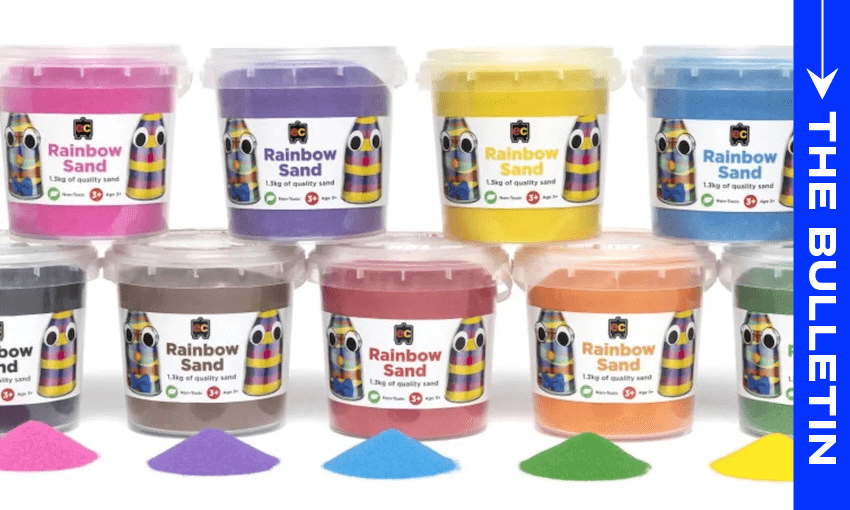
Parents and schools are asking questions about the level of risk posed by the asbestos – and how the contamination slipped through unnoticed, writes Catherine McGregor in today’s extract from The Bulletin.
To receive The Bulletin in full each weekday, sign up here.
Chance discovery triggers major recall
The asbestos scare unfolding across New Zealand began with a fluke. As the ABC reports (via RNZ), tremolite asbestos was first picked up in children’s play sand “by chance in an Australian laboratory” and was only reported to safety authorities “after a lab manager mentioned the findings in a podcast interview”. A few days later, asbestos was also confirmed in products sold here.
That prompted a sweeping recall of quartz-based sands stocked by Kmart, education suppliers and stationery stores. RNZ reports that Kmart NZ alone has sold 67,000 units across four children’s sand products, one of which has been on its shelves since 2015. MBIE has now expanded testing to similar products on the market, with results expected “later this week”. In the meantime, authorities have advised schools, childcare centres and parents to isolate any suspect sand immediately. The alert has grown quickly: more than 40 educational settings have closed or partially closed as a precaution, and hundreds more have contacted officials seeking advice.
Schools scramble to reassure families
The disruption has been significant. Deputy prime minister David Seymour told RNZ First Up that the education ministry has fielded several hundreds of calls from schools and early learning services, while a specialist removal company said teams were working “essentially 24 hours a day” to keep up with demand. Matipo School in Te Atatu Peninsula is one of many schools reporting that they have relocated classes, sealed off affected rooms, and begun professional decontamination. While Seymour says clear procedures are in place, on Midday Report, mother Janelle Hill expressed frustration at the lack of specific advice for households whose children used the products outside school.
Experts say risk is low – but key questions remain
Despite the widespread concern, experts stress that the sand is unlikely to pose a serious risk. AUT professor Terri-Ann Berry told Stuff that while no amount of asbestos exposure is considered safe, the chance of disease from low-level, incidental contact is “relatively low”. Testing so far has found no respirable fibres – the form that poses the greatest danger when inhaled – though Robert McAllister, a director of the Faculty of Asbestos Management of Australia and New Zealand, told the ABC that more work is needed to understand how easily the tremolite could become airborne during children’s play.
As Berry noted, asbestos is already widespread in New Zealand’s built environment, and most people exposed to small amounts never develop illness. The advice for parents who have the products at home is simple: isolate the product, bag it securely, and arrange proper disposal through the channels listed on your local authority’s website.
Spotlight falls on supply chains and product safety
The recall has also raised uncomfortable questions about how children’s products are vetted. Laura Gemmell of Eco Choice Aotearoa told RNZ the episode reflects a broader ‘high trust’ approach in New Zealand, where importers bear responsibility for verifying safety but are not required to prove it. That leaves consumers relying on the honesty and diligence of businesses sourcing products offshore – a system that, as this recall shows, can fail.
Contamination appears to have been unintentional, arising from naturally occurring asbestos in rock quarried in China. As scientist Brian Oliver noted in The Conversation, if the sand was taken from a beach then it is unlikely to be contaminated with asbestos. Whatever the specific source, Gemmell said the incident emphasised that businesses needed to understand their product. “They need to know what’s in that product, otherwise they shouldn’t be selling it.”
Subscribe to +Subscribe