
Welcome to the boulevards of broken dreams and ‘festering holes’. Follow me!
Before we begin, please assemble to consider the concept of an empty building. Every day in Tāmaki Makaurau, school children still stop in front of the “spooky” Carlile House, while grownups sigh wearily at the site of the St James. They’re famous reminders that buildings don’t maintain themselves. Doing so can be a costly exercise. New Zealand has no penalties for empty buildings. Demolition-via-neglect loopholes can lead to the removal of heritage protections and “uninhabitable” Epsom villas go for $5.9m.
While the number of empty buildings and “ghost homes” is debated, the truly vacant are plain to see. Interestingly, “visual aspects” are excluded from Auckland’s Property Maintenance and Nuisance Bylaw, though owners of abandoned or unoccupied buildings must prevent access and minimise risk of pests or “significant odours”. Basically, if a building just looks like shit, it’s not breaking any rules.
Will rule changes help? Auckland Council’s proposed changes to the Unitary Plan allow for increased density in central suburbs. The government hopes suggested tweakments to its earthquake-prone building (EPB) system would “reinvigorate” communities. Due to its low seismic risk, Auckland would be “removed from the regime entirely”
You’ll see many dark or boarded-up windows on a walk down Queen Street (as The Spinoff’s Joel MacManus has pointed out, office vacancy rates in the central city have continued to climb). But let’s come back down to street level and start the tour.
Fosters & Co building, 30-36 Fanshawe Street
With your back to the Harbour Bridge, marvel at this handsome, four-storey corner building with the “ship chandlery” sign that gets nice sun in the afternoon. In the lower windows you’ll see browning lumps of insulation and faded retail signs. The Fosters name is still on the building (it’s been in business for over a century and is now located in Westhaven), as is AET, for Auckland Electric Tramway Company, the previous occupant. Moss crawls down the building’s sides – graffiti includes “trigger” and “spite” – while at the rear there are roller doors, a fire escape and greenery bursting from the rainwater pipe. Through the front windows, you can see an architect’s model of a fancy high-rise.
 Trams used to rattle past here. (Images: Auckland Libraries Heritage Collections 786-A24-05, Vinnie Paunovic)
9-15 Albert Street
Gaze upon this vacant expanse filled with rubble, rebar and orange plastic (cones and barricades) while reminiscing about devouring larb and $5 beers upstairs. Once upon a time, this was the cheerful, pink Food Alley, the city’s oldest Asian food court until it closed in 2020. Tenants moved and the building was demolished. So was the one next door, which had been empty for decades. The owner of the block is M&L Auckland Central, a company associated with one of Singapore’s richest families. It wanted to develop the site into a 159-metre tower… until it didn’t. A “cessation of business in New Zealand” notice was filed in 2022. What’s next for the Albert Street address remains to be seen. (Civic leaders are “disappointed”). With the demolition company referring to the building as “pigeon palace”, any euphemisms are a waste of a word count. And yet, the raw concrete remains have earned a place in local lore. But let’s not stand here misty-eyed; there’s plenty to see on this block.
This whole block is a mystery. (Images: Vinnie Paunovic, Auckland Libraries Heritage Collections 1-W1866)
Next door is a 107-year-old, five-storey wooden building “set for restoration at a later date”. Originally occupied by Arthur Yates & Co Ltd, as a category B scheduled heritage building, with resource consent, it could technically be torn down. M&L planned to do exactly that and tear down neighbouring Link House too. Once upon a time, Link House was home to Henry Berry & Co, selling supplies for butchers and bakers. Now, jovially coloured Venetian blinds hang drunkenly down in front of boarded-up windows. At the front of the corner building, abandoned for as long as I can remember, everything is painted 1990s-computer-beige.
6 Wolfe Street
You’ll notice this street is a popular parking spot (it’s free for half an hour). Wedged between two well-maintained neighbours sits a boarded-up brick building, a warehouse in a past life. Purchased by an overseas investor in 1995, it had been vacant for 23 years by the time it was sold in 2018 for $5.5m to a New Zealand buyer (who had intentions to “refurbish”). The latest council valuation is $4.475m, with most of the value in the land.
So much potential. (Image: Vinnie Paunovic)
260 Queen Street
So many eras. (Images: Auckland Libraries Heritage Collections 435-08-16, Vinnie Paunovic)
This grande dame heritage building has been boarded up since McDonald’s left in 2020, moving a couple of doors down, its departure earning a eulogy from then-Herald writer Steve Braunias. Ghostly arches have remained above the brass street number since the company put the building on the market in 2023. You can now see “sold” scribbled in vivid on the front. The proud new owners are Precinct Properties and the company has plans to turn it into student accommodation.
Smith & Caughey’s, 253-260 Queen Street
No Christmas windows to see here this year, sorry. The feverishly documented closure of the historic department store has left this 145-year-old building (valued at $39m) empty. Those famous windows are now covered in black vinyl and the company has indicated it intends to sell the place. Around the back on Elliot Street, the lights are on inside. Mysterious!
What’s next for for the Queen Street address? (Images: Auckland Libraries Heritage Collections 580-00780, Vinnie Paunovic, Auckland Libraries Heritage Collections 435-10-22)
Sky World, 291-297 Queen Street
While not technically empty (Event Cinemas is still there and still a great place to see a movie), this once visionary building is now largely deserted – though worth $49m – with its rise and fall previously documented by The Spinoff. Remember the Starbucks that used to be in the curvaceous front bit? And Planet Hollywood before that? They’re long gone. So is the food court. What used to be Borders and, for a time, a Carl’s Junior, is now completely gutted, with pipes and wiring and other intimate pieces of engineering exposed. Upstairs, things are a bit more lively, with Metrolanes and the movies. Beneath it all is the sprawling Game On arcade, but there’s no time for that – let’s go look at an older entertainment venue.
RIP to the food court. (Images: Vinnie Paunovic)
St James Theatre
A source of frustration rather than mystery, the saga to secure funding to repair this empty building has been a sore point for the city. The closure hasn’t quite lasted 85 years, but it sure feels like it. There was a fire in 2007 and another in 2015, a burglary in 2022 (for the copper) and then there’s the general, ongoing disrepair, prompting Mayor Wayne Brown to call it a “festering hole”. Opened in 1928, in less festering times, it hosted everyone from the Queen and the Black Eyed Peas (sadly not at the same time). A small neon sign that reads “save me” is affixed to a boarded-up window. It’s what many have been trying to do. In the pit next to it are two utes, national symbols of progress. There’s $15m from the council and another $15m from the government aside for its restoration. Repairs are now underway.
Sigh. (Images: Auckland Libraries, Vinnie Paunovic)
10 Eden Crescent
Its creamy, pockmarked exterior is reminiscent of all that mouldy butter that made headlines recently, while assorted add-ons – there’s a shed on the roof – suggest interesting past lives. Once called Hotel Cargen, it was “famous for its elegance and style”. Guests (even George Bernard Shaw!) would regularly earn a mention in the social pages of the Herald and Auckland Star. It later became nurses’ accommodation, then the Transtasman Hotel and later “Crown Institute of Studies”. Someone, at some point, even had plans for “character apartments” drawn up. Boarded up for years, you’ll notice the handsome frontage covered in graffiti – including the infamous Blume, Porke and Ache. But, if the comings and goings of tradesmen and some razorwire-topped hoarding are anything to go by, the owners are finally doing something with it.
It was a headline-worthy hotel back in its heyday. (Images: Henry Winkelmann, Auckland Libraries Heritage Collections 1-W0841; Vinnie Paunovic)
Newman Hall, 16 Waterloo Quadrant
Look, it’s one of Auckland’s oldest buildings! Built by David Nathan in 1864 and converted into apartments three decades later, the next owners added an extension and donated the property to the Catholic Church. The best view is actually around the back. Walking down the path on the right-hand side will give you a full view of the rear – four floors with huge windows and balconies, and the lush backyard of what’s been enticingly described as the “largest freehold development site” in the central city. (It would make amazing flats.) Currently valued at $15.25m, the hazard board notes “dust”, “noise” and “asbestos/mould”.
Considered one of the oldest “character buildings” in the CBD and once called Bella Vista, it’s currently out of use. (Images: Vinnie Paunovic, Auckland Libraries Heritage Collections 918-15)
123 Grafton Road
This prominent corner spot by Grafton Bridge is home to a handsome old villa, built in 1885 for a banker. At one time occupied by tenants with bohemian proclivities, two by fours in the ground out front suggest ambitions of a deck. It’s now for sale; the council values it at $5.35m. There’s a pile of rubbish overgrown with weeds in the backyard, and it appears Aches has been here too.
With a prominent corner spot, this one is hard to miss. (Image: Vinnie Paunovic)
921 Dominion Road
This colourful slab on the corner of Louvain Avenue has caused quite the fuss. Neighbours say it’s dangerous. From the look of it – the roof is gone and so is the first storey floor – they make a solid argument.
The colourful building has elicited some colourful feelings. (Image: Vinnie Paunovic)
Whare Tapere Inc, School Road
Ferns might be sprouting from gutters, but The Spinoff has heard semi-solid rumours the Herbs can sometimes be heard coming from this handsome old hall. It still reads “honour before all”, and there appears to be movement underway to restore it.
Honour before all! (Image: Vinnie Paunovic)
Carlile House, Richmond Road
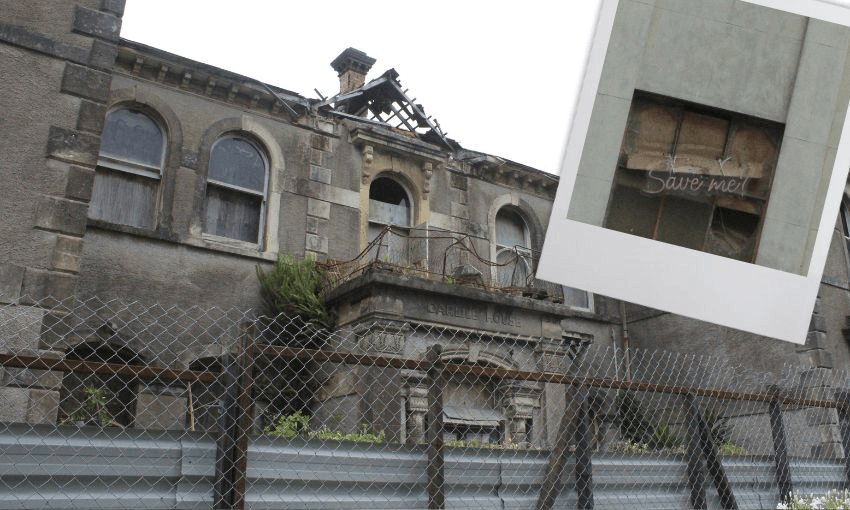
Built in 1886 and known as the “haunted house” to some who grew up in the neighbourhood, this still sits empty. Its history – industrial school, orphanage, hostel – and disrepair have been well documented. As you can see, attempts to stop people entering are obvious. The category-1 historic building is surrounded by a chainlink fence, metal bars and roofing; behind that is yet another fence, this one topped with razor wire and covered in vines. The fire escape that used to offer a route in has been ripped off and the windows are boarded up. It’s currently owned by the United Church of Tonga, but the huge cost required to fix it up ($10m apparently) is a “barrier”.
Local lore and urban legend have shaped public perceptions of the category one heritage building. (Images: Auckland Libraries, Vinnie Paunovic)
28 Ranui Road
You’ll need to jump on Google Maps for this one. The art deco property is, notes Remuera Heritage, “in a complete state of dereliction”. The society says Auckland Council investigated whether it warranted demolition and found it couldn’t be done under the Resource Management Act. Last sold for $2.95m in 2017, its current valuation is $3.925m. Most of the value is in the land, not the house, which was built in 1937. Neighbours told The Spinoff they’d maintained the verge and supplied plywood to secure the property. Rumour has it a restoration or renovation might be in the works…
Residents are riled up over the state of the Ranui Road property. (Images: Google Maps, Remuera Heritage)