
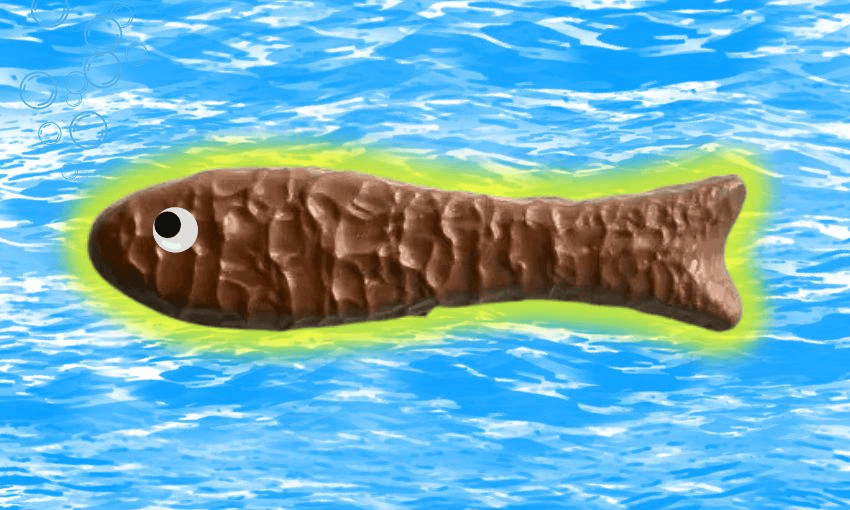
A deep dive into the delicious – and sometimes dark – history of a distinctly New Zealand treat.
When the political pranksters at the McGillicuddy Serious Party launched in the mid 1980s, they campaigned on a series of absurd policies. Their demands included decreasing the speed of light to 100km/h, raising the age of school leavers to 65 and the big one: replacing money with chocolate fish. While the party never achieved parliamentary representation, the vision lives on. Just this year, their spiritual successors at the Silly Hat Party also proposed that moving to an entirely chocolate fish-based economy would eradicate generational wealth.
“It will entirely be gone if we have chocolate fish, because obviously you can’t just keep them,” Dunedin candidate ‘King’ Flynn Nisvett told RNZ. “They go off. They go yuck.”
Where this policy falls down, aside from the obvious, is that the chocolate fish already is a form of currency far more powerful than the New Zealand dollar. For over a century, the marshmallow-filled, chocolate-covered sea creature has been a coveted reward for achievements big and small, be they dished out to children at Pohinga Valley rifle club in the 20s, presented to “crab dancers” on stage in Wellington in the 30s, gorged upon by Canterbury students during O-Week in the 80s, and used to sweeten Mazda deals in the 90s.
 An early Hudson’s chocolate fish box and the man himself. (Images: Chocolate Fish Company and Business Hall of Fame)
The chocolate fish story is widely believed to start with British-born Richard Hudson, who expanded his biscuit and cake factory in Dunedin to chocolate manufacturing in 1884. While there is no precise chocolate fish launch date, an early mould was found at a former Hudson’s site and ads suggest they had become popular by the early 1900s (“BOYS! You can buy your girl a chocolate fish for a half-penny”). A 1929 visit to the competing Heard’s factory in Parnell revealed a machine “turning out shoals of chocolate fish as numerous as herrings in the Gulf.”
In 1930 Hudson & Co underwent a “CHOCOLATE MERGER” with Cadbury Bros Ltd to become Cadbury Fry Hudson Co, which would establish them as the local home of the chocolate fish for the rest of the 20th century – until Cadbury relocated to Australia, but more about that later.
Aotearoa’s chocolate fish industry was thriving, but there was also a dark underbelly of crime emerging. In 1926, Rice’s sweet shop in Whanganui suffered a spate of late night burglaries, after which “a number of tell-tale teeth marks were found in the chocolate fish.” A confectioner’s on Dominion Road suffered a similar fate in 1930, when chocolate fish were “tossed on the floor” by thieves. In 1937, two Christchurch shopowners were fined £8 for illegally trading on a Sunday. Their defence? The single item sold was a chocolate fish for a hospital patient.
A selection of chocolate fish ads. (Image L-R: Central Hawke’s Bay Press, 24 November 1948, Press, 10 June 1964).
In the late 1960s, the country transitioned from using pound sterling to the New Zealand dollar, and chocolate fish customers were perturbed to find an accompanying price mark-up for their favourite treat. “Sir, we are very fond of chocolate fish (ie: Pisces marshmallocis var. chocolatus),” one aggrieved reader wrote to the Press in 1967. “On Decimal Currency day we were alarmed to find we were the victims of a price increase. However, we were consoled by a suspected genetic mutation which enabled the evolution of fatter fish.”
Others were not so gracious, such as this complainant in 1969 who described the price hike from three pence to four cents as “flagrant profiteering” by Big Choccy Fish: “This represents an increase in cost of 60 percent over a period of two years – an unjustifiably large inflation. The public should protest against the exploitation of a minority group who consider chocolate fish an essential, but now prohibitively expensive, part of their diet.” The furore even made it to question time in Parliament, when Labour MP Ron Barclay inquired about the excessive price hike.
“What about gobstoppers?” interjected National’s Frank Gill.
“The member needs a gobstopper,” replied Barclay.
A period of economic tumult for the chocolate fish made way for an era of fun and frivolity in the 80s and 90s, beginning with Jim Bolger giving delegates chocolate fish in their lunchboxes at the 1989 National conference (listen to Juggernaut S2 here). Commemorative chocolate fish were sold at the opening of aptly novel giant brown trout in Gore, and were even suggested as offerings to Hamilton’s controversial Egyptian god statues in 1991. “People should bring whatever they think is appropriate,” said Graeme Cairns. “I for one am bringing chocolate fish.”
These statues both have chocolate fish connections. (Images: Southland Council and Wikimedia)
The 90s was also when the chocolate-fish-as-reward concept began to spawn headlines, dangled as an incentive for everything from a University of Otago psychology study, to solving a mystery about a woman cyclist, to winning the Canterbury senior basketball championship. Its use in low-stakes gambling may have been cemented into culture before that, with Bob Jones revealing that he and Roger Douglas made a bet of “one chocolate fish” that Jones would never speak in public again after he punched Rod Vaughan on Eyewitness news.
Speaking of the National Party, in 1992 The Coalition Against Benefit Cuts marked the anniversary of 1991’s benefit cuts by awarding then-minister of social welfare Jenny Shipley with the Order of the Chocolate Fish for her “unsurpassed generosity”. In Christchurch, a giant papier-mache chocolate fish was carried around Cathedral Square on a stretcher before being presented to the Social Welfare Department as a symbol of the one percent increase in income-tested benefits – aka $1.86, or enough money to purchase three chocolate fish.
The chocolate fish was gaining power in politics, but also in popular culture. The 1990 dictionary of New Zealand English included “chocolate fish” for the first time, while actor Jay Laga’aia flirtily asked “If I was a chocolate fish, how would you eat me?” on TV3’s dating show Perfect Match. That same year, Gaylene Preston’s Ruby and Rata also incorporated the marine morsel, with eight-year-old character Willie drawn to “the old witch” Ruby through chocolate fish. Preston herself even described the movie as “a going down to the dairy to buy a chocolate fish film.”
Thingee and Jason Gunn. Image: Youtube
All this, and yet no pop culture figure made quite the impact on chocolate fish stocks in the 90s as Thingee, the friendly grey alien on The Son the Gunn Show who lived exclusively on chocolate-covered marshmallow. “Thingee just loved chocolate fish,” Jason Gunn told me over the phone. “Maybe it was because he had no teeth and no ability to bite, so there was a certain softness there, but also there was something slightly abnormal and curious about the chocolate fish, which is what many people would also say about Thingee. The two just went together hand in hand.”
The Son of a Gunn show would receive “thousands” of chocolate fish addressed to Thingee every week from New Zealand kids. Would Gunn ever indulge? “I’m not a big marshmallow fan,” he said. “I’m a hard caramel fan from way back.” But decades later, particularly following the passing of Thingee’s “right-hand man” Alan Henderson, Gunn has a newfound appreciation for the treat. “I will never turn down a chocolate fish now,” he said. “I don’t enjoy the taste any more than I did before, but I love how it always brings back many memories of a very dear friend.”
Gunn commends the chocolate fish for staying the course in our culture where other confectionery could not. “So many great things have disappeared – Jaffas have gone, and the biggest crime is Tangy Fruits,” he says. “And we can argue forever over Crowded House and pavlova, but we’ll always have the chocolate fish.” Indeed, even when Cadbury announced they would be relocating from Dunedin to Australia in 2018, several smaller makers stepped up to ensure that the humble chocolate fish would still be manufactured on New Zealand shores.
Bridgette Yates, co-founder of The Chocolate Fish Company. (Image: Supplied)
One of these people was Bridgette Yates, co-owner of The Chocolate Fish Company. Having worked for government agencies and with her business partner David Shaw working in medicine, they both were aware of the enduring value of the chocolate fish. “It’s a currency,” she says. “It’s a reward for a deed well done in so many different circles of our society.” Where their fish differ is that they are solid milk chocolate, and shaped like the endangered giant kōkopu. “We give money from the sale of each chocolate fish to help save them and the waterways.”
Even with Cadbury ceasing the manufacturing of their large-sized fish, claiming “either fewer good deeds are being done or people just haven’t been following through with their promise,” Yates maintains that the chocolate fish will never die out. In 2019, an Auckland petrol station stopped selling cigarettes, handing out free chocolate fish to smokers instead. In 2021, Seven Sharp’s Hilary Barry posted hundreds of chocolate fish as a reward for people getting their Covid-19 vaccination, while Bay of Plenty councillors spent $188 on a “supply of chocolate fish”.
Just last month, Marlborough District mayor Nadine Taylor faced an unofficial “chocolate fish fine” after her phone rang in a council meeting. After a second cellphone rang later in the meeting, Taylor reportedly said “I’m going to be so chocolate fished by the end of this.” It’s that kind of levity that Yates says is the secret weapon of the chocolate fish. “I think something about it that really connects with New Zealand humour,” she says, referencing cricketer John Bracewell who once claimed to have worked as a “chocolate fish boner” in an interview.
Beyond the many, many jokes (just one more from , Yates adds that the chocolate fish also is an important homegrown symbol of goodness and decency in these fractious, uncertain times. “It’s really awful, everything that’s going on, but I really think that the message behind the chocolate fish is relevant to the world today,” she says. “There’s a kindness to it, there’s a respect for other people, and there’s an awareness and acknowledgement of rewarding good behaviour.” It’s a simple idea, she adds, but an exceedingly powerful one:
“A small thank you goes a long way.”