
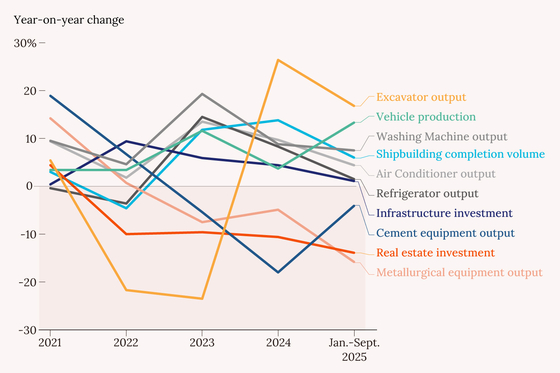
China’s steel industry is experiencing a period of acute imbalance between supply and demand. In 2025, domestic crude steel production dropped 2.9% year-on-year to 746 million tons by September, but domestic consumption fell even more sharply, by 5.7% to under 649 million tons. This supply-demand mismatch has resulted in overcapacity and has pushed steel prices to multi-year lows, with the China Steel Price Index temporarily dipping below 90 in June 2025, the lowest since 2017. Industry leaders attribute this contraction primarily to the end of the real estate and infrastructure boom, which historically drove steel demand, signaling a significant structural shift from growth to consolidation in China’s steel sector [para. 1][para. 2][para. 3][para. 4].
To manage the excess supply, Chinese mills have pivoted aggressively towards export markets. Steel exports surged to 110 million tons in 2024 (up 22.7%), and the first nine months of 2025 saw another 9.2% increase to 87.96 million tons, approaching a projected all-time annual high of 130 million tons. However, this rise in volume came at the expense of lower prices: in 2024, export prices dropped 19.3% to $755.40 per ton and fell another 9.5% in 2025. The industry’s export drive has squeezed margins, with companies willing to take lower profits or losses to maintain market share abroad [para. 5][para. 6].
Chinese firms are not just exporting, but are also investing overseas. By mid-2025, Chinese steelmakers had invested in over 20 countries, creating a combined overseas capacity of more than 120 million tons, representing a “second growth curve” amid weak domestic sales. Nevertheless, analysts expect that trade frictions and environmental standards will soon cap export opportunities, as China’s exports already represent around 30% of global trade. Over the next five years, direct exports may halve, lowering China’s steel consumption from current levels above 1 billion tons to approximately 750 million, reshaping the industry and the Chinese economy [para. 7][para. 8][para. 9][para. 10].
Domestically, the steel sector faces the contradiction of shrinking demand but resilient supply. Mills continue producing at high capacity because falling input costs (notably for coking coal and iron ore) temporarily improved profit margins. In the first three quarters of 2025, industry profits rebounded to 96 billion yuan ($13.5 billion), a 190% increase year-on-year, with sales margins rising to 2.1%. Still, the government has mandated a 5% production cut from 2023’s output, but enforcement remains difficult due to capacity loopholes. Many listed companies report losses due to high unsold inventories, and risks of further price and profit declines persist if supply is not effectively curtailed [para. 11][para. 12][para. 13][para. 14][para. 15][para. 16][para. 17][para. 18][para. 19].
China’s export surge has led to intensifying protectionism abroad. 11 countries imposed new trade measures against Chinese steel since early 2024, with major destinations like Vietnam slapping on significant duties. Despite barriers, exports were boosted by “preemptive buying” and shifting product mixes—moving from flat steel facing stricter rules to long products and semifinished billet. Competitive prices and reliability help China remain globally attractive, though illegal “invoice-free exports” inflate official numbers and attract foreign criticism [para. 20][para. 21][para. 22][para. 23][para. 24][para. 25][para. 26][para. 27][para. 28][para. 29][para. 30].
The persistent weak domestic demand and capped export growth are having upstream effects, notably on iron ore. China, which imports 80% of its iron ore (1.24 billion tons in 2024), is seeking greater pricing leverage—recently launching the Beijing Iron Ore Price Index to offer an alternative to global benchmarks skewed by spot market manipulation. Initial adoption by leading firms signals China’s attempts to regain some pricing power as steel margins remain narrow compared to mining profits [para. 31][para. 32][para. 33][para. 34][para. 35][para. 36][para. 37][para. 38][para. 39][para. 40].
In summary, China’s steel industry is in the midst of a structural transformation driven by weakening domestic demand, intense export competition, and efforts to globalize production. While profitability has temporarily recovered due to lower raw material costs, the underlying issue of overcapacity remains. With rising trade barriers and limited global demand growth, the sector faces a challenging period of adjustment, marked by consolidation, overseas expansion, and efforts to reform upstream pricing mechanisms [para. 41][para. 42][para. 43][para. 44][para. 45][para. 46][para. 47][para. 48][para. 49][para. 50][para. 51][para. 52][para. 53][para. 54][para. 55][para. 56][para. 57][para. 58][para. 59][para. 60][para. 61][para. 62].
AI generated, for reference only