
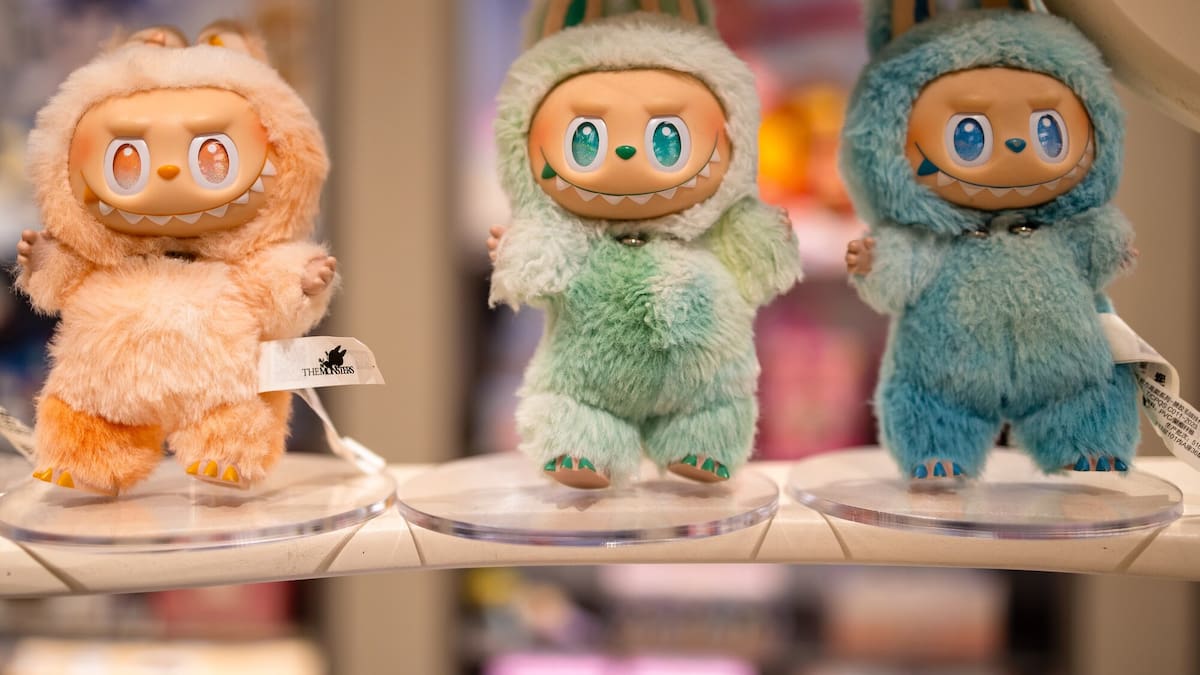
Depending on your generation, you might recall Christmas buying panics for any number of variations.
The internet tells me that this century alone we’ve been through Bratz, Uglydolls, Webkinz, Squinkies, Shopkins, Hatchimals, Squishmallows and more.
Before I get too deep into the soft-toy weirdness, I should say that this column was meant to be about the Nvidia result last week and the artificial intelligence (AI) bubble risk.
However, Bloomberg News then reported that Labubu dolls will be joining sneakers, hoodies and Pokemon cards on a futures exchange created with the collaboration of Prediction market Kalshi Inc and sneaker marketplace StockX.
That’s really pushing the boat out and as a worrying example of late-stage capitalistic excess, it’s hard to ignore.
The hype about Labubus has been created by Chinese toy retailer Pop Mart with a clever combination of viral social media marketing, a blind-box model (where buyers don’t know what variety of doll they get until they open the box) and engineered scarcity – particularly of certain varieties.
As a marketing model, it’s not actually that new.
The latter two of those strategies were pioneered by bubblegum card companies in the 1960s and 1970s.
It inevitably creates a trading culture, so it should come as no surprise that there is a hot secondary market for trading in these dolls.
It is hard to imagine, though, that teddy bear fans 125 years ago could foresee the kind of hyper-capitalism that would drive people to trade soft-toy pricing contracts on a market regulated by the US Commodity Futures Trading Commission.
Back in 1905, the futures market was for pork bellies and corn. It was designed to provide farmers with a hedge against wild price fluctuations. Basically, it was a kind of insurance.
Obviously, there has been speculative trading on the futures exchange for many years.
But now, if you think the Labubu craze is rubbish, you can bet against them.
Bloomberg reports that Kalshi will use StockX data to create event contracts tied to sneakers, trading cards and figurines.
Users will be able to trade on prospects like whether an item surpasses a price threshold after release day.
“This is really a natural evolution of a platform made from stock market mechanics,” Greg Schwartz, chief executive officer of StockX, said.
Well, define natural, I say.
Call me a dreamer, but I still like the idea that stock markets are a way to aggregate capital and invest it efficiently in companies that produce things with a view to delivering a return on that capital.
Everything else is just fancy gambling.
And that brings us to Nvidia and the bizarre scenario last week, where the whole financial world stopped in its tracks and waited with bated breath for its result.
It was like a verdict was being delivered on all the world’s fears about an AI bubble.
All the nuance and complex issues driving Nvidia’s performance fell away.
All that mattered was: would it beat market expectations or fall short?
It beat them and shares rose all over the world. You could watch the momentum of the NZX shift in real time from about 10.20am on Thursday.
Given an almost total lack of exposure to AI on the local exchange, it really shouldn’t make sense.
But market behaviour – despite what some people will tell you – isn’t always rational.
It just reflects the collective behaviour of humans who, after millions of years of evolution, still have a habit of panicking like a herd of wildebeest.
People panic about things crashing, and they panic about missing out if they don’t crash.
Underlying all the fear and greed, there is a very real and existential question about whether AI represents such a paradigm shift that crazy market valuations are justified.
I don’t think there’s any question that AI is going to change the world. It already has.
AI powerhouse Nvidia posted a profit of US$26.4 billion on record revenue of US$46.7b in the recently ended quarter. Photo / Getty Images
But will it deliver the kind of productivity gains and profits that justify an $8 trillion valuation?
“There’s been a lot of talk about an AI bubble,” Nvidia’s chief executive Jensen Huang said after the result.
“From our vantage point, we see something very different.”
He may be right.
But I fear that things like Labubu futures trading point to bigger forces inflating this bubble than just enthusiasm for new technology.
There is too much money chasing unrealistic investment returns.
In stock market jargon, that is sometimes described as a mania – an irrational surge in asset prices driven by speculative investor sentiment and herd mentality.
There does seem to be a culture of investing that is being pushed along by the desperation of people trapped in a system that no longer offers pathways to financial security through ordinary work and wages.
From cryptocurrency to gold, tech stocks and even property, people (especially young people) are trying to trade their way to wealth.
It’s risky and the odds are stacked against them.
Ironically, the odds of creating wealth are actually very good for those who take their time and follow some basic rules.
But that is not as exciting and isn’t going to garner social media clicks.
For the record, the market exuberance after Nvidia’s result was brief, and there has been more cautious selling of tech stocks on Wall Street.
That might be the best we can hope for, a mild correction, a cooling-off period that lets the tech stocks consolidate their value.
That would be a rational way forward. But I wouldn’t bet on it.
Liam Dann is business editor-at-large for the New Zealand Herald. He is a senior writer and columnist, and also presents and produces videos and podcasts. He joined the Herald in 2003.
Catch up on the debates that dominated the week by signing up to our Opinion newsletter – a weekly round-up of our best commentary.